
By continuing, you agree to LoansJagat's Credit Report Terms of Use, Terms and Conditions, Privacy Policy, and authorize contact via Call, SMS, Email, or WhatsApp
Disclaimer: The information published on LoansJagat is intended for general informational and educational purposes only and should not be considered financial, legal, or investment advice. Interest rates, loan terms, statistics, and other data may change over time and may vary by lender or source. Please verify the latest information and consult a qualified financial advisor or the respective Bank/NBFC before making any financial decisions.
Subscribe Now
About the author

Arshathul Afia
Arshathul Afia is a journalism graduate and fintech content writer with 4+ years of experience in digital publishing and research-led writing. She has written 200+ articles covering personal finance, lending, banking, digital payments, credit, insurance, and major financial developments in India. At LoansJagat, she focuses on simplifying complex fintech news, RBI updates, loan-related changes, policy developments, and industry trends for everyday readers. Her journalism background helps her approach stories with research, context, and clarity, while her SEO experience ensures content remains discoverable and relevant. She aims to make financial news easier to understand, practical, and useful for readers across India.
Related News
Simplify All Your Loans Into One Affordable EMI

Customers Served

Debt Consolidated

1200+ Reviews

Locations in India
Club all Loans & Credit Card Bills into Single EMI

Quick Apply Loan
Consolidate your debts into one easy EMI.

Takes less than 2 minutes. No paperwork.

10 Lakhs+
Trusted Customers

2000 Cr+
Loans Disbursed

4.7/5
Google Reviews

50+
Banks & NBFCs Offers
Other services mentioned in this article
Key Highlights
Hero Motors recovered after opening below its IPO price, offering relief to shareholders while leaving fresh buyers to weigh valuation concerns against the company’s prospects.
The reversal changed the position for IPO allottees, although investors who sold early could have booked a loss. Those buying later faced a different entry price. Beyond the debut, shareholders will need to assess whether the automotive supplier can use fresh capital to reduce borrowings, expand production and improve earnings.
Business Standard reported that the discounted opening followed weak grey-market indications before listing. However, grey-market quotes are unofficial. They do not determine the exchange opening price, and the available reports do not establish a single cause for the discount.
The company attracted more applications than the shares available during its IPO. That demand did not translate into an opening premium. Application figures describe interest during bidding; listing prices reflect the orders available when exchange trading begins.
For readers, the distinction is useful. An oversubscribed offer can still open below its issue price. Neither subscription demand nor an unofficial premium guarantees what an allottee will receive when selling.
For households that received shares through the IPO, the morning recovery changed an unrealized loss into an unrealized gain. A paper gain becomes a realized trading result only when shares are sold. Charges and applicable taxes can also change the amount retained.
Investors who missed allotment gained access through the exchanges, but they did not receive the original application price automatically. Buying after a rise means paying the available market price. The company may be unchanged while the return available to a new buyer has changed considerably.
The opening price and the later trading observation describe different moments. Business Standard’s September 23 report supplies the opening figures below, while Moneycontrol’s report from the same date supplies the morning update.
The final row is a timestamped market observation. It should not be presented as the day’s closing price or as a return earned by every shareholder. An investor’s own purchase and sale prices remain the relevant comparison.
An original calculation using the reported prices shows why return headlines need care. The move from ₹82 to ₹95.98 represents a gain of approximately 17.05%. Measured from the ₹84 issue price, the same later price represents approximately 14.26%.
Both calculations use the same endpoint. They answer different questions.
An IPO allottee starts with the issue price, while a buyer who obtained shares at the NSE opening starts with the opening price. A buyer entering later has another cost. Reporting the larger gain without naming its base could overstate the return available to applicants.
This comparison is arithmetic based on published prices, rather than a forecast. It excludes trading charges and taxes. More broadly, the rebound shows that a stock can recover from a weak opening without giving every participant the same opportunity to benefit.
Shivani Nyati, Head of Wealth at Swastika Investmart, took a neutral view in Business Standard’s September 23 report. She acknowledged Hero Motors’ powertrain business and electric-vehicle opportunities but flagged valuation relative to peers. She suggested waiting for a better valuation or price consolidation.
Moneycontrol quoted Mahesh M. Ojha, Vice President, Research & Business Development at Kantilal Chhaganlal Securities, highlighting engineering capabilities and international customers. He also raised valuation and customer concentration concerns. His suggested approach for fresh investors was to wait for price stability and assess subsequent quarterly results.
These are published analyst assessments, not fresh interviews conducted for this article. Their shared concern is the price paid for future growth. A company can have attractive products and customers while its shares still demand careful valuation.
The abridged prospectus accompanying the September 9, 2026, red herring prospectus, hosted by the Securities and Exchange Board of India, records a ₹600 crore fresh issue and a ₹400 crore offer for sale.
The company earmarked ₹190 crore for repayment, prepayment, or redemption of certain borrowings. It proposed another ₹200 crore for equipment supporting capacity expansion at Gautam Buddha Nagar, Uttar Pradesh.
Those disclosures give shareholders concrete developments to track. Debt repayment could reduce financing costs. Additional equipment could increase production capacity, provided customer demand supports its use. The offer-for-sale proceeds go to selling shareholders and cannot be treated as company expansion funds.
Hero Motors’ share movement does not change a household’s loan agreement or repayment schedule. The connection is through personal cash flow: money needed for an EMI may be exposed to a loss if it is used for speculative trading.
For readers using LoansJagat to compare borrowing options, that distinction is relevant. A loan repayment falls due on a contractual date. An investment recovery has no guaranteed timetable. This is an analysis of borrowing risk, not a company statement or a recommendation to finance share purchases.
The Press Information Bureau, in Release ID 2244334 dated March 23, 2026, described programs run by the Investor Education and Protection Fund Authority under the Ministry of Corporate Affairs. Their objectives include awareness of investment risks and informed financial decisions. That release provides general education context, not an assessment of Hero Motors.
Hero Motors moved from an opening discount to a morning recovery, leaving investors with different results depending on when they traded. The rebound changed the immediate price picture. It did not settle questions about valuation.
Debt reduction, capacity use, and future earnings now offer a better basis for assessing progress. Shareholders will need those disclosures to judge whether the business can support the price paid for its shares.
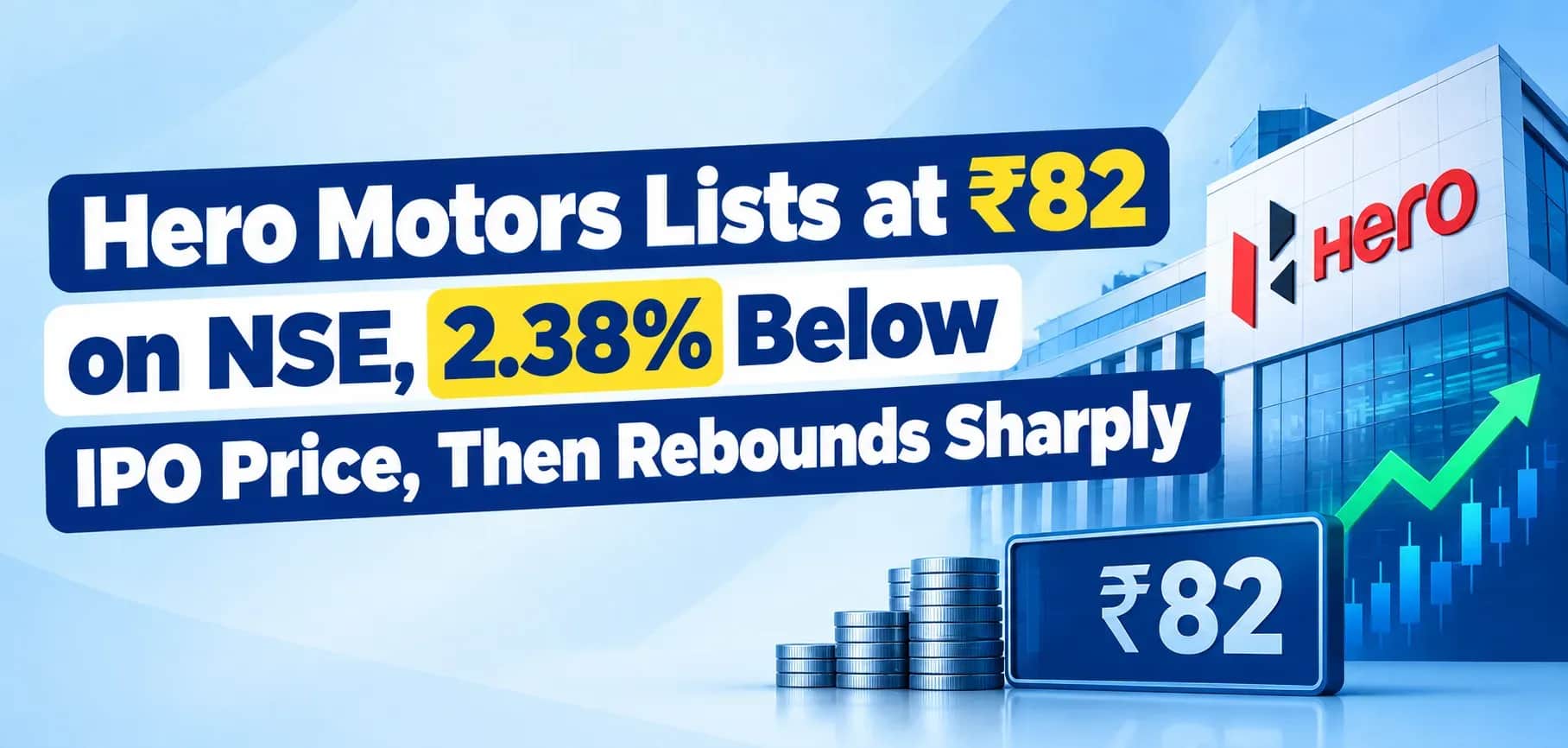
Hero Motors opened at ₹82 on the NSE on September 23, 2026, according to Business Standard. That was 2.38% below its ₹84 issue price. The opening quotation should be distinguished from prices recorded later during trading.
Yes. Moneycontrol reported ₹95.98 at 10:45 am IST on listing day. That observation placed the stock above the IPO price, but it was not a closing quotation or a guarantee that investors could sell at that price afterward.
This has no universal answer. Investors need to assess the business, valuation, and financial risks. Missing allotment does not, by itself, make buying through the exchange attractive or unsuitable.
The decision depends on the investment objective, purchase price, and ability to bear losses. An investor planning a short trade faces a different decision from someone prepared to follow the business over several reporting periods.
No. The offer included fresh shares and an offer for sale. Fresh proceeds support the company’s stated purposes after relevant expenses. Money paid for shares sold by existing holders goes to those sellers, not to factory expansion capital.









.png&w=3840&q=75)


