

By continuing, you agree to LoansJagat's Credit Report Terms of Use, Terms and Conditions, Privacy Policy, and authorize contact via Call, SMS, Email, or WhatsApp
Disclaimer: The information published on LoansJagat is intended for general informational and educational purposes only and should not be considered financial, legal, or investment advice. Interest rates, loan terms, statistics, and other data may change over time and may vary by lender or source. Please verify the latest information and consult a qualified financial advisor or the respective Bank/NBFC before making any financial decisions.
Subscribe Now
About the author

Arshathul Afia
Arshathul Afia is a journalism graduate and fintech content writer with 4+ years of experience in digital publishing and research-led writing. She has written 200+ articles covering personal finance, lending, banking, digital payments, credit, insurance, and major financial developments in India. At LoansJagat, she focuses on simplifying complex fintech news, RBI updates, loan-related changes, policy developments, and industry trends for everyday readers. Her journalism background helps her approach stories with research, context, and clarity, while her SEO experience ensures content remains discoverable and relevant. She aims to make financial news easier to understand, practical, and useful for readers across India.
Related News
Simplify All Your Loans Into One Affordable EMI

Customers Served

Debt Consolidated

1200+ Reviews

Locations in India
Club all Loans & Credit Card Bills into Single EMI

Quick Apply Loan
Consolidate your debts into one easy EMI.

Takes less than 2 minutes. No paperwork.

10 Lakhs+
Trusted Customers

2000 Cr+
Loans Disbursed

4.7/5
Google Reviews

50+
Banks & NBFCs Offers
Homebuyers in 2026 must check the full borrowing cost since a manageable EMI can still hide fees, higher interest and depleted household savings over time.
Indian homebuyers taking a loan in 2026 face a decision that can shape household spending for 20 years or longer. Banks and housing finance companies may approve an amount after reviewing income, credit history and existing debt, but the borrower must pay the EMI alongside school fees, healthcare and ordinary living costs.
Outlook Money raised this issue on August 11, 2026, through comments from Nakul Saxena, Business Head, Home Loans at Kotak Mahindra Bank. His warning was directed at buyers who stretch their sanctioned eligibility for a bigger property. In the short term, that choice can drain savings. Over several years, rate changes, delayed possession or interrupted income may make the monthly payment difficult to carry.
The first pressure appears before the first EMI. A lender may finance much of the property value, yet the buyer still arranges the margin contribution and purchase expenses. Stamp duty, registration, brokerage, initial maintenance and basic interiors can arrive close together. When the family uses every deposit for these payments, one medical bill or job interruption can push routine spending onto a credit card.
Early planning gives the buyer more room. A household can lower the property budget, build the down payment for a few more months or retain a separate emergency reserve. This may reduce the approved loan amount, but it protects other commitments. Retirement contributions, health cover and children’s education should continue after possession rather than stop because the EMI consumed the monthly surplus.
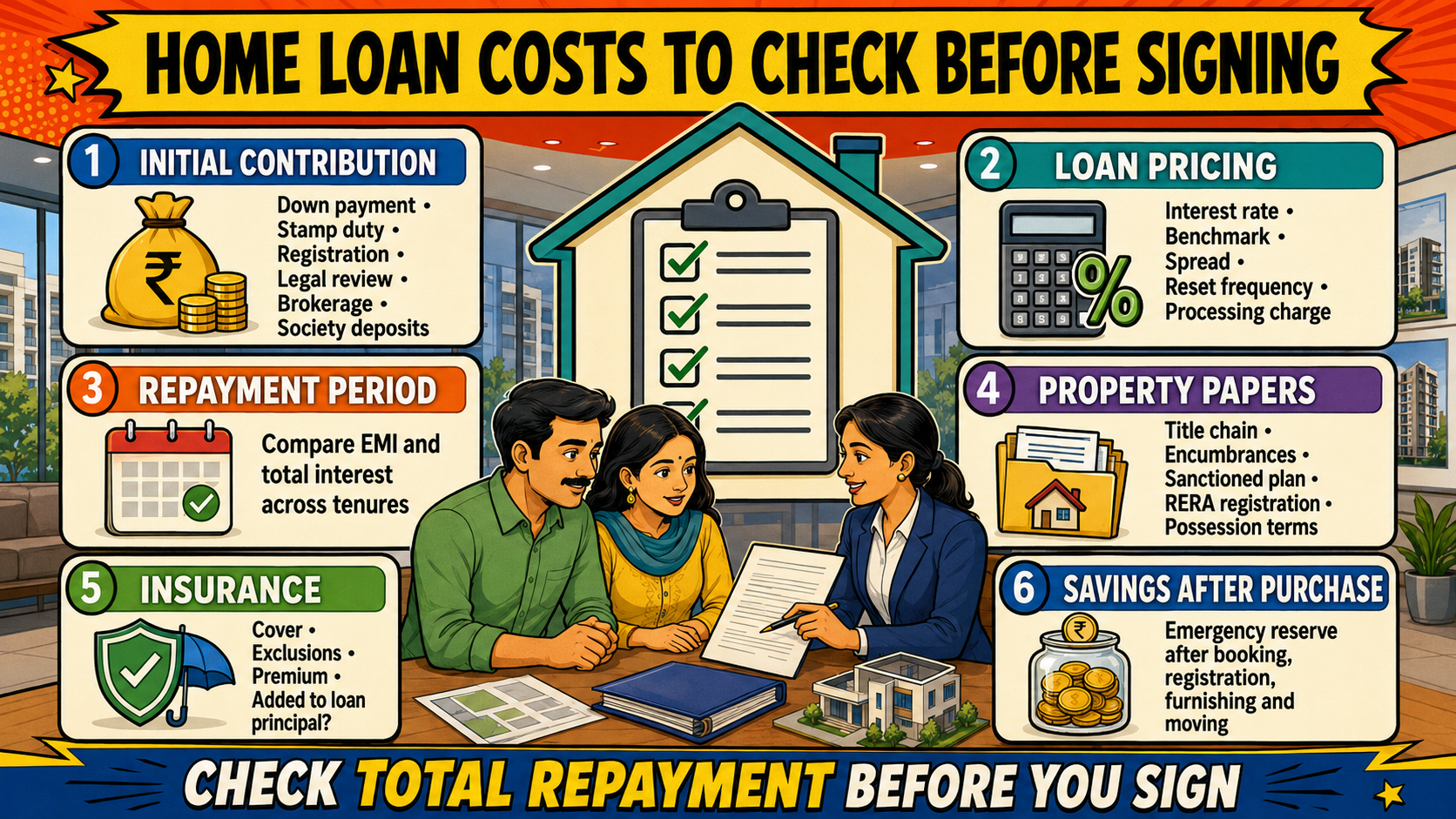
Borrowers should ask for total repayment across different tenures and obtain a written list of charges. The sale agreement also needs attention because a cheap loan cannot repair a weak title or unrealistic possession schedule.
This check often changes the property budget. A borrower who can arrange the booking amount may still be short of cash at registration or possession. Tax relief or a future bonus should not support an EMI that already looks tight without them.
Saxena told Outlook Money that borrowers should generally keep the home-loan EMI within 30% to 40% of net monthly income. He also advised combining the proposed EMI with car loans, personal loans and card repayments, then checking whether total debt payments cross 50% of income. These figures are planning guides. A lender may use a different credit policy.
Rishi Anand, Managing Director and Chief Executive Officer of Aadhar Housing Finance, made a related point in an Outlook Money article published on July 6, 2026. He said applicants should assess repayment capacity, build savings and keep monthly obligations manageable over the loan period. For a single-income family, the workable EMI may be lower than the lender’s offer. A dual-income household also needs a backup plan if one salary stops.
The practical solution is a 6-month stress test. The family can remove uncertain income, then calculate whether regular earnings cover the EMI and household bills. If the result requires another loan, the proposed property is too expensive at that point.
A longer tenure reduces the EMI but keeps interest running for additional years. That trade-off can make a property appear affordable during sanction even though the final payment rises sharply. Borrowers should compare 15-year, 20-year, 25-year and 30-year schedules using the same principal and rate. The total amount payable belongs beside the EMI on the comparison sheet.
A July 2026 LoansJagat analysis of ₹50 lakh home-loan decisions examined tenure, rate selection and prepayment together. Its useful point for borrowers is that no single decision produces the cheapest loan in every case. A comfortable EMI helps prevent missed payments, while planned partial payments can shorten the account when surplus funds actually arrive.
The original analysis here adds another test. The loan should be assessed against the borrower’s age at the final EMI, not only age at sanction. A 30-year loan started at 38 may continue until 68. Salary growth may help during the middle years, but retirement timing, health costs and children’s higher education can arrive before the account closes.
Eligible urban families can examine the PMAY-U 2.0 Interest Subsidy Scheme. The scheme applies to qualifying home loans sanctioned and disbursed from September 1, 2024. Households earning up to ₹9 lakh may qualify when the loan is up to ₹25 lakh and the property value is up to ₹35 lakh. The benefit is a 4% subsidy on the first ₹8 lakh for up to 12 years, with maximum actual assistance of ₹1.80 lakh.
Approval is not automatic. Buyers should use the Ministry of Housing and Urban Affairs’ PMAY portal rather than a broker’s estimate. The State Real Estate Regulatory Authority website should separately be checked for the project’s registration and filed details.
Tax treatment needs the same caution. The Income Tax Department guidance for AY 2026-27, updated on July 9, 2026, lists up to ₹2 lakh of qualifying interest for a self-occupied property under the old tax regime. Eligible principal repayment forms part of the combined ₹1.50 lakh deduction limit. Ownership, property use, completion conditions and the selected tax regime can change the actual claim.
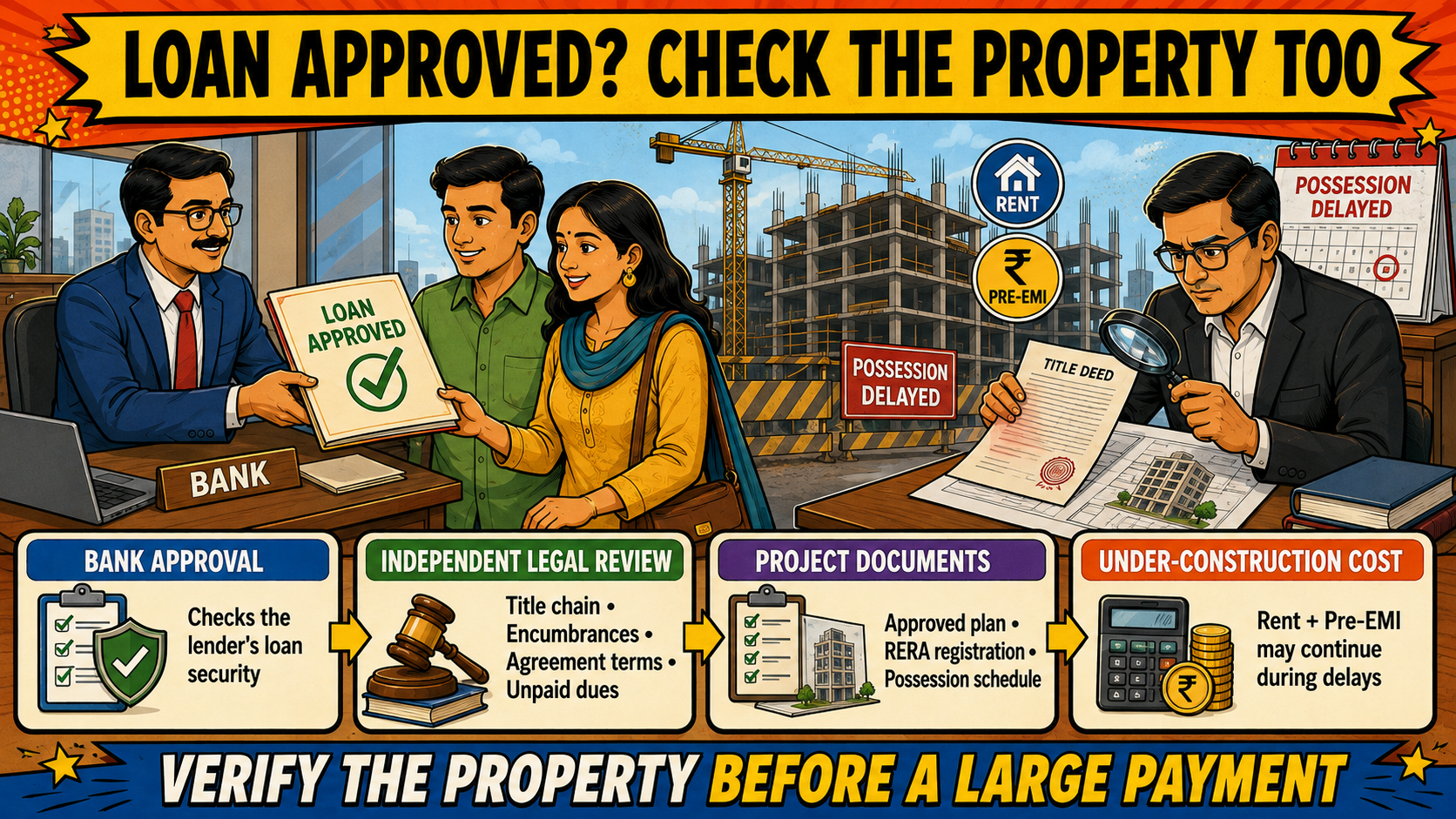
Some buyers treat bank approval as a legal certificate for the property. That is risky. An independent lawyer should examine the title chain, encumbrances, approved plan, agreement terms and unpaid dues before a large payment leaves the buyer’s account.
Under-construction projects bring another cost. A buyer may pay rent and pre-EMI together while the lender releases money in stages. The agreement should state the construction schedule, payment milestones and delay provisions.
Saxena favoured home-loan protection for families that could lose the property after the principal borrower’s death or permanent disability. Borrowers should still compare a lender-linked policy with an independent term plan. The comparison should cover exclusions, disability benefits, nominee payment, declining cover and the treatment of the premium after a balance transfer.
A single premium added to the loan may attract interest throughout the tenure. Existing term insurance may already cover part of the liability. Families also need accessible savings for a temporary loss of income.
A home loan taken in 2026 should fit the household after registration, possession and ordinary monthly bills, not only on the sanction date. The borrower needs enough income for the EMI and enough savings for an uncomfortable period. A larger approval does not change that calculation.
Before signing, the buyer should compare total interest, fees, tenure, insurance and property documents. Government support and tax deductions can lower the cost for eligible applicants, though neither repairs an unaffordable budget. The stronger loan plan leaves space for emergencies, education, healthcare and retirement while the house is still being repaid.
Stamp duty, registration, brokerage, legal review, interiors, maintenance deposits and insurance may require separate payment.
It lowers the monthly EMI, but additional repayment years can raise the total interest substantially.
No. The claim depends on the tax regime, property use, ownership, completion rules and eligible interest.
Enough should remain for household bills, insurance, savings and emergencies without using cards for routine spending.
Usually no. A larger contribution reduces interest, but the household should retain an accessible emergency reserve.









.png&w=3840&q=75)


