By continuing, you agree to LoansJagat's Credit Report Terms of Use, Terms and Conditions, Privacy Policy, and authorize contact via Call, SMS, Email, or WhatsApp
Disclaimer: The information published on LoansJagat is intended for general informational and educational purposes only and should not be considered financial, legal, or investment advice. Interest rates, loan terms, statistics, and other data may change over time and may vary by lender or source. Please verify the latest information and consult a qualified financial advisor or the respective Bank/NBFC before making any financial decisions.
Subscribe Now
About the author

Arshathul Afia is a journalism graduate and fintech content writer with 4+ years of experience in digital publishing and research-led writing. She has written 200+ articles covering personal finance, lending, banking, digital payments, credit, insurance, and major financial developments in India. At LoansJagat, she focuses on simplifying complex fintech news, RBI updates, loan-related changes, policy developments, and industry trends for everyday readers. Her journalism background helps her approach stories with research, context, and clarity, while her SEO experience ensures content remains discoverable and relevant. She aims to make financial news easier to understand, practical, and useful for readers across India.
Related News
Simplify All Your Loans Into One Affordable EMI

Customers Served

Debt Consolidated

1200+ Reviews

Locations in India
Club all Loans & Credit Card Bills into Single EMI

Quick Apply Loan
Consolidate your debts into one easy EMI.

Takes less than 2 minutes. No paperwork.

10 Lakhs+
Trusted Customers

2000 Cr+
Loans Disbursed

4.7/5
Google Reviews

50+
Banks & NBFCs Offers
Other services mentioned in this article
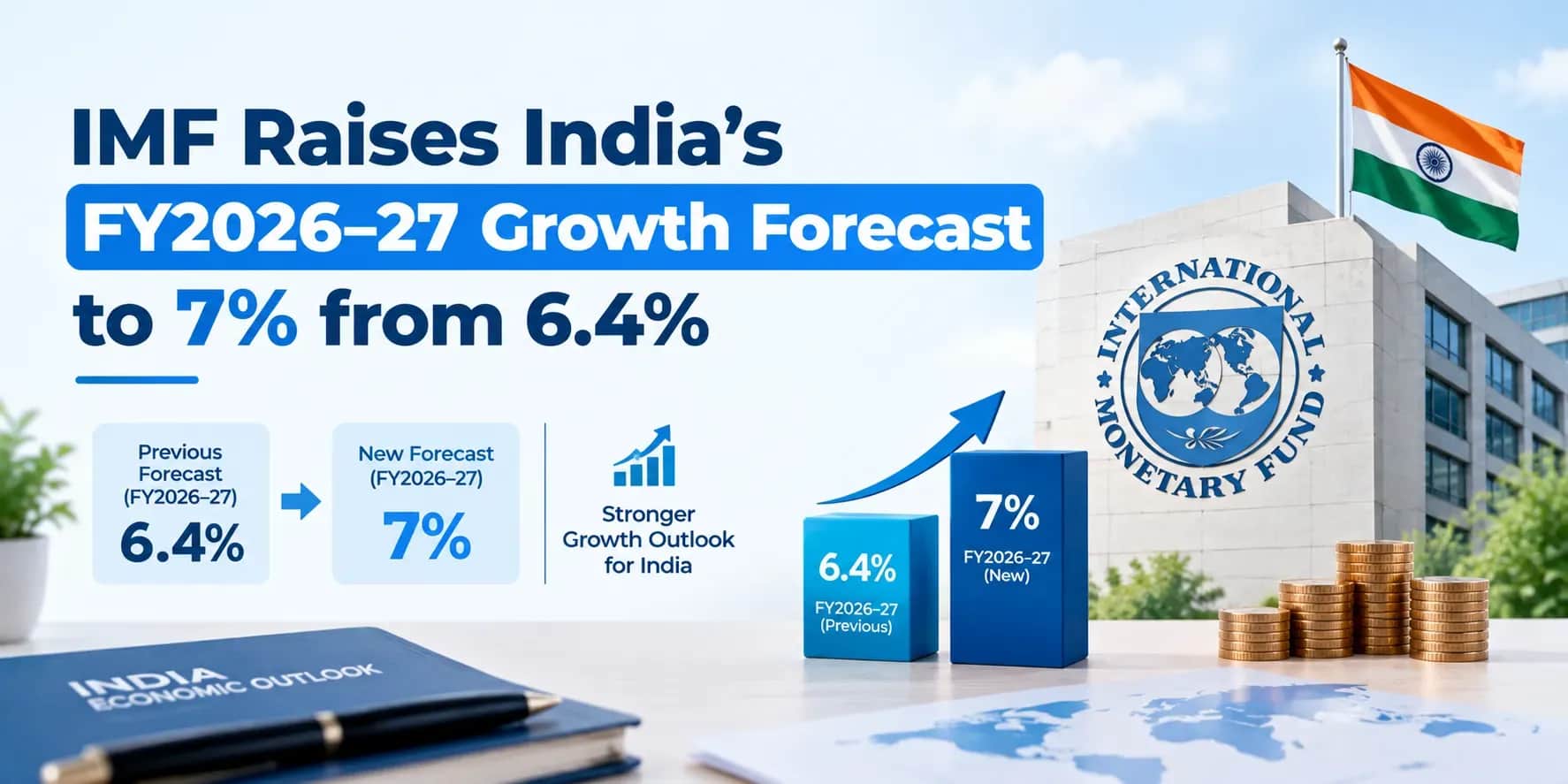
India’s FY2026–27 growth outlook has improved since July. The IMF now expects 7% growth instead of 6.4%, even with costly oil and weaker economic conditions abroad. Spending within India remains a major source of support.
Key Highlights
At the IMF–World Bank Annual Meetings in Bangkok on 13 October 2026, the International Monetary Fund released its October 2026 World Economic Outlook. India’s growth estimate was higher than in the previous assessment. The revised assessment attributes the upgrade to stronger economic activity, supported by domestic demand and services.
A growing domestic market supports India’s longer-term growth prospects. Oil costs still threaten that outlook, with the IMF warning that food and energy could remain expensive if disruption in the Middle East continues. For households, stronger economic growth and pressure on monthly budgets can therefore exist together.
Spending within India has held up better than the IMF previously expected. Services activity has also helped the economy withstand higher oil prices. Sustained momentum is one part of the IMF’s October assessment. The report also identifies favourable demographic trends and structural reforms behind India’s improved outlook.
Real GDP grew by 7.8% during April–June 2026, the opening quarter of India’s financial year. The government recorded this performance in its India’s GDP Performance factsheet, published on 1 September 2026. Household consumption and investment increased alongside manufacturing and services activity. That quarterly result provides context for the upgrade, although it covers a shorter period than the IMF’s annual forecast.
The positive development is that demand within India has continued to support businesses despite pressure from abroad. For households, however, GDP growth measures national output rather than individual pay. The IMF’s upgrade should not be read as a forecast that salaries will rise by the same amount.
Our reading for borrowers is that the upgrade improves the economic outlook without changing the arithmetic of an existing loan. Repayment capacity still rests on income after essential expenses and existing EMIs. A calculation using our personal loan EMI calculator depends on the amount borrowed, interest rate and tenure. The IMF forecast does not change those inputs.
In the Fund’s 13 October 2026 statement, Deniz Igan, division chief in the IMF’s Research Department, described a global economy still withstanding shocks but with growing differences between countries. Technology investment was helping some economies, while energy costs placed others under greater pressure.
For households facing rising food and energy costs, Igan urged governments to focus financial assistance on those most affected, provide it for a limited period, and ensure that such measures do not interfere with market prices or economic activity. She also asked governments to restore their financial capacity to respond to crises and to work toward more stable supplies of energy and continued trade cooperation. These were global policy recommendations, rather than new measures announced for India.
The IMF’s World Economic Outlook Update: Global Economy in Crosscurrents of War and Technology, released on 8 July 2026, already identified private consumption and services as strengths for India. October’s assessment raises the expected growth rate for both financial years.
The India projections use financial years, with the IMF labelling each period by its starting year. Its 2026 entry therefore refers to FY2026–27. The Fund also slightly raised its global forecast for calendar 2026, so the India upgrade did not accompany a fresh cut to the worldwide growth estimate.
India’s domestic economy has performed better than the IMF expected in July. The October upgrade recognises that strength while retaining the warning over energy costs. Borrowers still have to meet monthly repayments from their own income, even when the forecast for the national economy improves.
The October 2026 outlook projects 7% growth for FY2026–27 and FY2027–28. The IMF released the assessment on 13 October 2026.
No. The headline figure covers FY2026–27, from April 2026 to March 2027. Calendar-year projections use a different reporting period.
India imports crude oil. Higher international prices increase import costs, while the IMF warns that prolonged energy disruption could put further pressure on inflation and growth.
GDP growth alone cannot establish that. For this question, raised in public discussion, household income and purchasing power are more relevant than the national growth rate by itself.
GDP and salaries measure different things, a distinction also raised in public discussion. Output can increase unevenly across sectors, while pay varies by employer and occupation. The IMF’s forecast is an estimate of output growth.