
By continuing, you agree to LoansJagat's Credit Report Terms of Use, Terms and Conditions, Privacy Policy, and authorize contact via Call, SMS, Email, or WhatsApp
Disclaimer: The information published on LoansJagat is intended for general informational and educational purposes only and should not be considered financial, legal, or investment advice. Interest rates, loan terms, statistics, and other data may change over time and may vary by lender or source. Please verify the latest information and consult a qualified financial advisor or the respective Bank/NBFC before making any financial decisions.
Subscribe Now
About the author

Arshathul Afia
Arshathul Afia is a journalism graduate and fintech content writer with 4+ years of experience in digital publishing and research-led writing. She has written 200+ articles covering personal finance, lending, banking, digital payments, credit, insurance, and major financial developments in India. At LoansJagat, she focuses on simplifying complex fintech news, RBI updates, loan-related changes, policy developments, and industry trends for everyday readers. Her journalism background helps her approach stories with research, context, and clarity, while her SEO experience ensures content remains discoverable and relevant. She aims to make financial news easier to understand, practical, and useful for readers across India.
Related News
Simplify All Your Loans Into One Affordable EMI

Customers Served

Debt Consolidated

1200+ Reviews

Locations in India
Club all Loans & Credit Card Bills into Single EMI

Quick Apply Loan
Consolidate your debts into one easy EMI.

Takes less than 2 minutes. No paperwork.

10 Lakhs+
Trusted Customers

2000 Cr+
Loans Disbursed

4.7/5
Google Reviews

50+
Banks & NBFCs Offers
Other services mentioned in this article
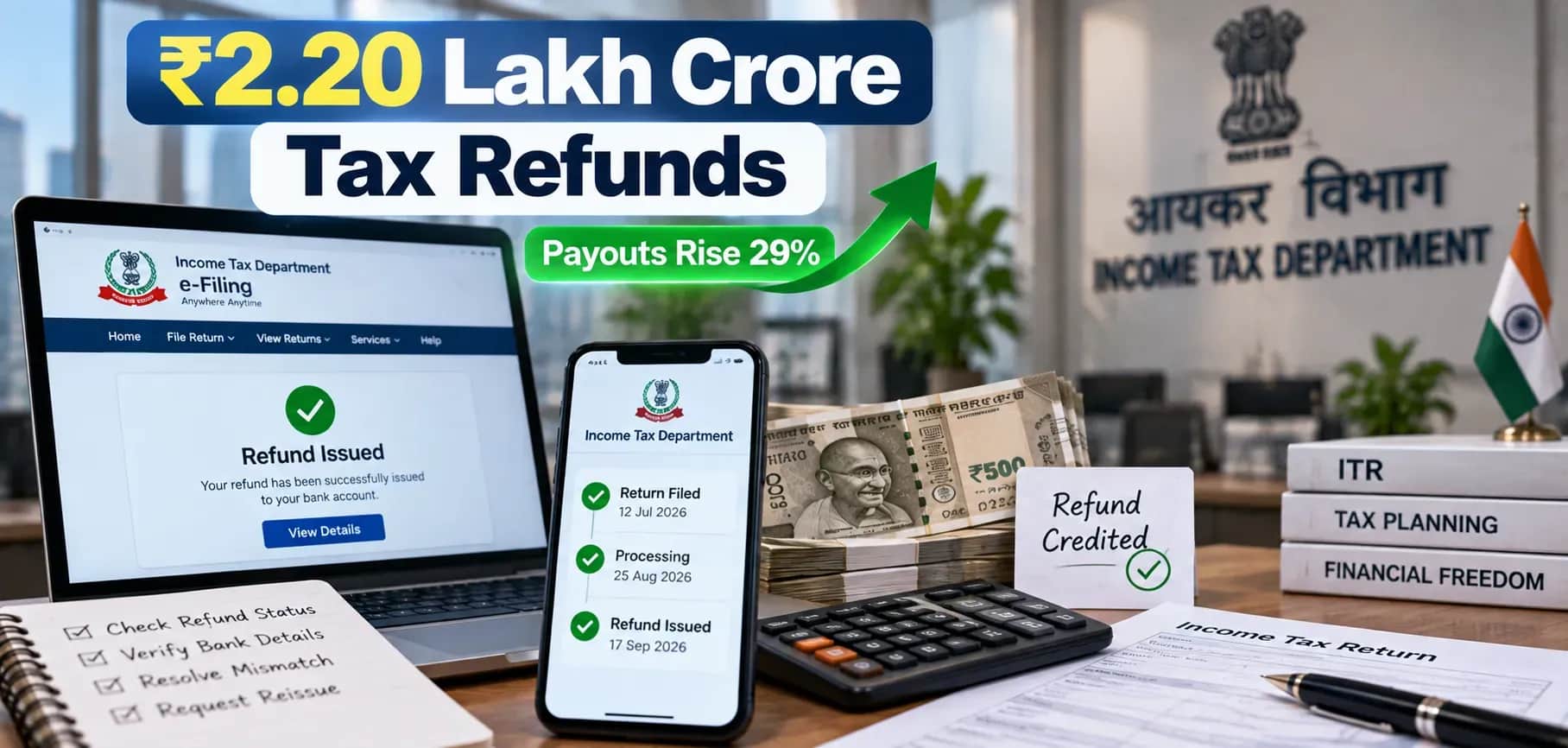
India’s direct-tax refunds reached ₹2.20 lakh crore by September 17, 2026, rising 29.19%, while delayed taxpayers may need to check verification, bank details, and records.
The short-term effect is fairly direct. A delayed refund can hold back money set aside for an EMI, school fees, insurance or household spending. There is a positive side too. More excess tax is moving back through the system. A calculation from the department’s figures shows refunds were about ₹49,716 crore higher than at the same date last year. Useful movement, yes, but it does not give any single taxpayer a payment date.
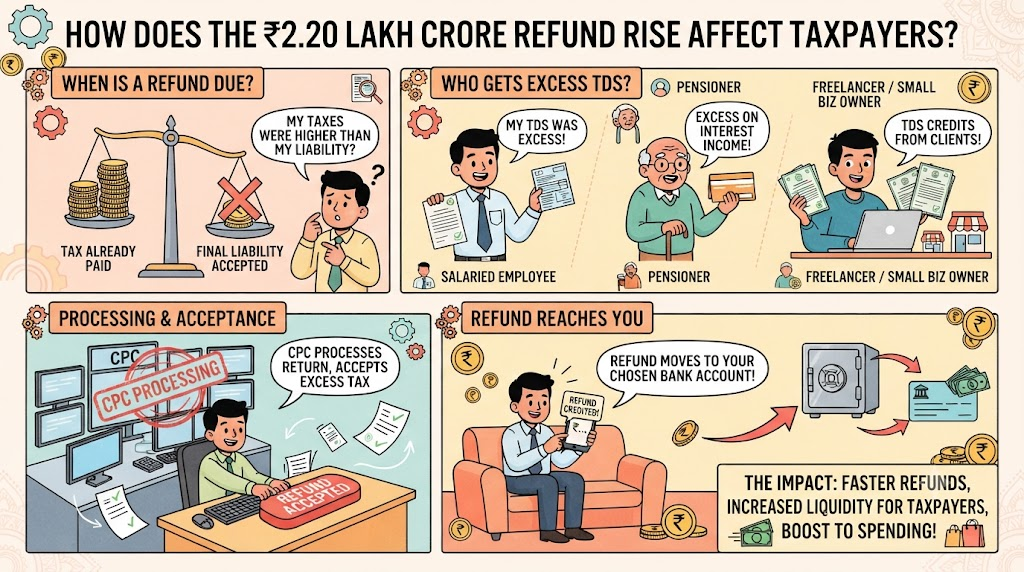
A refund becomes due when tax already paid is higher than the final liability accepted after processing. Salaried employees may have excess TDS. Pensioners can face excess deduction on interest income, while freelancers and small business owners may build up TDS credits from several clients. Once CPC processes the return and accepts the excess tax, the refund moves towards the bank account chosen on the portal.
The larger payout can put money back into household budgets earlier where returns move without a problem. Still, taxpayers should not plan around an expected refund until the status has moved far enough. LoansJagat’s September 7, 2026 refund guide makes a borrower-focused point: a pending refund should not be treated as cash available for the next EMI until the credit actually appears. The same guide cites Tax2win CEO Abhishek Soni, who said correctly filed and verified refunds are generally processed within about 2 to 6 weeks. That range is useful for planning, but it is not a fixed deadline.
The Income Tax Department says refund processing begins only after the return is e-verified. Its Refund Status User Manual places the usual credit period at around 4 to 5 weeks. A return taking longer does not automatically mean rejection or scrutiny. It may remain under processing. In other cases, a mismatch, old tax demand, or bank-account issue needs action.
The portal status should decide the next step. Comparing one refund with somebody else’s faster payment usually tells very little.
Bank details deserve attention because a taxpayer can complete the return correctly and still miss the final credit. The department lists lack of pre-validation, a name difference between bank records and PAN details, invalid IFSC, and a closed account among possible causes. An inoperative PAN can also stop the transfer. “Refund failed” therefore needs a different response from “return under processing”.
Once CPC processes the return, the Section 143(1) intimation can show whether the refund claimed in the ITR has been accepted, reduced, or changed into a demand. Reading that document before filing a grievance can prevent a taxpayer from chasing a bank problem when the issue actually lies in the tax computation.
Faster refunds were already on the government’s agenda before the September figures came out. Speaking at the 167th Income Tax Day in New Delhi on July 24, 2026, Finance Minister Nirmala Sitharaman referred to quicker return processing, faster refunds and improvements in grievance handling. The Ministry of Finance’s Press Information Bureau release from the same day also said she wanted the department to look closely at problems taxpayers keep facing, instead of treating each complaint as a one-off case.
CBDT Chairman Ravi Agrawal spoke at the same event and pointed to progress in quicker return processing, refunds, and grievance handling. The direction from the tax administration is fairly evident from those statements: taxpayers should get quicker digital processing, while repeat problems need to be identified earlier rather than dealt with case by case after complaints arrive.
For delayed taxpayers, however, the solution remains specific to the status shown on their return. A return at CPC needs monitoring. A tax-credit difference may require a check against Form 26AS, AIS, and the filed details. A failed bank transfer needs correction and, where required, a reissue request. Repeatedly raising grievances before checking the actual cause can waste time.
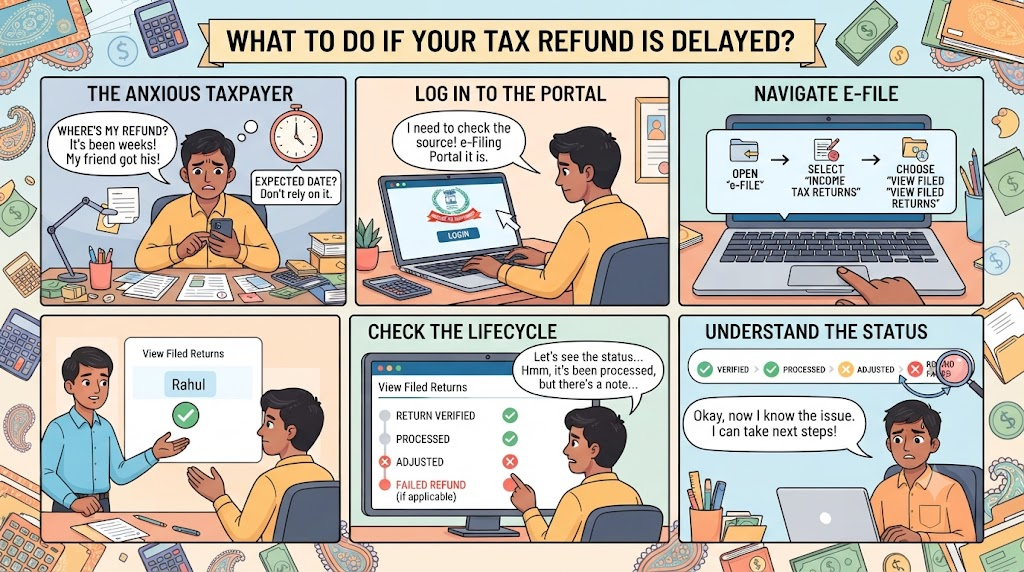
The first step is to check the filed return on the e-Filing portal rather than relying on an expected date or somebody else’s refund timeline. After logging in, the taxpayer can open e-File, select Income Tax Returns, choose View Filed Returns, and inspect the relevant assessment year. The lifecycle shows whether the return is verified, processed, adjusted, or linked to a failed refund.
If the return remains under processing, the taxpayer should check the registered email and portal notices before changing anything. When a mismatch appears, the response should address that point. TDS and other tax credits should be compared with Form 26AS and the information used in the return. An earlier outstanding demand also needs review if the refund has been adjusted.
When the status says “refund failed”, waiting will not fix a closed account or invalid IFSC. The bank account should be corrected and validated first. After that, the Refund Reissue facility can be used if the failed refund is available for reissue. Correcting bank details and restarting a failed payment are 2 separate actions, and taxpayers can miss the second one.
Refund processing had been a stated government priority well before September 2026. The Ministry of Finance’s Department of Revenue Year Ender 2024, released through the Press Information Bureau on December 24, 2024, said more than ₹2.35 lakh crore had been refunded during the period covered by that review. It also said more than 3.87 crore ITRs were processed within 7 days.
Those older figures need careful reading. Processing a return within 7 days does not guarantee bank credit within 7 days. A return can move through CPC and later face a failed payment or demand adjustment. Different return types, tax-credit records and bank details can also produce very different timelines for taxpayers who filed around the same date.
By July 24, 2026, the government was again publicly discussing prompt refunds and faster return processing at Income Tax Day. The September 17 data now gives a newer financial marker, with refund outgo up 29.19% year-on-year. For taxpayers still waiting, the broader figure is encouraging, but their own return status remains the more useful piece of information.
India’s direct-tax refund outgo reached ₹2.20 lakh crore by September 17, 2026, a 29.19% rise from the comparable period last year. The government has also been publicly pushing faster processing and prompt refunds. Yet the nationwide payout figure cannot tell a taxpayer exactly when one pending ITR refund will arrive.
The next action depends on the status shown against that return. E-verification must be complete. Tax credits and old demands may need checking. Bank details should be active and validated. If CPC has already attempted the payment and the refund has failed, a Refund Reissue Request may be needed after the bank problem is fixed. For households waiting on the money, checking that status is far more useful than simply watching the calendar.
Income Tax Department guidance places the usual period at around 4 to 5 weeks after e-verification, though some cases can take longer.
It generally means CPC approved the refund, but the bank credit failed. Bank validation, IFSC, account status, and PAN-linked name should be checked.
Yes. A refund may be partly or fully adjusted against an outstanding demand. The taxpayer should review the related intimation before responding.
E-verification starts normal processing. CPC may still be checking the return, tax credits, an earlier demand, or payment details before issuing the refund.
First, check for a notice, mismatch, demand, or bank failure. If no action is pending and the delay continues, the portal grievance route can be used.









.png&w=3840&q=75)


