
By continuing, you agree to LoansJagat's Credit Report Terms of Use, Terms and Conditions, Privacy Policy, and authorize contact via Call, SMS, Email, or WhatsApp
Disclaimer: The information published on LoansJagat is intended for general informational and educational purposes only and should not be considered financial, legal, or investment advice. Interest rates, loan terms, statistics, and other data may change over time and may vary by lender or source. Please verify the latest information and consult a qualified financial advisor or the respective Bank/NBFC before making any financial decisions.
Subscribe Now
About the author

Arshathul Afia
Arshathul Afia is a journalism graduate and fintech content writer with 4+ years of experience in digital publishing and research-led writing. She has written 200+ articles covering personal finance, lending, banking, digital payments, credit, insurance, and major financial developments in India. At LoansJagat, she focuses on simplifying complex fintech news, RBI updates, loan-related changes, policy developments, and industry trends for everyday readers. Her journalism background helps her approach stories with research, context, and clarity, while her SEO experience ensures content remains discoverable and relevant. She aims to make financial news easier to understand, practical, and useful for readers across India.
Related News
Simplify All Your Loans Into One Affordable EMI

Customers Served

Debt Consolidated

1200+ Reviews

Locations in India
Club all Loans & Credit Card Bills into Single EMI

Quick Apply Loan
Consolidate your debts into one easy EMI.

Takes less than 2 minutes. No paperwork.

10 Lakhs+
Trusted Customers

2000 Cr+
Loans Disbursed

4.7/5
Google Reviews

50+
Banks & NBFCs Offers
Other services mentioned in this article
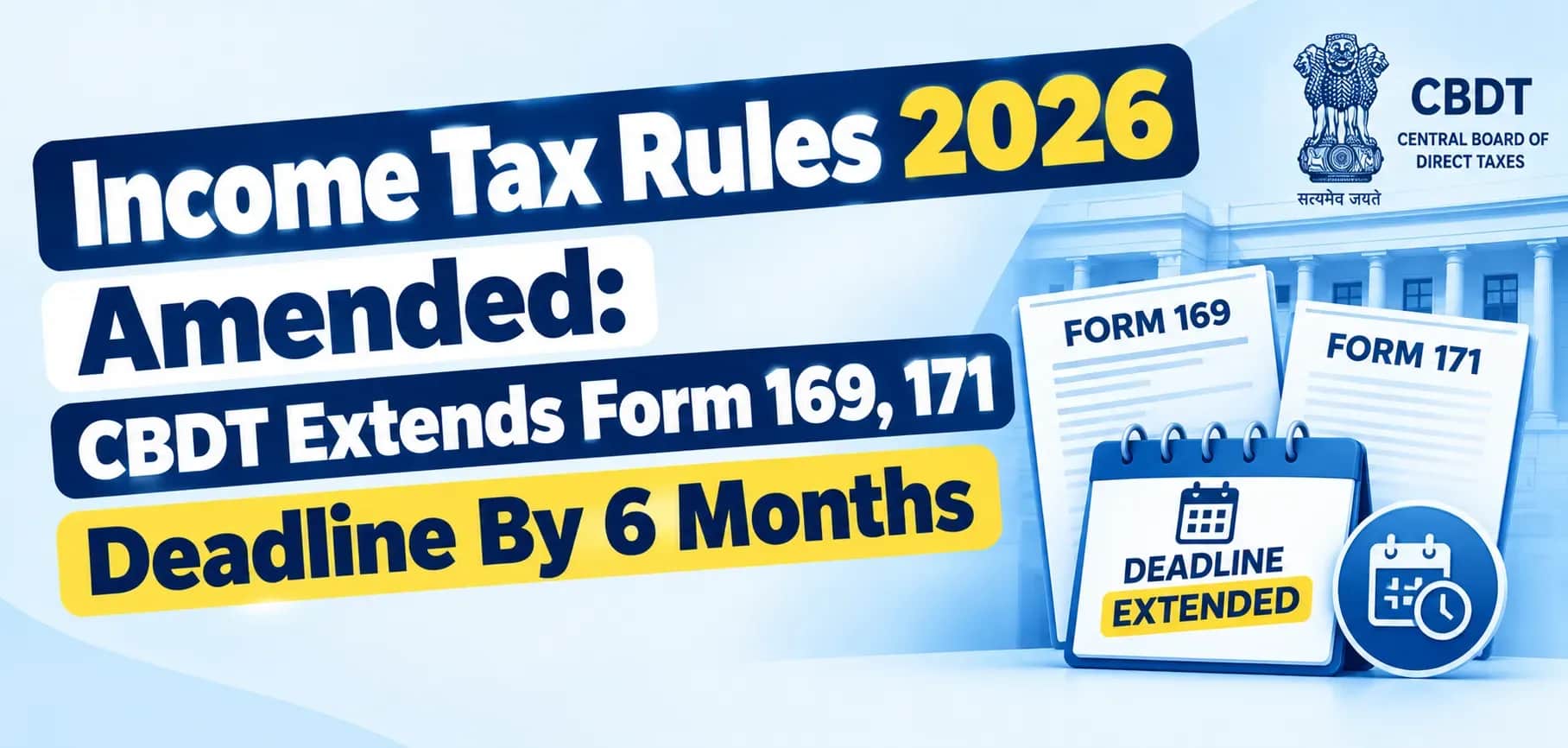
CBDT has revised Forms 169 and 171, giving existing valuers and tax practitioners 6 more months to complete registration by March 31, 2027, under the rules.
Key Highlights
CBDT has given 06 months additional grace period to all the existing registered valuers and authorised income-tax practitioners for continuous operation of their transitional period. In Notification No. 120/2026, G.S.R. 822(E), issued in New Delhi on September 17, 2026, it changed the deadline under Rules 246(4) and 256(4) from September 30, 2026, to March 31, 2027. It also introduced more up-to-date Forms 169 and 171. The notification has been published on the official Income Tax Department website.
The immediate benefit goes to professionals carrying valid registrations from the earlier tax system. They now have additional time to update records rather than face the September cut-off. For regular taxpayers, there is a possible point of confusion. March 31, 2027 does not replace existing return-filing, advance-tax, or tax-audit dates. The change deals with professional registration. Over time, the revised forms could also make professional records more detailed because they ask for qualifications, earlier registrations, work history, and eligibility information.
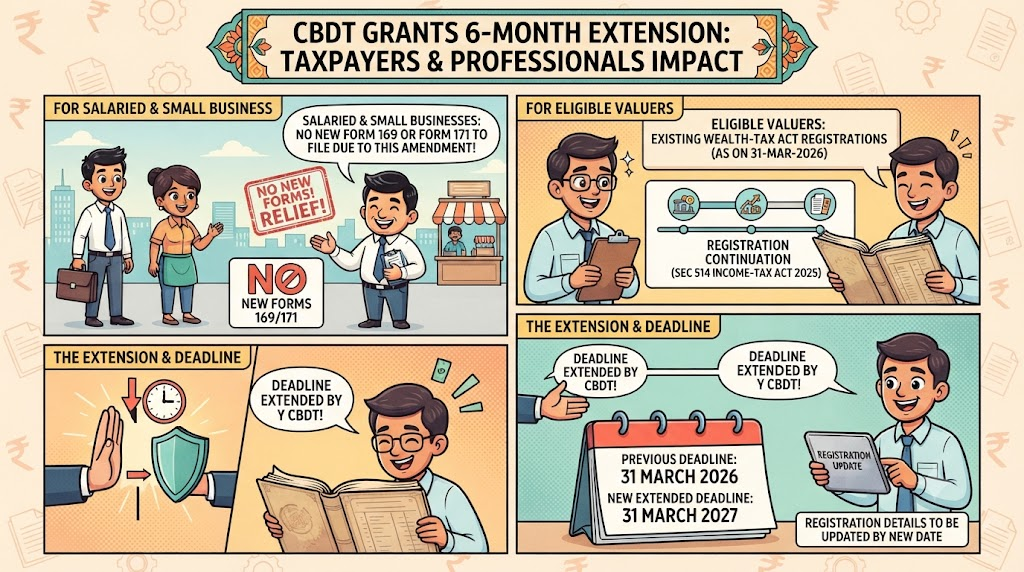
For an ordinary salaried taxpayer or small business owner, there is no new Form 169 or Form 171 to file because of this amendment. Rule 246(4) deals with eligible valuers who already held a valid registration under the Wealth-tax Act, 1957, as on March 31, 2026. They were allowed to continue under Section 514 of the Income-tax Act, 2025, subject to updating the required registration details. CBDT has now given them until March 31, 2027.
Rule 256(4) provides a similar transition for eligible authorised income-tax practitioners registered under the Income-tax Act, 1961. The practical effect for taxpayers comes when they need professional help with tax proceedings or valuation work. An existing practitioner does not suddenly lose the transition opportunity on September 30. The extra period may reduce rushed filings and documentation errors among professionals shifting from the earlier legal framework.
Tax professionals quoted after the amendment have focused on both the additional time and the deeper disclosures now required. Riaz Thingna, Partner at Grant Thornton Bharat, said the registration changes point towards greater professionalisation in tax valuation and representation through qualification, disclosure and independence checks. Jayesh Sanghavi, Tax Partner at EY India, said better verification and standardisation could improve the credibility of professionals available to taxpayers.
Amit Maheshwari, Managing Partner at AKM Global, said the longer transition period and structured application process should reduce difficulties during migration. The safest course for existing registrants is fairly direct. Old registration certificates, PAN records, educational documents and professional details should be checked early. Those applying as valuers should also identify the exact asset class for which registration is required instead of treating March 31, 2027 as a date to start collecting papers.
Form 169 is the application for registration as a valuer under Section 514 of the Income-tax Act, 2025. The revised version asks for personal information such as PAN, address and contact details, followed by educational qualifications, previous employment and professional practice. Applicants are also asked to provide details of valuation experience, including assets valued or assignments undertaken during the preceding 3 years.
The revised form recognises 11 asset classes, including immovable property, agricultural land, plantations, forests, mines and quarries, securities and business assets, machinery and plant, jewellery, works of art and other assets. CBDT's form notes also state that separate applications are required for different asset classes. A normal Form 169 application carries a ₹10,000 fee, while an eligible valuer already registered under the Wealth-tax Act, 1957 does not have to pay that fee again.
The core change can be read quickly in the table below.
Form 171 deals with registration as an authorised income-tax practitioner under Section 515. The replacement form asks for PAN, residential addresses, contact details and the principal place of profession in India. A person who is a partner must also provide the relevant firm's name and PAN. Educational qualifications and earlier registration under the Income-tax Act, 1961 also form part of the application.
That distinction is useful for taxpayers too. Form 169 concerns people authorised to value specified assets, while Form 171 concerns professionals seeking registration to represent taxpayers before income-tax authorities under the prescribed provisions. Neither form is a substitute for an individual's income-tax return.
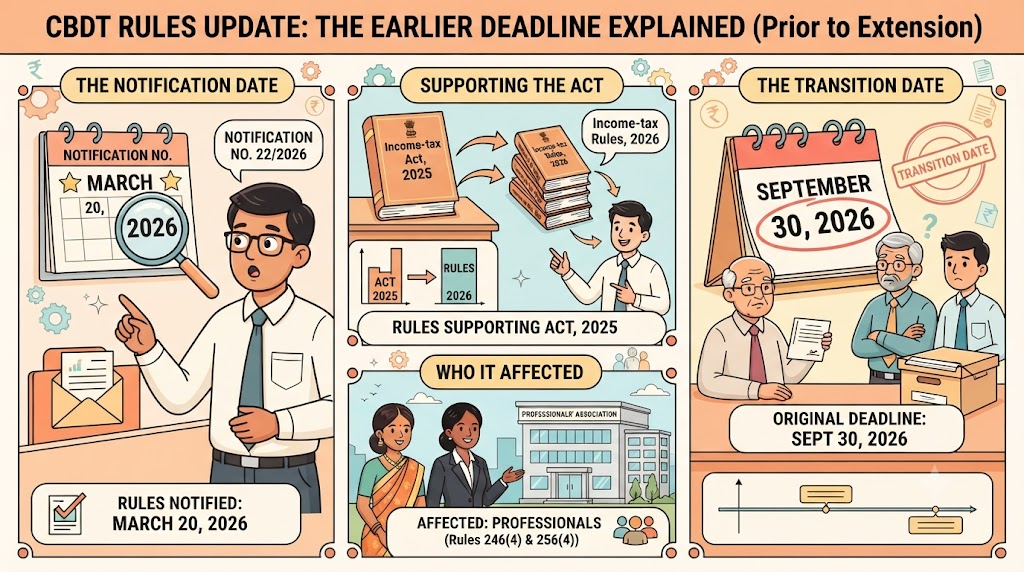
The present amendment follows the Income-tax Rules, 2026 notified through Notification No. 22/2026, G.S.R. 198(E), on March 20, 2026. That notification established the rules supporting the Income-tax Act, 2025 and originally placed September 30, 2026 as the transition date for the existing professionals covered by Rules 246(4) and 256(4).
The Ministry of Finance on February 8, 2026, announced that the CBDT has made the proposed Income-tax Rules and forms available in the public domain and sought suggestions from stakeholders. The Press Information Bureau opined on simpler language, less litigation, less compliance burden, and redundant provisions, among others. The Income-tax Act, 2025, was to come into force on April 1, 2026.
The switch also formed part of a much wider reworking of tax forms rather than an isolated change involving valuers. LoansJagat reported on March 25, 2026, that the new tax framework would introduce renumbered and consolidated forms from April 1. That earlier rollout helps explain why Forms 169 and 171 are now being refined after professionals began moving into the new system.
From a taxpayer's point of view, the useful reading is narrow. Someone who needs a valuation for an asset or professional representation may want to check that the person handling the work holds the appropriate registration and has completed the new compliance process when required. The amendment does not alter a borrower's EMI, interest rate or loan eligibility by itself. A professional valuation can be relevant when assets are used in financial or tax transactions, but CBDT's notification does not change bank credit rules.
The same notification contains changes outside Forms 169 and 171. Rule 176 has been amended so that the earlier wording referring to affixing a digital signature is replaced with wording referring to electronic communication. That amendment is deemed to have applied from April 1, 2026.
CBDT also changed Rule 225 dealing with tax recovery. Several provisions relating to arrest and detention were omitted, including sub-rules 75 to 83 and 91. Reporting on the amendment, tax specialists said other recovery routes, such as attachment or sale of property, remain available under the applicable framework. These recovery changes are separate from the Form 169 and Form 171 deadline extension, although CBDT notified them through the same September 17 amendment.
The distinction needs to stay intact when the news is read quickly. One part deals with professional registration and the March 2027 deadline. Another part changes recovery provisions and electronic communication wording. Combining all of them into a general "tax deadline extension" would give taxpayers the wrong takeaway.
The authority of CDIT has now allowed any registered valuers and authorised I-T practitioners to complete the registration process under the 2026 rules within an extended timeline. The initial 30 September 2026 deadline was extended to March 31, 2027, providing members of the local profession with 6 more months to work through the process.
For taxpayers, the headline date needs to be read carefully. There is no blanket extension of income-tax return or tax-audit deadlines in this notification. The change is directed at professional registration. For valuers and tax practitioners covered by the transitional rules, however, the extra time offers a useful window to update older registrations, assemble supporting records and move into the Income-tax Act, 2025 framework before the revised deadline arrives.
No. The March 31, 2027 date introduced by this amendment applies to the transition requirements for eligible valuers and authorised income-tax practitioners under Rules 246(4) and 256(4). It does not create a general ITR filing extension for individual taxpayers.
Form 169 is used for registration as a valuer under Section 514 of the Income-tax Act, 2025. The revised application asks for the relevant asset class, qualifications, professional background, valuation experience, and other eligibility information.
Form 171 is the registration application for specified authorised income-tax practitioners under Section 515. It records personal and professional information, qualifications, earlier registration details, and applicable eligibility disclosures.
The deadline has moved, but delaying the process offers little benefit. A practitioner covered by Rule 256(4) can use the additional period to organise existing registration records, PAN information, and supporting documents. The new date gives extra time to comply, rather than removing the requirement.
An eligible valuer already registered under the Wealth-tax Act, 1957 does not have to pay the ₹10,000 Form 169 fee again under the transition provision. The revised form specifically records this exemption.









.png&w=3840&q=75)


