
By continuing, you agree to LoansJagat's Credit Report Terms of Use, Terms and Conditions, Privacy Policy, and authorize contact via Call, SMS, Email, or WhatsApp
Disclaimer: The information published on LoansJagat is intended for general informational and educational purposes only and should not be considered financial, legal, or investment advice. Interest rates, loan terms, statistics, and other data may change over time and may vary by lender or source. Please verify the latest information and consult a qualified financial advisor or the respective Bank/NBFC before making any financial decisions.
Subscribe Now
About the author

Arshathul Afia
Arshathul Afia is a journalism graduate and fintech content writer with 4+ years of experience in digital publishing and research-led writing. She has written 200+ articles covering personal finance, lending, banking, digital payments, credit, insurance, and major financial developments in India. At LoansJagat, she focuses on simplifying complex fintech news, RBI updates, loan-related changes, policy developments, and industry trends for everyday readers. Her journalism background helps her approach stories with research, context, and clarity, while her SEO experience ensures content remains discoverable and relevant. She aims to make financial news easier to understand, practical, and useful for readers across India.
Related Blog Post
Simplify All Your Loans Into One Affordable EMI

Customers Served

Debt Consolidated

1200+ Reviews

Locations in India
Club all Loans & Credit Card Bills into Single EMI

Quick Apply Loan
Consolidate your debts into one easy EMI.

Takes less than 2 minutes. No paperwork.

10 Lakhs+
Trusted Customers

2000 Cr+
Loans Disbursed

4.7/5
Google Reviews

50+
Banks & NBFCs Offers
Card usage in India was on the rise, and the total transaction value was seeing a rise in the month of July 2026, marking this as the third month in a row of growth in credit card transactions.
Indian's spending on credit cards surged to Rs 2.08 trillion in July 2026, from Rs 2.01 trillion in June and Rs 1.93 trillion in July 2025. Card spending reached more than Rs 2 trillion per month for the 3rd straight month in July. The number of cards also increased, and transactions increased at a far higher rate than total spending. That's a sign of a market that's beginning to be used more regularly than it is for a high-dollar purchase or for traveling.
Consumers will benefit from the immediate effect. A card can make online shopping easier, pay off bills on a regular basis, and offer rewards for spending. The risk in the long run is when people roll over debt. The monthly spending should not be considered unpaid debt, as many cardholders pay the entire statement. However, government data reveals that the number of card receivables and bad loans have increased over the past few years. That makes the July number on the less savoury side.
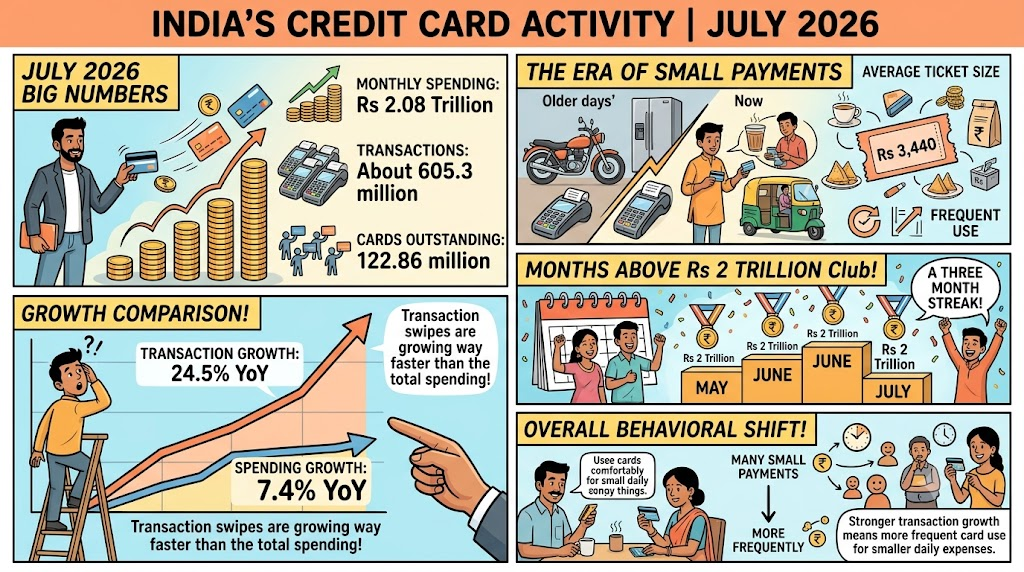
The total number of credit cards in circulation in India stood at 122.86 million by July 2026 in contrast with 111.62 million in the previous year, July 2025. The base of the card increased by approximately 9.9% for the year. Transaction activity, on the other hand, grew much faster at 24.5% to approximately 605.3 million transactions. The same customer might use a card that they used primarily to purchase a flight ticket or a new phone in one month, and then use it for groceries, app purchases, fuel, and food delivery in another month.
That's what the average transaction value says. It fell from Rs 3,987 in July 2025 to about Rs 3,440 in July 2026, a decline of nearly 14%. Average payments are smaller, but so is card usage. They think that cards are becoming a common way of settling bills at home. It's convenient for those who pay off their bills in full. If this is the case, and you are constantly only paying the minimum, it can add up fast.
The scale is indicated by a few numbers, but it is not made into a data sheet.
Debts should not be utilized along with monthly expenditures. A person might deposit Rs 40,000 in July and pay off the entire Rs 40,000 when the bill comes in. Another person can pay Rs 15,000 and pay only a bit, then take it for several months. Even though the amount of the original purchase was less, the second borrower is under more pressure.
Any regular use is only effective if the payment amount is anticipated. The customer might not realize that 8 or 10 little transactions added together over fuel, streaming services, food delivery, or shopping apps have added up. Those purchases can add up to a much larger bill as of the statement date.
After the July numbers, Saurabh Bhalerao, Director, CareEdge Ratings, said that the monthly credit card spending of Rs 2 trillion was expected to be the “new normal”. The expenditure has remained above the previous level, but India was not. Spending rates might exceed the previous year's level during the upcoming festival season because consumers are expected to buy more electronics, travel, clothing and home appliances.
The practical answer for the borrower is simple. When it's paid off on time, revolving interest does not cost households. Subscriptions that involve recurring payments ought to be reviewed monthly. Online statements should be scrutinized as fraudulent payments can be disguised within regular small payments. According to a release by the Ministry of Finance, published through the Press Information Bureau on 20 July 2026, the various consumer-protection measures to be adopted in the context of fintech encompass cyber-safety measures, fraud-detection measures and national reporting mechanisms.
As per the analysis by LoansJagat, cumulative credit card spending in FY2025-26 was estimated to be Rs 23.6 trillion. That provides some useful scale to the numbers for the present month. The base is now much bigger; hence the Rs 2 trillion months. However, for borrowers, a higher level of spending by the system does not necessarily result in lower carried balances.
Before 2026, India had already hit Rs 2 trillion worth of credit card spending per month. The peak during festive shopping season was in October 2024 at Rs 2.02 trillion. Then the figure seemed to be linked to abnormally large purchases. Later, spending continued to fall.
It's not been a tidy 2026. The spending in January was almost Rs 1.99 trillion. February softened. This was boosted to about Rs 2.18 trillion in March due to buying and paying at the end of the financial year. April settled at Rs 1.97 trillion, making the previous month of March look as if it had a seasonal boost.
But all that changed in May. Spending rose to around Rs 2.02 trillion, stayed at Rs 2.01 trillion in June, and rose to Rs 2.08 trillion in July. The most recent one is persistence. We cannot rely on one festival month or one year-end push and expect to overcome the Rubicon in the case of India.
The average monthly spending in January-July 2026 was nearly Rs 2 trillion, whereas 2025 saw average spending of about Rs 1.93 trillion. But the growth rate has moderated. Spending in July was just 7.4% up from a year ago. Even though growth in the absolute numbers is declining in the annual releases, a large market can continue posting high numbers.
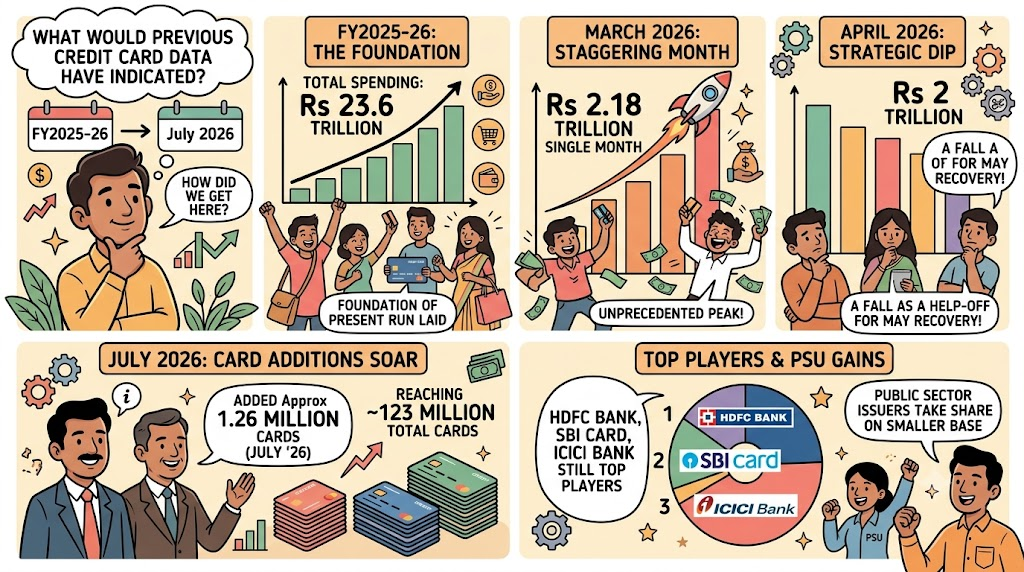
The foundation of the present run was laid in FY2025-26. The total credit card spending during the year was about Rs 23.6 trillion, and in March 2026, it was a staggering Rs 2.18 trillion in a single month. Then April went down to Rs 2 trillion. That fall was more helpful as a tip-off for the May recovery.
The issuers added approximately 1.26 million cards during the month itself in July 2026, reaching a tally of nearly 123 million. HDFC Bank, SBI Card and ICICI Bank were still the top players in the market. Public sector issuers also took their share at the expense of a smaller base.
Banks will be monitoring the spending at the festival, but when the bills come due, the quality of the repayments will also be crucial. The more cards are used, the more income is generated from fees, and the more engagement is generated with the customer. This also puts lenders at risk of more unsecured balances when borrowers fall behind in payments.
As per the response by the Finance Ministry to the parliament on 10 March 2026, the credit card advances outstanding of scheduled commercial banks as on 31 March 2025 were at Rs 2,95,084 crore as compared to Rs 2,10,400 crore on 31 March 2023. During this period, the Gross NPAs increased from Rs 4,072 crore to Rs 6,778 crore.
In FY2024-25, the banks had provided credit card receivables credit losses worth Rs 15,674 crore and realized Rs 1,968 crore on credit card receivables during the FY. Data for the ministry showing how many customers end up rolling over balances as opposed to paying bills in full is not kept system-wide, the ministry also said. That prevents a quick conclusion that borrowers are in financial trouble by having Rs 2.08 trillion in monthly expenditure.
Another concern is fraud since card usage is becoming commonplace. With statements that have dozens of legitimate purchases, it can be easy to miss smaller transactions. It is important for cardholders to monitor alerts and statements and report any unauthorized transactions promptly.
India’s Rs 2.08 trillion credit card spending in July 2026 is significant because it followed 2 other months above the same threshold. The number is appearing more regularly, even outside a single festival spike or financial year-end rush.
The household story underneath the headline is straightforward. Cardholders are making more transactions, while the average value of each payment has fallen. Credit cards are moving further into routine spending.
That wider usage brings convenience, but repayment habits remain the deciding factor. Government data shows outstanding card advances and gross NPAs have risen. The more useful test will come after the festival rush, when monthly spending either stays near Rs 2 trillion or slips below it.
July 26 spending at Rs 2.08 trillion was unchanged as a result of more transactions, a bigger card base and regular consumer spending.
No. India did not cross this level before. It was the third month ending in July in the red of Rs 2 trillion and above.
The number of credit cards in circulation in India rose to nearly 122.86 million as against 111.62 million one year ago.
No. Monthly spending includes purchases that many customers repay completely when their statements become due.
It points to more frequent use for smaller payments, including groceries, fuel, subscriptions and online purchases.
Cardholders should track the full monthly bill, avoid carrying balances where possible, and review statements for unfamiliar transactions.








.png&w=3840&q=75)


