
Disclaimer: The information published on LoansJagat is intended for general informational and educational purposes only and should not be considered financial, legal, or investment advice. Interest rates, loan terms, statistics, and other data may change over time and may vary by lender or source. Please verify the latest information and consult a qualified financial advisor or the respective Bank/NBFC before making any financial decisions.
Subscribe Now
About the author

Arshathul Afia is a journalism graduate and fintech content writer with 4+ years of experience in digital publishing and research-led writing. She has written 200+ articles covering personal finance, lending, banking, digital payments, credit, insurance, and major financial developments in India. At LoansJagat, she focuses on simplifying complex fintech news, RBI updates, loan-related changes, policy developments, and industry trends for everyday readers. Her journalism background helps her approach stories with research, context, and clarity, while her SEO experience ensures content remains discoverable and relevant. She aims to make financial news easier to understand, practical, and useful for readers across India.
Related News
Simplify All Your Loans Into One Affordable EMI

Customers Served

Debt Consolidated

1200+ Reviews

Locations in India
Club all Loans & Credit Card Bills into Single EMI

Quick Apply Loan
Consolidate your debts into one easy EMI.

Takes less than 2 minutes. No paperwork.

10 Lakhs+
Trusted Customers

2000 Cr+
Loans Disbursed

4.7/5
Google Reviews

50+
Banks & NBFCs Offers
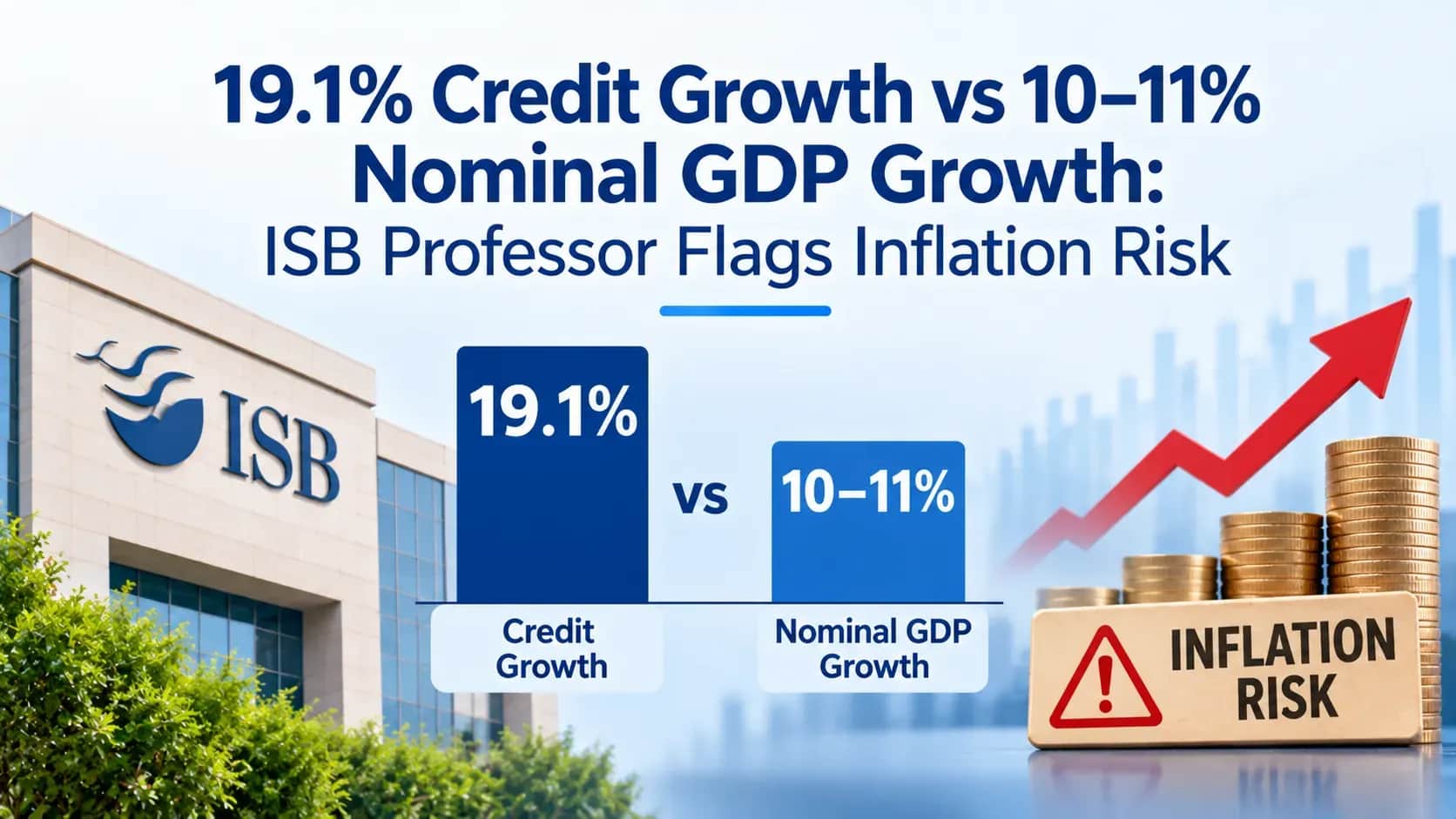
Rapid lending growth risks keeping inflation high, ISB professor Prasanna Tantri warns, with consequences for household spending, loan repayments and the purchasing power of salaries.
Key Highlights
India's rapid loan expansion could keep inflation high, Indian School of Business finance professor Prasanna Tantri warned, according to a report published on 1 November 2026. The finance professor at the Indian School of Business ranked persistent inflation above exchange-rate concerns in remarks reported on 1 November 2026.
For India's salaried households, rising prices reduce what monthly pay can buy, while borrowing costs determine how much income goes towards repayments. September 2026 data showed retail inflation rising even as fresh lending rates eased. The immediate household concern is the amount left after bills and EMIs.
The Ministry of Statistics and Programme Implementation put April–June 2026 nominal GDP growth at 10.3% in its 31 August 2026 release. This measure includes price changes because it values output at current prices. The comparison uses a later credit reading: on 30 September 2026, outstanding non-food bank loans were 19.1% higher than a year earlier.
The 8.8-percentage-point gap compares September lending growth with April–June output growth. The loan balance is measured on a specific date, while GDP adds up the production during a quarter. The difference cannot be treated as an amount of excess borrowing. For India's economy, judging the quality of lending also requires examining what borrowers finance and whether businesses expand production.
Data from the Reserve Bank of India (RBI), reported on 30 October 2026, showed faster growth in non-food bank credit. Separately, official consumer price figures released on 12 October 2026 recorded higher inflation in September.
September 2026 therefore brought rising consumer inflation alongside lower average rates on fresh loans. The lending figures also recorded an unchanged average rate of 8.96% on outstanding rupee loans.
Tantri recommended reducing credit growth to 13–14% initially, followed by closer alignment with nominal GDP growth. He questioned whether lending was expanding productive capacity or financing demand that supply could not meet.
“The exchange rate is not our biggest macroeconomic problem. The risk of sustained inflation is,” Tantri wrote. He urged policymakers to slow credit growth before expectations of persistent inflation became entrenched. Tantri urged policymakers to rein in lending while they could still keep expectations of persistent inflation from taking hold.
In September 2026, fresh loan rates fell, but rising prices reduced what each rupee of salary bought. For salaried borrowers, interest affects the cost of repaying a loan; prices affect purchasing power. An unchanged EMI still takes money from a household budget facing higher expenses. India's inflation reading does not measure the price increase experienced by every family, because spending patterns differ.
The fall in September's fresh lending average also needs careful interpretation. New rupee loans across sectors feed into this average. For a salaried applicant, it does not replace the personal loan rate quoted by a lender. Repayment estimates from a personal loan EMI calculator use the entered loan amount, interest rate and tenure. Comparing the lender's offer and total repayment is more useful than using the national average.
Any assessment of India's lending and GDP figures needs to check what each number measures and which period it covers. For salaried households, September 2026 combined higher consumer inflation with lower average fresh lending rates. Tantri's warning adds a broader question: whether borrowing is helping supply expand quickly enough to meet the spending it finances.
The corresponding year-earlier growth rate was 11.2%; by 30 September 2026, non-food bank credit was expanding 19.1% year-on-year. That exceeded April–June nominal GDP growth. The comparison raises questions about lending and production, although the different reporting periods limit what the headline figures alone can establish.
Tantri proposed slowing the annual growth of bank credit to 13–14% initially. The figure describes how quickly lending expands across the banking system. It is not an interest rate, an EMI calculation or a proposed reduction in an individual customer's existing loan balance.
The average rate fell for fresh rupee loans in September 2026. For loans already outstanding, the average held steady. An individual loan follows its agreed pricing terms. The difference between the published averages cannot be treated as a rate reduction due to every existing borrower.
A matching rise in prices does not automatically follow an increase in money. Changes in production, and in how quickly money moves through the economy, also affect inflation. India's credit growth figure measures lending, rather than the entire money supply. It would therefore be wrong to use 19.1% as an inflation forecast.
The rupee amount owed does not fall with inflation. Its real value falls because those rupees buy less when prices rise. For India's salaried borrowers, loan terms and income still determine repayment affordability. Higher household bills leave less income available, even when inflation has reduced the debt's real value.
Start your journey today
Apply Now*T&C apply











