Disclaimer: The information published on LoansJagat is intended for general informational and educational purposes only and should not be considered financial, legal, or investment advice. Interest rates, loan terms, statistics, and other data may change over time and may vary by lender or source. Please verify the latest information and consult a qualified financial advisor or the respective Bank/NBFC before making any financial decisions.
Subscribe Now
About the author

Arshathul Afia is a journalism graduate and fintech content writer with 4+ years of experience in digital publishing and research-led writing. She has written 200+ articles covering personal finance, lending, banking, digital payments, credit, insurance, and major financial developments in India. At LoansJagat, she focuses on simplifying complex fintech news, RBI updates, loan-related changes, policy developments, and industry trends for everyday readers. Her journalism background helps her approach stories with research, context, and clarity, while her SEO experience ensures content remains discoverable and relevant. She aims to make financial news easier to understand, practical, and useful for readers across India.
Related News
Simplify All Your Loans Into One Affordable EMI

Customers Served

Debt Consolidated

1200+ Reviews

Locations in India
Club all Loans & Credit Card Bills into Single EMI

Quick Apply Loan
Consolidate your debts into one easy EMI.

Takes less than 2 minutes. No paperwork.

10 Lakhs+
Trusted Customers

2000 Cr+
Loans Disbursed

4.7/5
Google Reviews

50+
Banks & NBFCs Offers
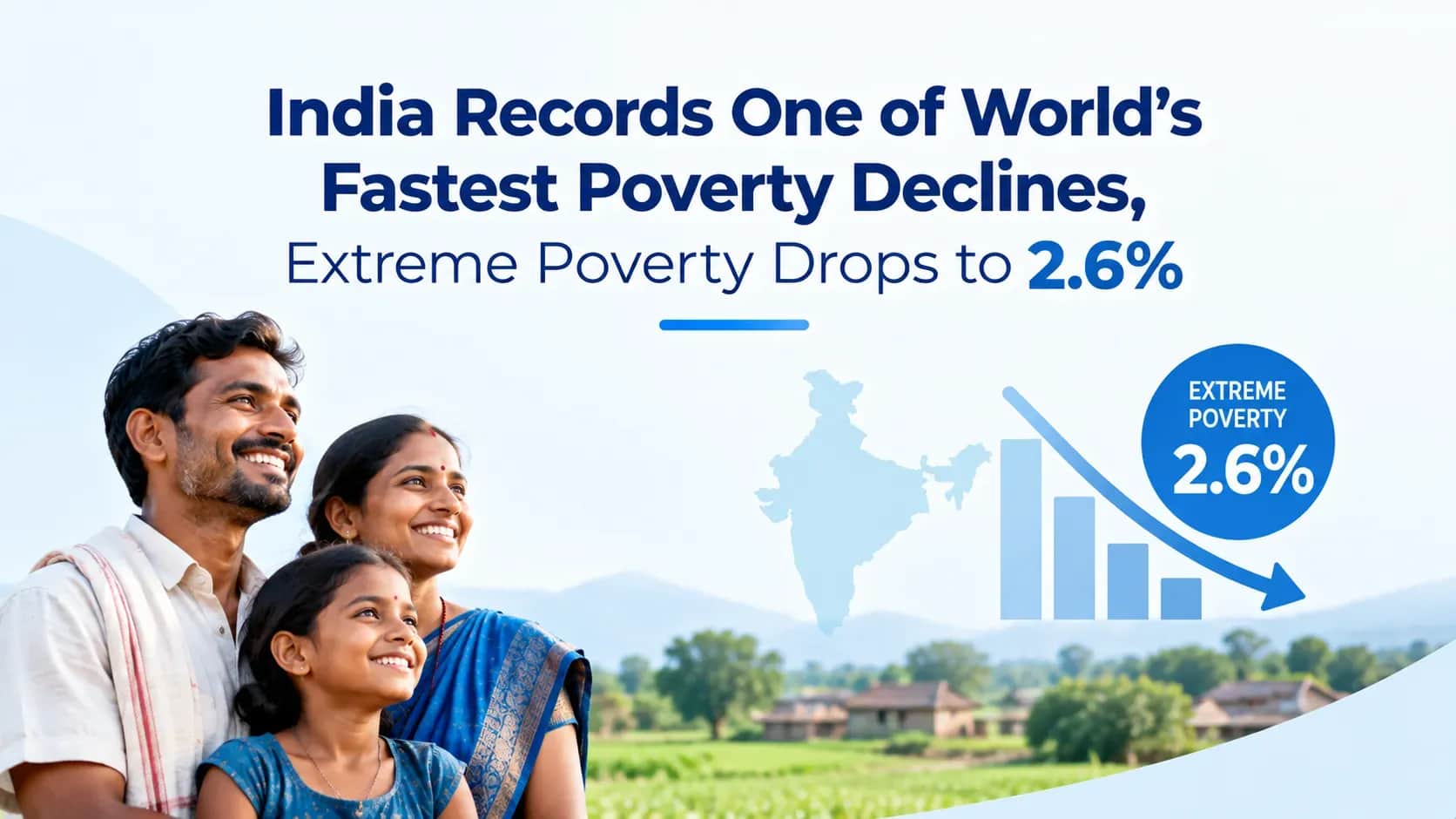
Higher consumption and employment supported India’s poverty decline. The World Bank’s household welfare estimates put extreme poverty at 2.6% in 2023–24, against 27.1% in 2011–12.
Key Highlights
The World Bank used household welfare estimates for 2011–12 and 2023–24 to assess India’s progress in its India Poverty and Equity Brief, dated 9 October 2026. Its description was “one of the fastest poverty declines in the world." The reported 2.6% covers people below the $3-per-person daily threshold, measured at 2021 purchasing power parity.
India’s gains extended across rural and urban households. More people entered paid work, particularly rural women, while food subsidies supported consumption. The Bank also reports broadly unchanged real earnings and employment concentrated in activities with relatively low productivity. These weaknesses remain obstacles to further poverty reduction, even as more households move above the international thresholds.
The World Bank reports that poverty under the higher $4.20 daily line fell from 57.7% to 16.1% over the same period. The estimated 496 million people, equivalent to 49.6 crore, leaving poverty refers to this measure. The Bank regards this lower-middle-income poverty line as relevant to India’s income status.
The figures below come from Box 2.1 of the April 2026 India Development Update. Both daily amounts use 2021 purchasing power parity, allowing the comparison to account for price differences between countries.
The extreme-poverty decline amounts to 24.5 percentage points. India’s 49.6 crore reduction at the higher line should therefore remain separate from the extreme-poverty rate. Converting either daily dollar threshold at the current exchange rate would also misrepresent the purchasing-power adjustment used in these estimates.
The Bank places rural poverty at 19.3% and urban poverty at 8.6% in 2023–24 under the $4.20 line. Rural India made faster progress, narrowing the gap with urban areas. Even after that decline, a disproportionate share of India’s poor lived in villages. Access to higher-quality work outside farming remained limited.
Between 2017 and 2023, India added around 134 million people to its employed population. Rural women entering paid employment accounted for much of this growth. Households consequently had more earners. Food subsidies were among the expanded social transfers that the Bank links to falling poverty. It also records improved household welfare and higher consumption during this period.
In the bank's figures, the 2.6% living in extreme poverty form part of the 16.1% below $4.20. The other 13.5 percentage points represent people above the extreme-poverty threshold whose consumption remained below the lower-middle-income benchmark. The headline improvement therefore accompanies continued deprivation under the higher standard.
For household finance analysis, this distinction has practical importance. The poverty estimates measure consumption against specified thresholds. Crossing the $3 line establishes an improvement under that measure, while the $4.20 results capture a wider group facing limited resources. Reading both together gives a fuller account of the progress recorded for India.
The October brief identifies productive employment in poorer states as a priority. Around 57% of India’s poor population lives in a belt stretching from Uttar Pradesh to West Bengal. The Bank says further national poverty reduction will increasingly depend on employment opportunities in these states.
In comparing 2022–23 with 2023–24, the Bank finds that better measurement likely contributed to the gains, along with improved household welfare. Some spending by wealthier households may go unrecorded in household surveys, leaving inequality understated. The Bank therefore presents the poverty decline alongside its cautions about measurement and the differences in job quality.
A government background note published on 5 July 2025 recorded extreme poverty at 5.3% in 2022–23 under the revised $3 line. The 2.6% estimate covers the subsequent 2023–24 survey period and already appeared in the Bank’s April 2026 development update.
India recorded a substantial poverty decline over 12 years. The World Bank’s findings also place productive employment, stronger earnings and progress in poorer states at the heart of further reductions. Reporting the $3 and $4.20 rates separately preserves the difference between the levels of deprivation each measure.
The October 2026 brief reports 2.6% extreme poverty for 2023–24, measured against the $3 daily line at 2021 purchasing power parity.
An estimated 49.6 crore people moved out of poverty during 2011–12 to 2023–24 when measured at the $4.20 daily line. The figure uses this higher threshold.
The Bank’s monetary poverty estimates depend on household consumption. It uses a daily $3 threshold for extreme poverty and $4.20 for lower-middle-income countries.
The Bank identifies limited productive employment and low productivity in rural areas. Among those who remain poor, households with fewer assets and less education make up a growing share.
The Bank had already reported 2.6% in its April quarter 2026 India Development Update. The October brief reports that figure alongside its assessment of poverty and employment.
Start your journey today
Apply Now*T&C apply