Disclaimer: The information published on LoansJagat is intended for general informational and educational purposes only and should not be considered financial, legal, or investment advice. Interest rates, loan terms, statistics, and other data may change over time and may vary by lender or source. Please verify the latest information and consult a qualified financial advisor or the respective Bank/NBFC before making any financial decisions.
Subscribe Now
About the author

Arshathul Afia is a journalism graduate and fintech content writer with 4+ years of experience in digital publishing and research-led writing. She has written 200+ articles covering personal finance, lending, banking, digital payments, credit, insurance, and major financial developments in India. At LoansJagat, she focuses on simplifying complex fintech news, RBI updates, loan-related changes, policy developments, and industry trends for everyday readers. Her journalism background helps her approach stories with research, context, and clarity, while her SEO experience ensures content remains discoverable and relevant. She aims to make financial news easier to understand, practical, and useful for readers across India.
Related News
Simplify All Your Loans Into One Affordable EMI

Customers Served

Debt Consolidated

1200+ Reviews

Locations in India
Club all Loans & Credit Card Bills into Single EMI

Quick Apply Loan
Consolidate your debts into one easy EMI.

Takes less than 2 minutes. No paperwork.

10 Lakhs+
Trusted Customers

2000 Cr+
Loans Disbursed

4.7/5
Google Reviews

50+
Banks & NBFCs Offers
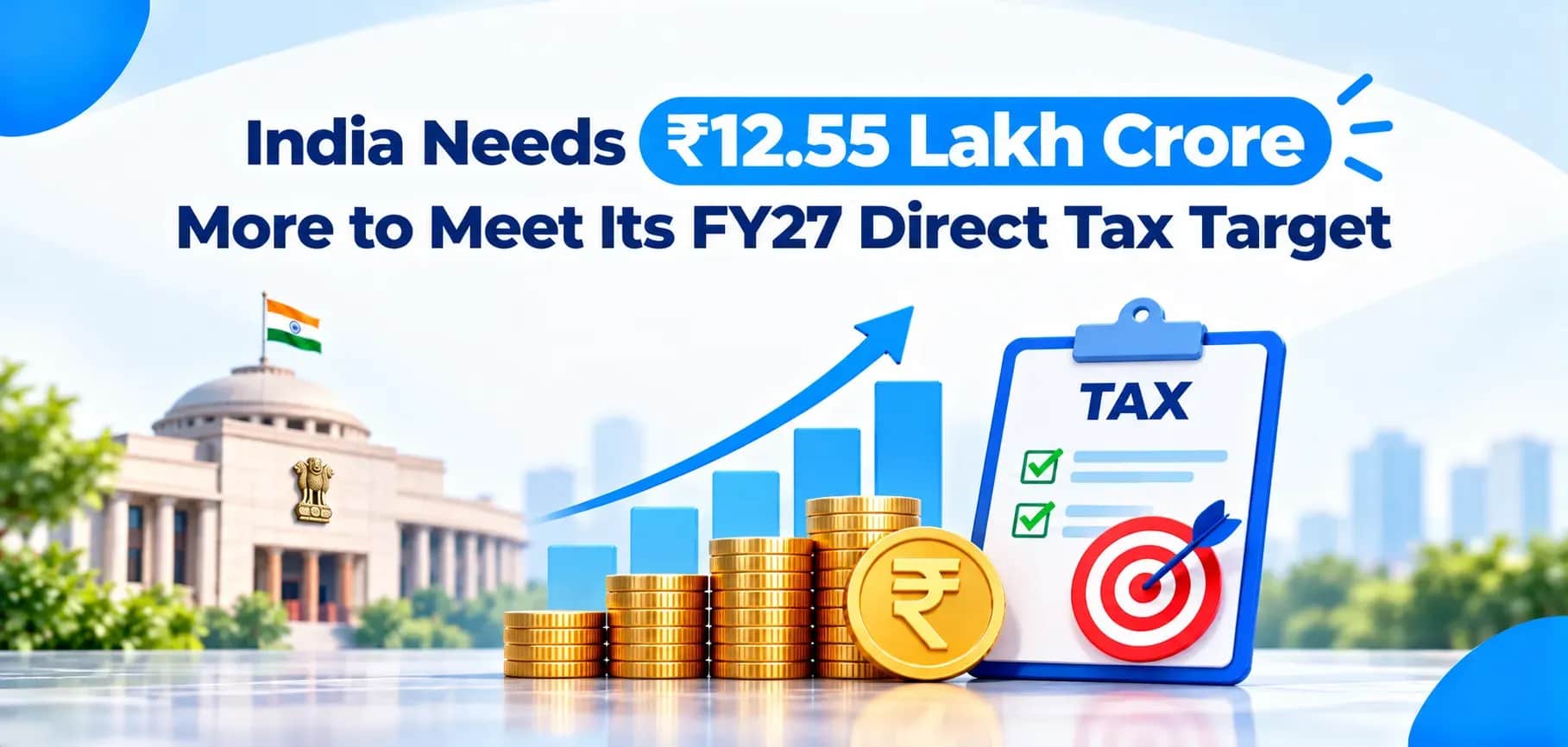
India has collected about 53% of its FY27 direct tax target. December and March advance tax payments will show whether receipts are picking up fast enough.
Key Highlights
India’s net direct tax collections reached ₹14.42 lakh crore by 10 November 2026 against the Union Budget’s FY27 target of ₹26.97 lakh crore. Tax experts assessing the figures on 12 November said the target was still within reach if corporate tax and advance tax payments picked up over the rest of the financial year.
The Budget target is about 15% above the ₹23.40 lakh crore collected in FY26. With receipts up 11.76% so far, the Centre needs faster year-on-year growth from 11 November through March. The December instalment will show how much ground it can make up before the final quarter.
The Centre had collected ₹12.90 lakh crore after refunds at the same point last year. This year, companies contributed nearly ₹96,000 crore in additional net receipts. The increase from non-corporate taxpayers, a group that includes individuals, firms and Hindu Undivided Families, was about ₹38,000 crore. Even with slower growth, non-corporate tax remained the larger of the two categories by value.
For taxpayers on the regular advance tax schedule, cumulative payments are due to reach 75% of estimated liability by 15 December and 100% by 15 March. Earlier instalments count towards those totals. By March, companies have a clearer view of their full-year profits and can adjust the final instalment accordingly.
Tax partner Jayesh Sanghvi said corporate profitability and the remaining instalments would shape the Centre’s chances of meeting the target. Faster growth in non-corporate receipts would spread the gains across more taxpayers. Senior tax partner Amit Agarwal also pointed to year-end payments alongside the scheduled instalments, putting some of the receipts needed to close the gap in the final weeks of FY27.
Read also: India’s Retail Inflation Hits 6.09% in October as Food Prices Push It Past RBI’s Ceiling
Gross collections rose 14.02%, but refunds increased 25.91%. The Centre issued ₹3.08 lakh crore in refunds by 10 November, up from ₹2.45 lakh crore a year earlier. About ₹1.70 lakh crore went to corporate taxpayers and ₹1.39 lakh crore to non-corporate taxpayers.
Tax partner Rohinton Sidhwa said refund outflows generally run higher in the first 3 quarters. Refunds had slowed in the previous financial year and were running higher again in FY27. Sidhwa said a slowdown in refunds, coupled with stronger advance tax receipts in the final quarter, would improve the Centre’s chances of meeting the Budget estimate.
Securities Transaction Tax (STT) brought in ₹54,077.90 crore through 10 November, up 51.56% from a year earlier. From 1 April 2026, the rate on futures sales rose from 0.02% to 0.05%. The rate on option sales rose from 0.10% to 0.15% of the premium, and the rate on exercised options rose from 0.125% to 0.15% of intrinsic value.
Agarwal also pointed to more companies raising money through initial public offerings, growing retail participation and a gradual shift in household savings towards financial assets, including equities. STT still accounted for less than 4% of net direct tax receipts through 10 November. Sanghvi said the extra revenue offered a cushion, with limited scope to cover a large shortfall in other taxes.
The Centre needs net direct tax receipts to grow about 19.5% over the rest of FY27 to meet its ₹26.97 lakh crore target. December and March advance tax payments will show whether collections are accelerating, and refund outflows will determine how much of that revenue the Centre retains.
The figures cover 1 April to 10 November 2026. The year-on-year comparisons use collections and refunds from the same dates in 2025.
The Budget raised STT rates on futures sales, option sales and exercised options from 1 April 2026. It put direct taxes at ₹26.97 lakh crore, or 61.2% of estimated gross tax revenue.
Advance tax paid during the year is credited against the final tax liability. A taxpayer who still owes tax after accounting for advance tax and other credits pays the balance as self-assessment tax.
Gross collections measure receipts before refunds. Net collections show the amount left after the department deducts the refunds it issued during the period.
The figure measures the increase in the total amount refunded nationwide. An individual’s refund depends on the difference between the tax already paid and the final tax liability.
Start your journey today
Apply Now*T&C apply