Disclaimer: The information published on LoansJagat is intended for general informational and educational purposes only and should not be considered financial, legal, or investment advice. Interest rates, loan terms, statistics, and other data may change over time and may vary by lender or source. Please verify the latest information and consult a qualified financial advisor or the respective Bank/NBFC before making any financial decisions.
Subscribe Now
About the author

Arshathul Afia is a journalism graduate and fintech content writer with 4+ years of experience in digital publishing and research-led writing. She has written 200+ articles covering personal finance, lending, banking, digital payments, credit, insurance, and major financial developments in India. At LoansJagat, she focuses on simplifying complex fintech news, RBI updates, loan-related changes, policy developments, and industry trends for everyday readers. Her journalism background helps her approach stories with research, context, and clarity, while her SEO experience ensures content remains discoverable and relevant. She aims to make financial news easier to understand, practical, and useful for readers across India.
Related News
Simplify All Your Loans Into One Affordable EMI

Customers Served

Debt Consolidated

1200+ Reviews

Locations in India
Club all Loans & Credit Card Bills into Single EMI

Quick Apply Loan
Consolidate your debts into one easy EMI.

Takes less than 2 minutes. No paperwork.

10 Lakhs+
Trusted Customers

2000 Cr+
Loans Disbursed

4.7/5
Google Reviews

50+
Banks & NBFCs Offers
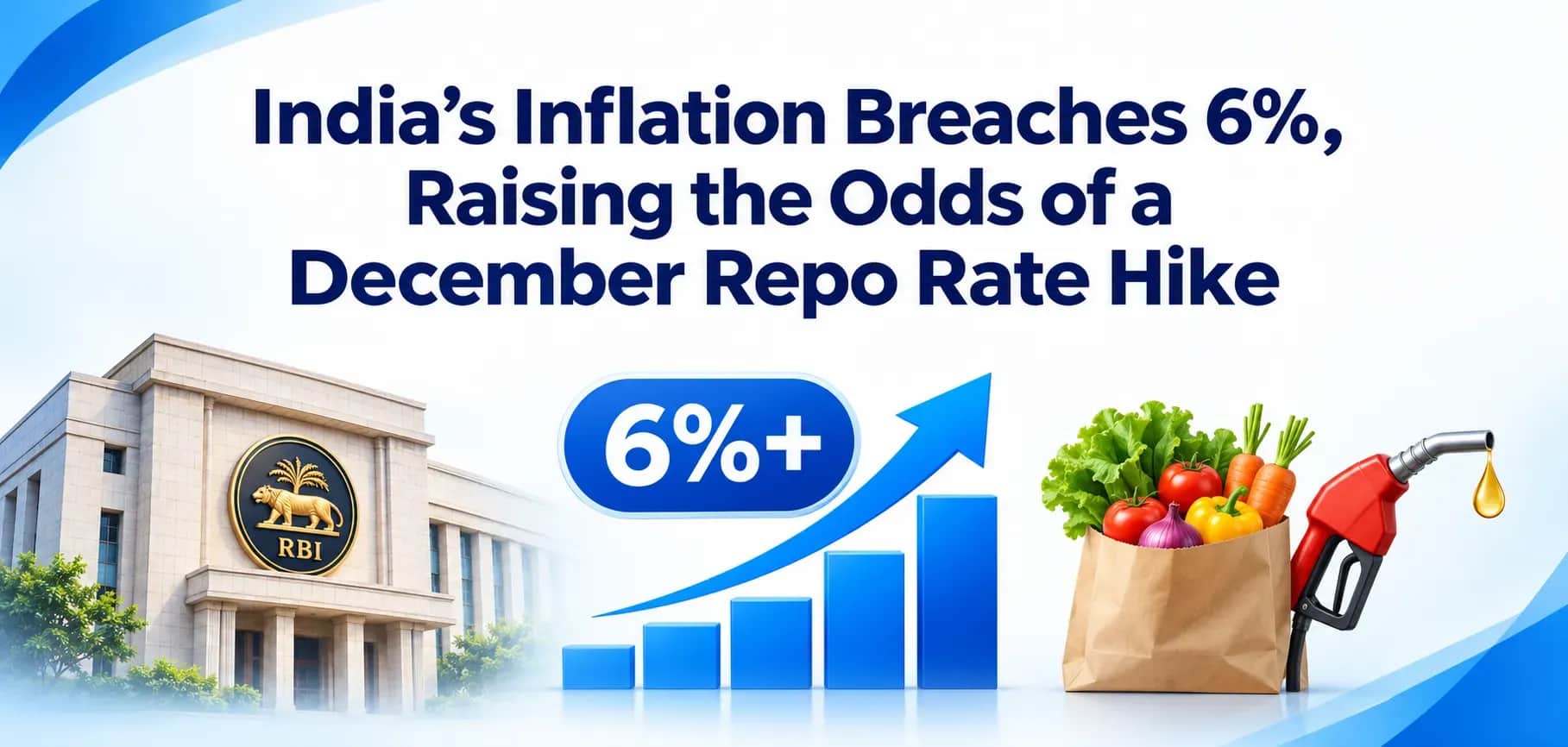
India’s retail inflation hit 6.09% in October, putting another repo rate hike on the table for December as households contend with rising food and fuel costs.
Key Highlights
For the RBI, the December meeting will be the first since retail inflation crossed 6%. The October reading, released on 12 November, was up from 5.54% in September. The increase came after the MPC unanimously raised the repo rate in October and shifted its policy stance from neutral to calibrated tightening.
India last saw borrowing costs around the levels now being discussed about 2 years ago. Crude oil is now near US$100 a barrel, food prices are climbing and overseas investors have only recently returned to Indian equities after months of heavy selling. Those pressures give policymakers less room to cushion the effect of higher borrowing costs on spending.
Food inflation climbed from 7.74% in September to 8.94% in October. The strain was greater in rural India, where overall retail inflation reached 6.63%, compared with 5.41% in urban areas. Apoorva Javadekar, research head at Shriram Research, expects the combination of higher prices and borrowing costs to weigh on consumption, particularly in rural areas where below-normal rainfall has already hurt farm prospects. A severe El Niño also threatens harvests globally.
The conflict in West Asia has kept crude oil prices high, making oil imports more expensive for India. The merchandise trade deficit widened to US$39.88 billion in October, a 1-year high. Javadekar expects the pressure on public finances to persist and price increases to take longer to ease.
October’s figures are provisional. The RBI aims to keep retail inflation at 4% over time, within a tolerance band of 2% to 6%.
Read also: RBI Repo Rate Could Reach 6.25% as Food and Fuel Costs Pinch Households
ICRA chief economist Aditi Nayar expects inflation to stay above 6% for the next couple of months and sees a 25-basis-point December hike as highly likely. HSBC’s chief India economist, Pranjul Bhandari, expects a larger move of 50 basis points, citing the risk that oil and food shocks spill into other prices. A 25-basis-point increase would take the repo rate to 5.75%. A 50-basis-point rise would lift it to 6%.
The 6.25% figure refers to the upper end of expectations for the coming months. In October, the MPC left itself room to either raise rates again or pause. It projected average retail inflation of 6% in the October to December quarter and 5.7% in the January to March quarter. October’s 6.09% reading is the first of 3 months that will make up the December-quarter average.
Real GDP grew 7.8% from April to June, and private consumption rose 7.1%. Higher borrowing costs could slow household spending as families pay more for food and fuel.
RBI measures helped the rupee recover from its October record low of nearly ₹97 per US dollar. Foreign investors also resumed buying Indian shares. Further US rate increases could narrow the yield advantage of Indian assets and put pressure on the rupee again.
The MPC goes into its 2 to 4 December meeting with retail inflation at 6.09%, above its 6% tolerance ceiling. A 25-basis-point hike would take the repo rate to 5.75%, and a 50-basis-point hike would take it to 6%. For households with repo-linked loans, the next reset date will determine when any increase affects their EMI, repayment tenure or both.
The repo rate applies when banks borrow short-term funds from the RBI against eligible securities. In a reverse repo, the RBI absorbs money from banks.
Yes. When a floating-rate home loan resets, the lender can extend the repayment tenure. Borrowers can also choose a higher EMI or combine both options.
The repo rate stands at 5.50% as of 16 November 2026. The Monetary Policy Committee raised it by 25 basis points at its October meeting.
The Monetary Policy Committee is scheduled to meet from 2 to 4 December 2026. Its October decision raised the repo rate after the August pause.
The RBI’s latest decision set the repo rate at 5.50%. A move to 6.25% represents the upper end of market expectations for the coming months.
Start your journey today
Apply Now*T&C apply