By continuing, you agree to LoansJagat's Credit Report Terms of Use, Terms and Conditions, Privacy Policy, and authorize contact via Call, SMS, Email, or WhatsApp
Disclaimer: The information published on LoansJagat is intended for general informational and educational purposes only and should not be considered financial, legal, or investment advice. Interest rates, loan terms, statistics, and other data may change over time and may vary by lender or source. Please verify the latest information and consult a qualified financial advisor or the respective Bank/NBFC before making any financial decisions.
Subscribe Now
About the author

Arshathul Afia
Arshathul Afia is a journalism graduate and fintech content writer with 4+ years of experience in digital publishing and research-led writing. She has written 200+ articles covering personal finance, lending, banking, digital payments, credit, insurance, and major financial developments in India. At LoansJagat, she focuses on simplifying complex fintech news, RBI updates, loan-related changes, policy developments, and industry trends for everyday readers. Her journalism background helps her approach stories with research, context, and clarity, while her SEO experience ensures content remains discoverable and relevant. She aims to make financial news easier to understand, practical, and useful for readers across India.
Related Blog Post
Simplify All Your Loans Into One Affordable EMI

Customers Served

Debt Consolidated

1200+ Reviews

Locations in India
Club all Loans & Credit Card Bills into Single EMI

Quick Apply Loan
Consolidate your debts into one easy EMI.

Takes less than 2 minutes. No paperwork.

10 Lakhs+
Trusted Customers

2000 Cr+
Loans Disbursed

4.7/5
Google Reviews

50+
Banks & NBFCs Offers
Other services mentioned in this article
A polymer bank note of ₹10 and ₹20 will be tested in India following government approval, and the paper bank notes will continue to be valid; no date has been announced for their rollout.
Union Government has given permission for field trials of banknotes of Rs 10 and 20 in polymer format in India. The decision was announced by the Minister of State for Finance Pankaj Chaudhary in a Lok Sabha reply in July, 2026. The proposal would include 100 crore notes of each denomination, which would have a combined face value of ₹3,000 crore. If the notes pass through the activity of field testing, regular issue will occur; otherwise, it will not occur,
There is no immediate change on the counters of the shops. Paper notes are still valid currency and no withdrawal date has been announced, nor has there been a proposal on how to exchange notes or a public launch schedule announced. Much of the short-term work will be done behind the scenes, e.g., selecting suppliers, making and testing prints with cash-counting machines, etc.
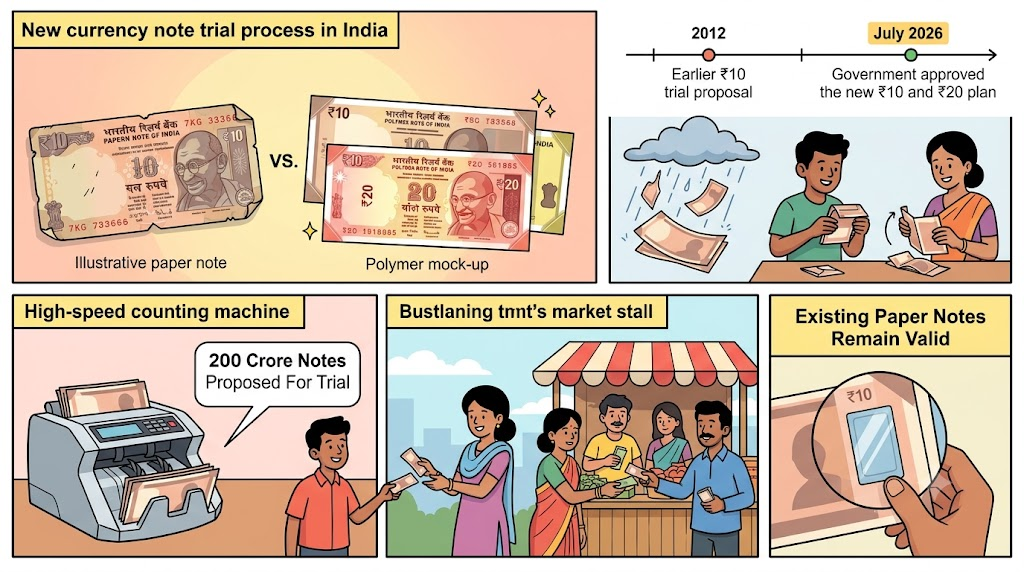
The first distinction will be in the physical. A polymer note feels smoother than a conventional Indian banknote due to the use of a thin synthetic substrate instead of cotton-based paper in the note. It is also more moisture-resistant. This is helpful in the small change market, in railway stalls, local buses, tea shops, and in weekly bazaars.
A 10 rupee note can be in many hands till lunch. Can be folded in half two times, placed next to coins, wet fingers, and shoved into a tight coin drawer. The paper notes are prone to softness or to ripping at the edges when used like this. Polymer can be longer lasting in the same environment. Not in a lab alone, the trial now has to prove its effectiveness in Indian conditions.
The paper notes will not be handed over to the customers. If the field trial is successful, both types can circulate at the same time. If a shopkeeper gets a ₹20 note from the first customer and a polymer note from the second customer. But before that, public instructions will be required, particularly from the older citizens and small traders who might be confused by the unfamiliar texture of the polymer notes and fake notes.
The proposal does not change loan rates, EMIs or credit rules. LoansJagat’s view is that the direct impact falls on cash handling rather than borrowing costs. Small traders may benefit if low-value notes remain usable for longer, while borrowers will see no change in their repayment schedules. This position also fits the LoansJagat report on UPI’s growing share in Indian payments, which shows why digital transactions can grow even while cash remains necessary for many daily purchases.
The government has approved a proposed volume of 200 crore notes. This figure refers to the number of trial banknotes, not notes already printed and ready for circulation. The combined face value is ₹3,000 crore. It does not represent the cost of the project.
Before looking at the table, one distinction is important. Currency value and production expenditure are different figures. Printing ₹3,000 crore in notes does not mean the government will spend ₹3,000 crore on the trial.
The supplier document lists 34,000 reams for each denomination, with 500 sheets in a ream. That produces an indicative total of 3.4 crore substrate sheets. The final number of notes per sheet will depend on the approved printing layout and dimensions.
BRBNMPL has sought BOPP-based opacified polymer substrate. BOPP refers to biaxially oriented polypropylene, a material used for durable banknote sheets. The tentative thickness is around 90 micrometres. Suppliers must also show that samples do not contain animal tallow or animal DNA.
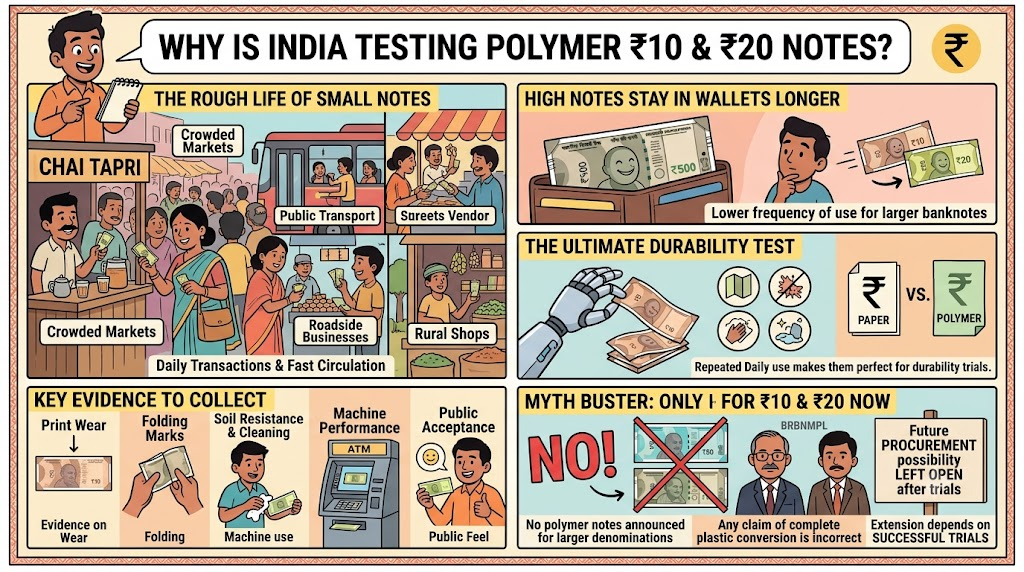
Small notes suffer rough use. They travel through crowded markets, public transport, roadside businesses and rural shops where cash continues to play a strong role. Higher-denomination notes may stay in wallets for longer periods. ₹10 and ₹20 notes often move repeatedly during the same day.
That makes them useful for testing durability. If polymer cannot perform well in these denominations, there would be little reason to extend the material to other notes. The trial can provide evidence on print wear, folding marks, cleaning, machine performance and public acceptance.
The government has not announced polymer versions of ₹50, ₹100, ₹200 or ₹500 notes. BRBNMPL has only left open the possibility of future procurement after successful trials. Any claim that all Indian banknotes are about to become plastic would go beyond the approved proposal.
There is another point. Low-value notes compete with coins in many transactions, yet people often prefer notes because they are lighter and easier to carry. A stronger ₹10 or ₹20 note could stay in use longer without adding the weight of more coins. That benefit will depend on how well the substrate handles creasing and heat.
India considered polymer currency more than a decade ago. On December 13, 2012, the Ministry of Finance announced a field trial involving 100 crore ₹10 polymer notes across 5 cities. The Press Information Bureau release published on December 13, 2012, said the main aim was to increase the life of lower-denomination banknotes.
Later parliamentary replies named Kochi, Mysore, Jaipur, Shimla and Bhubaneswar as the planned locations. Those cities offered different weather conditions. Kochi brought humidity. Jaipur added dry heat. Shimla gave a colder setting. The selection could have produced useful comparisons.
Yet the notes never became part of routine public circulation. The earlier plan stayed in the trial and procurement phase. No broad launch followed.
The 2026 proposal goes further by including ₹20 notes and issuing a new global supplier invitation. It still faces several of the same steps. Samples must be approved. Printing has to begin. Machines need testing. Trial locations must be selected. Public feedback will then shape the final call.
The trial is unlikely to reverse digital payment growth. UPI serves instant transfers, online purchases and QR-code payments. Cash serves another set of situations. It works without mobile data, battery power or a functioning bank server.
A roadside seller may accept UPI all morning and still need ₹10 notes to return change to a cash buyer. A passenger in an area with weak network coverage may rely on cash for a bus ticket. Elderly users may also prefer currency for small purchases. Polymer changes the material used for the note. It does not change the role of digital payments.
There could be a small operational benefit for cash-dependent businesses. Fewer torn notes may reduce disputes at counters. Banks may also receive fewer unfit low-value notes if the material performs as expected. Those results will take time to measure.
No official forecast has been issued on how polymer notes may affect cash demand or UPI volumes. Any exact prediction at this stage would be guesswork.
Cost remains one concern. Polymer substrate can carry a higher purchase price than conventional note paper. The government would need to compare that extra expense with savings from longer circulation. A note lasting longer may still prove economical, but the trial must produce India-specific evidence.
Heat can create another issue. Notes left on vehicle dashboards, near cooking areas or inside packed outdoor stalls may face temperatures not seen in controlled testing. Repeated crumpling can leave permanent folds. Some polymer notes may also feel slippery when new.
Machine rejection would create immediate trouble. Banks, metro stations, parking machines and deposit kiosks must recognise the notes without repeated failures. A trial should include these settings before a wider release.
Disposal also needs planning. Worn paper notes are processed through established systems. Polymer requires a separate recycling or destruction route. Without that, longer use could simply shift the environmental burden to the end of the note’s life.
India has approved a large field trial, not a nationwide currency change. The ₹10 and ₹20 polymer notes still have to pass printing checks, machine tests and daily use across different locations. For citizens, there is nothing to exchange. Current notes remain valid.
The next useful update will be the announcement of trial cities, printing dates or the first controlled release. Until then, the proposal should be treated as a serious test of tougher small currency, not the end of paper banknotes.
Are existing ₹10 and ₹20 paper notes being withdrawn?
No. The government has not announced any withdrawal, exchange date or compulsory replacement.
Will India replace all paper notes with polymer currency after the ₹10 and ₹20 trial?
Not immediately. Paper notes are expected to remain in circulation unless the polymer trial proves more durable, affordable and convenient for daily use.
Is ₹3,000 crore the cost of the polymer note project?
No. It is the combined face value of the 200 crore proposed trial notes.
Will polymer notes work in cash-counting machines?
That will be examined during testing. Some machines may need recalibration before wider circulation.
Are polymer notes waterproof?
They resist moisture better than ordinary banknote paper, though the Indian trial will test actual performance.
Will ₹50 and ₹100 polymer notes be issued next?
No such issue has been approved. Other denominations may be considered only after successful trials.
Can shops refuse current paper notes?
Valid paper ₹10 and ₹20 notes remain legal currency and should continue to be accepted.









.png&w=3840&q=75)


