Disclaimer: The information published on LoansJagat is intended for general informational and educational purposes only and should not be considered financial, legal, or investment advice. Interest rates, loan terms, statistics, and other data may change over time and may vary by lender or source. Please verify the latest information and consult a qualified financial advisor or the respective Bank/NBFC before making any financial decisions.
Subscribe Now
About the author

Arshathul Afia is a journalism graduate and fintech content writer with 4+ years of experience in digital publishing and research-led writing. She has written 200+ articles covering personal finance, lending, banking, digital payments, credit, insurance, and major financial developments in India. At LoansJagat, she focuses on simplifying complex fintech news, RBI updates, loan-related changes, policy developments, and industry trends for everyday readers. Her journalism background helps her approach stories with research, context, and clarity, while her SEO experience ensures content remains discoverable and relevant. She aims to make financial news easier to understand, practical, and useful for readers across India.
Related News
Simplify All Your Loans Into One Affordable EMI

Customers Served

Debt Consolidated

1200+ Reviews

Locations in India
Club all Loans & Credit Card Bills into Single EMI

Quick Apply Loan
Consolidate your debts into one easy EMI.

Takes less than 2 minutes. No paperwork.

10 Lakhs+
Trusted Customers

2000 Cr+
Loans Disbursed

4.7/5
Google Reviews

50+
Banks & NBFCs Offers
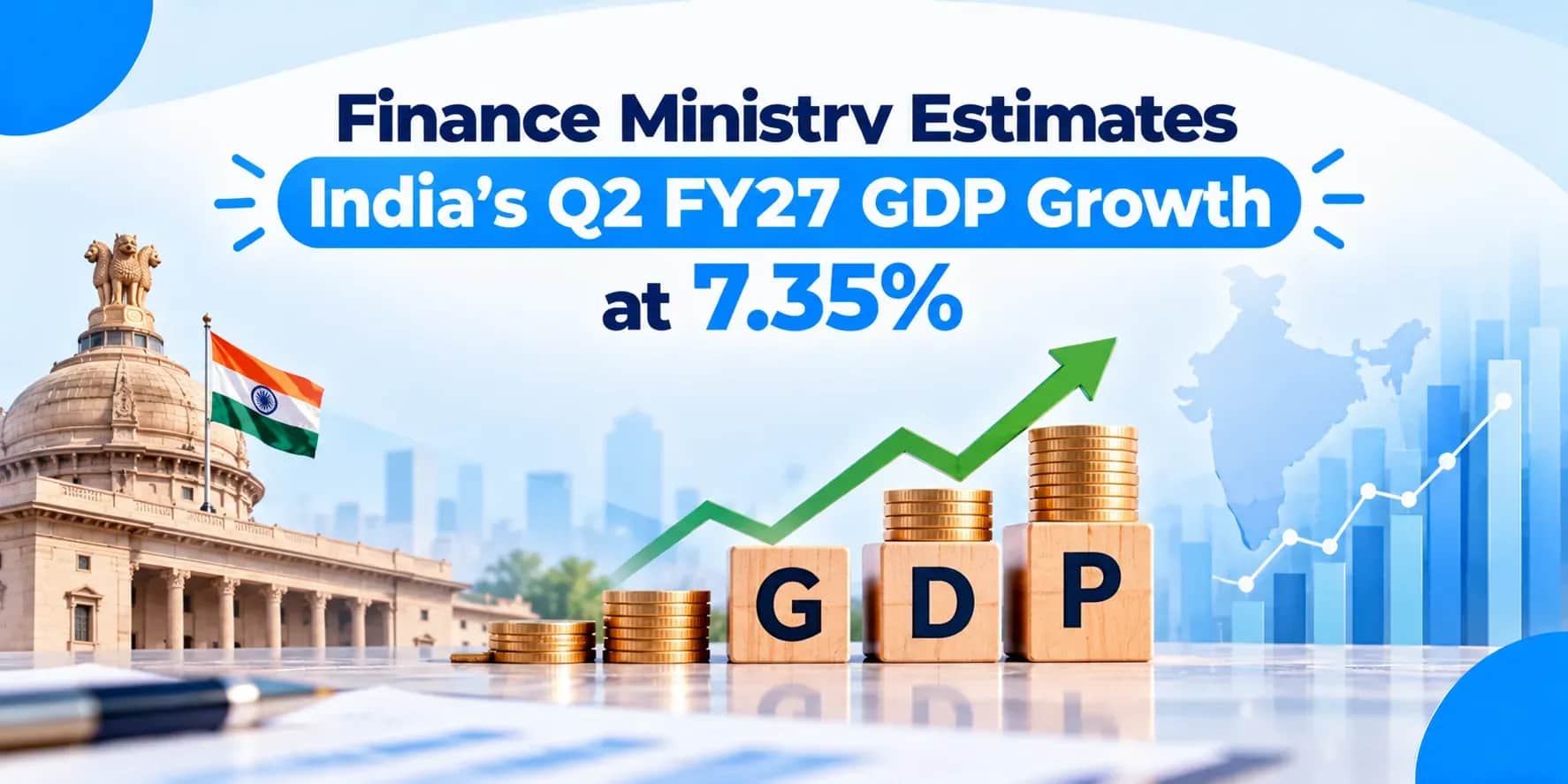
At 7.35%, India’s estimated Q2 FY27 growth reflects firm domestic demand, the Finance Ministry says, though food prices and energy costs continue to pose risks.
Key Highlights
On 29 October 2026, the Finance Ministry released its Monthly Economic Review for October 2026, putting growth for July–September at 7.35%. That is Q2 of FY2026–27. The estimate comes from the Finance Ministry's nowcasting model, which uses recent economic indicators. The quarter’s official GDP release is scheduled for 30 November 2026.
The ministry remains concerned about the kharif crop. Food inflation and costlier crude oil add to the risks. Even so, it expects domestic demand and investment to support activity through the remaining financial year. The ministry’s priority for the coming months is to keep production growing while limiting price pressure. Over the longer term, the ministry wants Indian industry to create more value domestically and improve its competitiveness in export markets.
The October review identifies stronger industrial output and energy consumption as support for economic activity. Port traffic, GST collections and automobile sales also contributed to the ministry’s assessment. Together, these indicators cover production, goods movement and spending. The ministry’s view is that domestic activity has held firm despite a difficult external environment, with demand and investment supporting the economy through the rest of FY2026–27.
For households with loan repayments, the useful distinction is between national output and money available after essential expenses. That is the practical implication of the ministry discussing growth and food-price pressure together. Stronger production supports its economic outlook, while food and energy costs affect purchasing power. The amount left for repayments depends on what a household earns and spends; the ministry’s price warnings therefore remain relevant alongside its growth estimate.
The GST Council's proposed process reforms aim to simplify compliance and ease working-capital pressures through faster refunds and wider input tax credit eligibility. Healthy credit growth and recent trade agreements should provide further support to consumption, investment and exports, the review said. For manufacturing, the ministry pointed to firm production and improving order flows. It also identified better manufacturing sentiment and industrial credit as support for the near-term outlook.
On prices, the ministry said “sustaining economic activity while safeguarding price stability” would guide policymakers during the second half of FY2026–27. To ease food prices, the review points to onion supplies through the Kanda Express and stockholding limits for sugar dealers. Cuts in customs duty on crude edible oils form part of that response. The ministry also warned about an intensifying El Niño ahead of rabi sowing. Higher crude oil prices and freight disruptions through West Asia add to the risks identified in the review.
The September 2026 review had estimated Q2 growth at 7.3%. Services picked up in August, but manufacturing activity and e-way bill generation had slowed. That was the backdrop to the assessment reported on 1 October 2026, in which the ministry described growth continuing at a more measured pace. Electricity and fuel consumption, along with bank lending, supported the investment outlook.
The October review raises that estimate slightly. The comparison below separates the ministry’s successive Q2 assessments from the growth already recorded in Q1.
The revision improves the ministry’s assessment of the same July–September quarter. The latest estimate still falls below Q1’s recorded growth. Those comparisons describe different developments: the ministry has become slightly more positive about Q2, while its model continues to indicate a lower growth rate than in April–June. Slower growth also differs from a fall in output; the ministry’s estimate still points to expansion.
The Finance Ministry’s October review presents an economy supported by domestic demand, investment and industrial activity, with price pressure requiring continued attention. Its Q2 estimate is slightly higher than the September assessment. The official GDP release scheduled for 30 November 2026 is the next update on July–September output.
For July–September 2026, the ministry’s estimate puts real GDP growth at 7.35%. Its October review bases that assessment on the Department of Economic Affairs’ nowcasting model.
The ministry saw stronger industrial output alongside increased energy use and port traffic. GST collections and automobile sales also fed into its October Q2 estimate.
For July–September 2026, the official GDP release is due on 30 November 2026 from the Ministry of Statistics and Programme Implementation, after the October assessment.
The calculation values final goods and services produced in India, using production and expenditure data. Real GDP uses constant prices to measure that domestic output.
Growth across the economy does not translate into an equal rise in income for every household. Earnings and employment, measured against living costs, determine each household’s financial position.
Start your journey today
Apply Now*T&C apply