By continuing, you agree to LoansJagat's Credit Report Terms of Use, Terms and Conditions, Privacy Policy, and authorize contact via Call, SMS, Email, or WhatsApp
Disclaimer: The information published on LoansJagat is intended for general informational and educational purposes only and should not be considered financial, legal, or investment advice. Interest rates, loan terms, statistics, and other data may change over time and may vary by lender or source. Please verify the latest information and consult a qualified financial advisor or the respective Bank/NBFC before making any financial decisions.
Subscribe Now
About the author

Arshathul Afia is a journalism graduate and fintech content writer with 4+ years of experience in digital publishing and research-led writing. She has written 200+ articles covering personal finance, lending, banking, digital payments, credit, insurance, and major financial developments in India. At LoansJagat, she focuses on simplifying complex fintech news, RBI updates, loan-related changes, policy developments, and industry trends for everyday readers. Her journalism background helps her approach stories with research, context, and clarity, while her SEO experience ensures content remains discoverable and relevant. She aims to make financial news easier to understand, practical, and useful for readers across India.
Related News
Simplify All Your Loans Into One Affordable EMI

Customers Served

Debt Consolidated

1200+ Reviews

Locations in India
Club all Loans & Credit Card Bills into Single EMI

Quick Apply Loan
Consolidate your debts into one easy EMI.

Takes less than 2 minutes. No paperwork.

10 Lakhs+
Trusted Customers

2000 Cr+
Loans Disbursed

4.7/5
Google Reviews

50+
Banks & NBFCs Offers
With further tightening under consideration, India’s rupee defence now extends to monetary conditions, raising concerns about borrowing costs and the impact on businesses and growth.
Key Highlights
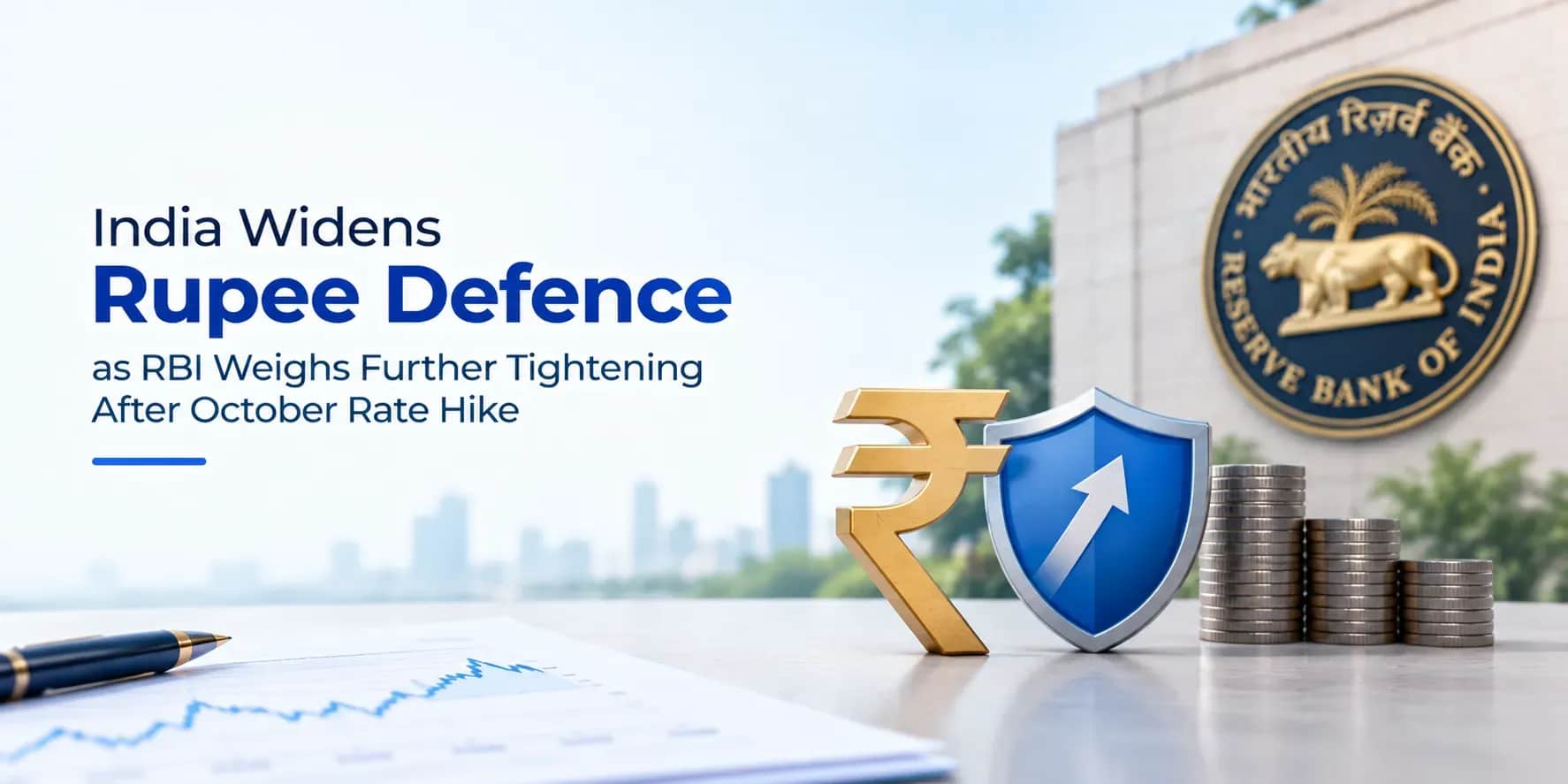
The Reserve Bank of India is discussing further tightening to counter capital outflows and make bets against the rupee costlier. Unnamed sources familiar with those discussions spoke to financial journalists Ira Dugal and Dharamraj Dhutia, whose Mumbai report was published on 16 October 2026. The approach remains cautious because rapid tightening could hurt domestic borrowers and growth.
In its 7 October 2026 statement, the RBI paired a 25-basis-point rate increase with “calibrated tightening”. The inflation figures followed on 12 October 2026: September retail inflation was 5.54%, the Ministry of Statistics and Programme Implementation reported. Higher rates are intended to stop price pressures spreading through the economy. For borrowers, that policy also brings more expensive credit.
After October’s increase, some floating-rate borrowers may pay more each month; others may take longer to repay. The timing depends on the loan’s benchmark and reset terms. Under the RBI’s loan-reset framework, updated on 1 October 2025, lenders must communicate increases in instalments or tenure and provide repayment choices. A fixed-rate contract does not automatically reprice with the repo rate.
Our reading is that an unchanged EMI deserves attention during this tightening cycle. A bank may have extended the repayment schedule instead, leaving the monthly debit untouched while adding interest costs. For loan repayment planning, the useful comparison is the revised schedule against the previous one. The loan’s closing date belongs in that comparison, not just the amount deducted each month.
Stephen Chang, PIMCO’s managing director and Asia portfolio manager, said in an interview published on 14 October 2026 that food and energy inflation risks had returned despite strong Indian growth. For Chang, domestic conditions remained the main reason to expect further tightening, though rupee stability also influenced policy. Inflation therefore formed part of his case for higher rates, alongside support for the currency.
Ze Yi Ang, senior portfolio manager at Allianz Global Investors, warned on 16 October 2026 that repeated hedging-rule changes could push legitimate transactions offshore and reduce policy predictability. Banks have suggested a different way to raise hedging costs. Reporting published on 12 October 2026 said lenders sought a flat charge instead of the cash reserve, arguing that this would avoid tying up treasury liquidity. That remains a banking-sector proposal.
The October rate increase was followed by measures affecting bank cash and customers’ foreign-currency transactions. The rules do not all work through loan rates. Some limit banks’ flexibility in managing rupees, while others change the cost and conditions of buying foreign currency for future payments.
The announced measures distinguish between daily cash requirements, qualifying hedges and oil companies’ dollar purchases.
The 99% requirement is a daily maintenance rule, not a headline CRR of 99%. The obligation to set aside cash falls on authorised dealers handling contracts covered by the hedging rule. It does not impose a tax on all importers. Whether a reserve is required depends on the contract, with the dealer responsible for maintaining it.
Importers still have foreign-currency bills to pay after the October restrictions. Reporting published on 14 October 2026 found that businesses continued booking forward contracts despite additional charges passed on by banks. A stronger spot rupee partly offset those charges, giving importers an opportunity to secure more favourable purchase rates.
Their continued hedging shows that higher charges have not removed commercial demand for dollars. The RBI’s 15 October 2026 FAQ directs authorised dealers to guard against attempts to structure derivative transactions to avoid the foreign exchange reserve requirement.
India’s October measures now reach both borrowing costs and currency transactions. The RBI’s policy statement leaves further action dependent on economic conditions, with a hike or pause available. For borrowers and importers, existing rate resets and hedging charges are already changing costs, regardless of the next policy decision.
Following the MPC meeting on 7 October 2026, the repo rate increased by 25 basis points to 5.50%. Calibrated tightening was also adopted as the committee’s policy stance.
No. The reserve applies to authorised dealers handling specified currency derivatives exceeding $2 million for qualifying current-account hedges.
The special window meets IOC, HPCL and BPCL’s daily dollar requirements through designated banks. Operations began on 12 October 2026, and the RBI has not set a closing date. The arrangement will continue until further notice.
Compare the EMI amount and remaining repayment period shown in the original schedule with those in the lender’s revised schedule. Differences between them show whether the lender changed either or both.
When interest rates rise, lenders may extend the repayment period on a floating-rate loan rather than increase the monthly EMI. Lenders must communicate such changes under the applicable reset rules.