
By continuing, you agree to LoansJagat's Credit Report Terms of Use, Terms and Conditions, Privacy Policy, and authorize contact via Call, SMS, Email, or WhatsApp
Disclaimer: The information published on LoansJagat is intended for general informational and educational purposes only and should not be considered financial, legal, or investment advice. Interest rates, loan terms, statistics, and other data may change over time and may vary by lender or source. Please verify the latest information and consult a qualified financial advisor or the respective Bank/NBFC before making any financial decisions.
Subscribe Now
About the author

Arshathul Afia
Arshathul Afia is a journalism graduate and fintech content writer with 4+ years of experience in digital publishing and research-led writing. She has written 200+ articles covering personal finance, lending, banking, digital payments, credit, insurance, and major financial developments in India. At LoansJagat, she focuses on simplifying complex fintech news, RBI updates, loan-related changes, policy developments, and industry trends for everyday readers. Her journalism background helps her approach stories with research, context, and clarity, while her SEO experience ensures content remains discoverable and relevant. She aims to make financial news easier to understand, practical, and useful for readers across India.
Related News
Simplify All Your Loans Into One Affordable EMI

Customers Served

Debt Consolidated

1200+ Reviews

Locations in India
Club all Loans & Credit Card Bills into Single EMI

Quick Apply Loan
Consolidate your debts into one easy EMI.

Takes less than 2 minutes. No paperwork.

10 Lakhs+
Trusted Customers

2000 Cr+
Loans Disbursed

4.7/5
Google Reviews

50+
Banks & NBFCs Offers
Other services mentioned in this article
India’s July GST mop-up stayed firm, but the faster rise in import-linked tax shows why domestic demand needs closer tracking now.
As per the monthly revenue numbers published on the GST portal, India recorded ₹2.11 lakh crores in gross GST revenue in July 2026. This revenue is from the GST on domestic economic activities, imports, and the revenue net of the GST refund. For the Centre and the states, this is a good start to the second quarter of FY27, as the GST revenue is the key source of financing government expenditure, transfers to the states, and welfare and infrastructure programs.
The headline is strong. But it needs a little care while reading. Import-linked GST revenue grew faster than domestic GST revenue in July, which means the monthly rise may have been helped by higher landed values, more overseas sourcing, costlier inputs or larger import volumes. That can help government revenue now. Later, if input costs stay high, businesses may have to work with thinner margins or revise prices.
For households, GST collection may look like a distant government number, but it travels through public spending. Better tax inflows help governments keep road work, local projects, welfare schemes and vendor payments moving. A delayed payment cycle hurts small contractors first. A steady tax month reduces that risk.
Small businesses may read this differently. When more firms enter formal books, they build a transaction record. That record can help them show turnover, file returns, prove cash flow and approach lenders with cleaner documents. The Press Information Bureau said on 30 June 2026 that GST taxpayers increased from 66.5 lakh in 2017 to 1.65 crore as of May 2026. For a shop owner, trader or service provider, that shift can improve access to formal finance if filings stay regular.
There is a catch. A higher GST collection does not always mean every local market is selling more. If a bigger share of the rise comes from imports, the tax system is collecting more at ports, while some domestic-facing businesses may still be moving slowly. That is why July’s number should be read with the domestic GST trend, not just the final total.
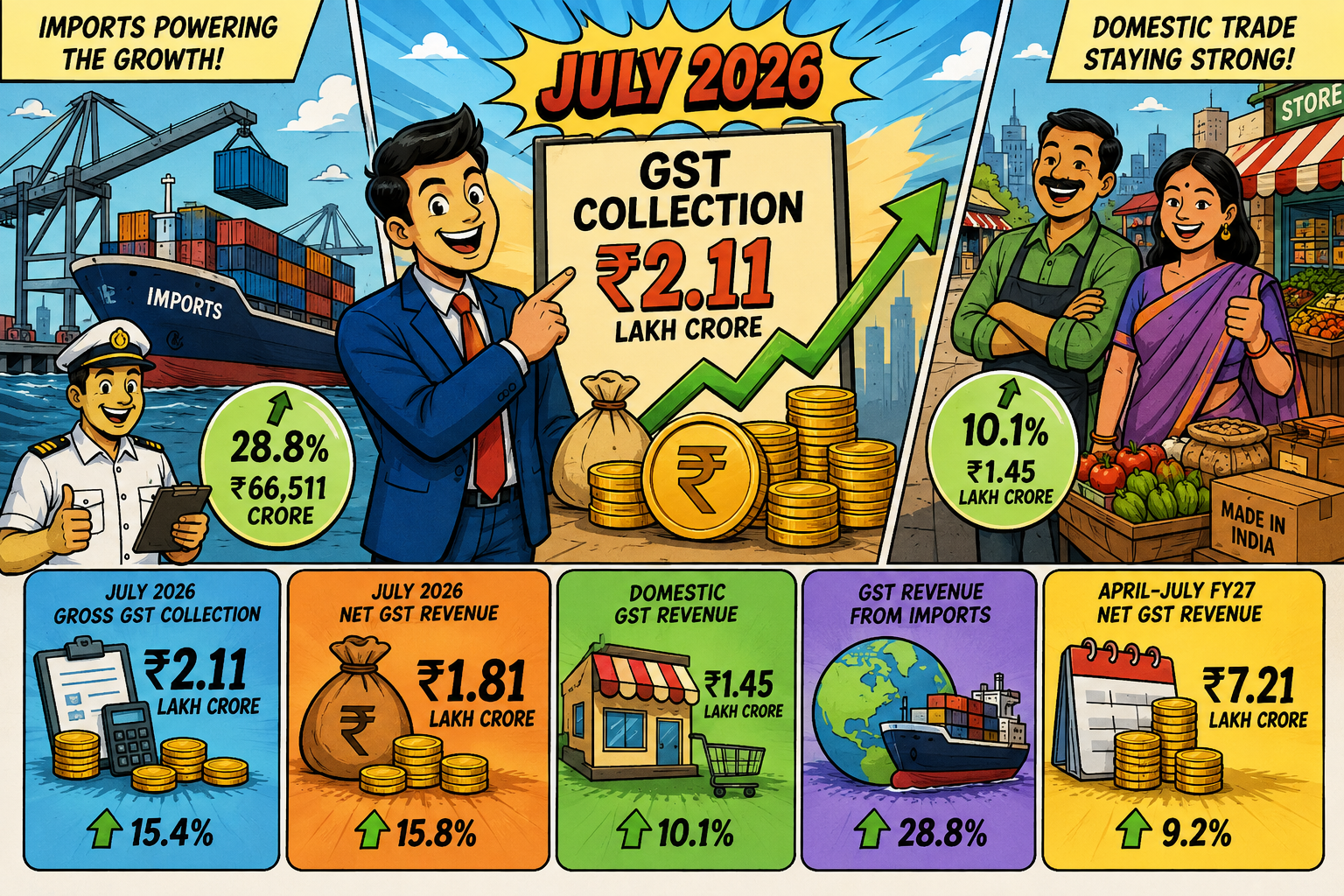
The July GST figure crossed ₹2 lakh crore due to the contributions made by both imports and domestic trade. Domestic GST collection recorded a YoY growth of 10.1%, amounting to ₹1.45 lakh crore. GST collection on imports went up by 28.8% to ₹66,511 crore. Net GST collection for July, post refunds, stood at ₹1.81 lakh crore.
A more nuanced picture is provided by the monthly breakup.
The table shows why the July number cannot be treated as a plain domestic consumption story. Domestic activity added to the rise, yes. But imports did a larger part of the work. Ports, customs-linked transactions and high-value inward shipments carried more weight in the July tax print.
For buyers, the price link may come later. A trader dealing in imported phone accessories, a workshop buying machinery spares, or a small factory using chemicals and components may see higher purchase bills before customer demand improves. Some will absorb the cost for a while. Others may pass it on in small price changes.
The last GST update had already provided cues regarding the same. In June 2026, the total gross GST collection was ₹194,812 crore, which was an increase of 13.9% over the previous year. Domestic GST collection grew by 6.5%. However, GST collection linked to imports grew by 34.6%. That made June a clearly import-heavy month.
LoansJagat had also covered the June 2026 GST trend and noted that the collection reached ₹194,812 crore, with imports carrying a major share of the growth. The LoansJagat reading fits the July update because the same pattern continued for another month. This is where the story becomes more than a one-month jump.
GST has now completed 9 years in India. In that period, the system has moved more traders, service providers and firms into formal reporting. E-invoicing, return filing, invoice matching and data checks have also reduced the space for large-scale underreporting. Revenue has improved because the tax net has become wider, not only because tax rates exist on paper.

Tax experts have read July as a good revenue month but not as a one-line celebration. Abhishek Jain, Indirect Tax Head and Partner at KPMG, treated the collections as healthy while pointing to the need to see what kind of imports drove the increase. Finished goods, raw material imports and currency-linked valuation effects all tell different stories.
Pratik Jain, partner at Price Waterhouse & Co. LLP, also pointed out that import-led GST revenues were outpacing domestic transactions. That view is relevant because domestic transactions are closer to local demand. If that side remains slower for several months, policymakers will have to separate tax revenue growth from actual demand growth.
The solution is not a decrease in imports. India needs inputs from abroad to manufacture goods, build electronics, generate power, construct infrastructure, and create production to export. The better way is to make domestic demand wider, make refunds for honest exporters quicker, reduce classification disputes, and ease filing for smaller firms. If compliance isn’t burdensome, more firms will remain within the system.
July’s GST data separates revenue strength from demand strength. A higher import GST number can come from factory inputs, machinery shipments, electronics, fuel-linked items or finished goods entering India. That helps when it feeds production. It becomes a concern when the rise is driven mainly by costlier imports.
Small manufacturers usually feel this first. A pump maker in Rajkot, a packaging unit in Noida or an electronics trader in Delhi may pay more before customers place bigger orders. Margins shrink, credit needs rise, and price revisions slowly move through wholesale markets.
So the July figure should not be read only as a victory lap for tax collections. It is also a signal for policymakers to watch local demand, input prices and refund flow together over the next 2 or 3 months.
The July GST collections denote a stable revenue stretch for the Indian government in the second quarter of FY27. The gross collection of ₹2.11 lakh crores and a 9.2% increase in the April-July GST collection period indicate the growth of tax revenue, which leads to improvements in public expenditure and state financials.
The cautious analysis is that July and the previous June recorded a higher growth rate of Imports vis-a-vis domestic GST revenue. A positive domestic GST growth in the coming months is likely to show wider growth in revenue. In case import revenue continues to play the dominant role, the front end of the revenue model may still record an impressive growth, leaving corporate revenue and consumers exposed to cost impacts.
Gross GST receipts came in at ₹2.11 lakh crore during July. It was another month above the ₹2 lakh crore level.
After refunds, collections for the first 4 months of FY27 reached ₹7.21 lakh crore. That was 9.2% higher than the same period last year.
Tax collected on imported goods rose much faster than revenue from local transactions. So, ports and overseas purchases added heavily to July’s increase.
Yes, though at a slower pace. Domestic GST revenue touched ₹1.45 lakh crore, recording 10.1% yearly growth.
June collections were ₹1,94,812 crore, up 13.9%. Imports had already been driving a sizeable part of the rise then.










.png&w=3840&q=75)


