
Disclaimer: The information published on LoansJagat is intended for general informational and educational purposes only and should not be considered financial, legal, or investment advice. Interest rates, loan terms, statistics, and other data may change over time and may vary by lender or source. Please verify the latest information and consult a qualified financial advisor or the respective Bank/NBFC before making any financial decisions.
Subscribe Now
About the author

Arshathul Afia is a journalism graduate and fintech content writer with 4+ years of experience in digital publishing and research-led writing. She has written 200+ articles covering personal finance, lending, banking, digital payments, credit, insurance, and major financial developments in India. At LoansJagat, she focuses on simplifying complex fintech news, RBI updates, loan-related changes, policy developments, and industry trends for everyday readers. Her journalism background helps her approach stories with research, context, and clarity, while her SEO experience ensures content remains discoverable and relevant. She aims to make financial news easier to understand, practical, and useful for readers across India.
Related News
Simplify All Your Loans Into One Affordable EMI

Customers Served

Debt Consolidated

1200+ Reviews

Locations in India
Club all Loans & Credit Card Bills into Single EMI

Quick Apply Loan
Consolidate your debts into one easy EMI.

Takes less than 2 minutes. No paperwork.

10 Lakhs+
Trusted Customers

2000 Cr+
Loans Disbursed

4.7/5
Google Reviews

50+
Banks & NBFCs Offers
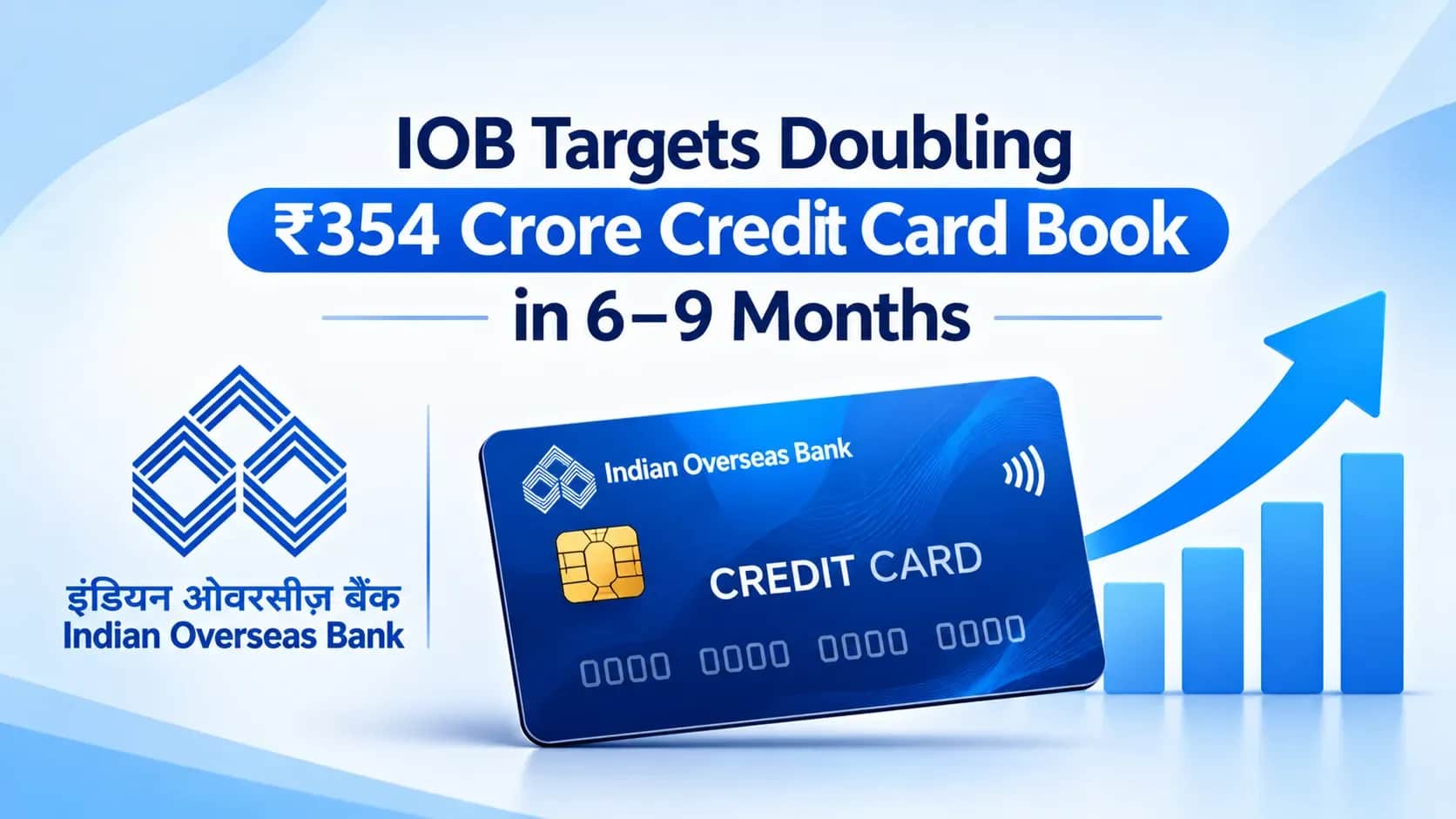
Indian Overseas Bank plans to double credit card outstandings within 6–9 months, while preparing a wealth management vertical and retaining existing checks for salaried applicants.
Key Highlights
IOB’s Managing Director and CEO Ajay Kumar Srivastava outlined the plans in an interview updated on 5 November 2026. The Chennai-based public sector lender is pursuing retail growth and customer acquisition. FY28 starts on 1 April 2027.
The outstanding credit card book measures balances across IOB’s card business. Active cards and individual sanctioned limits measure different things. Reading a bank-wide growth target as a promise to double every customer’s limit would give it a different meaning.
IOB’s published Most Important Terms and Conditions explain how individual limit changes work. Cardholders seeking an increase submit an application and financial documents declaring their income. IOB then decides whether to approve an increase under its internal credit criteria. The bank communicates sanctioned limits and available credit through card statements.
IOB’s credit card page, updated on 3 October 2026, sets a minimum monthly income of ₹15,000 for salaried applicants. The bank checks employment stability, bank statements and existing debt obligations. Net monthly income and the credit bureau score help determine the sanctioned limit. These checks link the application to the borrower’s financial position.
For IOB International Credit Cards, the published criteria specify a CIBIL score of 700 or above, or equivalent, alongside a satisfactory credit record. IOB also provides a secured-card route against term deposits for applicants without income proof. Readers comparing personal loan options for salaried employees face separate product terms; IOB’s card expansion concerns its credit card business.
Read alongside IOB’s lending criteria, the expansion target describes the bank’s business ambition. The individual borrower’s position still turns on income, existing commitments and the limit approved by IOB. Salary documentation therefore has a direct role in the application, even as the bank increases its customer acquisition activity.
Repayment deserves equal attention. IOB’s published card terms list finance charges of 2.50% a month, or 30% a year, on unpaid balances and cash advances, subject to applicable conditions. Its terms warn that paying only the minimum amount stretches repayment and adds compounded interest. For a salaried household, the relevant distinction is between credit available to spend and the outstanding amount carried into later statements.
Srivastava had discussed the wealth management proposal on 27 October 2026, before the latest interview. “We are working on it,” he said. IOB was examining inorganic opportunities and joint ventures, with discussions at an advanced stage. He indicated a possible launch at the beginning of the next financial year.
“It’s wealth management only,” Srivastava said when distinguishing the proposal from establishing an insurance entity. IOB’s insurance approach involved onboarding partners. The November update places the dedicated wealth vertical alongside the bank’s retail expansion plans, with the proposed start tied to FY28.
IOB’s card and wealth plans concern different business activities. The following table separates the current card position from the proposed expansion timetable.
The table records management’s stated plans. IOB’s individual card approval process and repayment obligations remain governed by the terms applicable to each customer.
Salaried applicants continue to face income and credit assessments, while existing cardholders seeking higher limits follow IOB’s application process. The announcement concerns expansion of the bank’s business, with separate decisions governing each borrower’s access to credit.
IOB aims to double credit card outstandings within 6–9 months. The target concerns balances across its card business.
IOB plans the dedicated vertical from the beginning of FY28. That financial year starts on 1 April 2027. Srivastava had discussed the proposal in October 2026.
IOB’s published criteria specify ₹15,000 a month for salaried applicants. Credit history, employment stability and existing debt also enter the bank’s assessment.
IOB’s published criteria include non-customers, subject to satisfactory creditworthiness and identification and address checks. A salary account alone does not determine approval.
IOB considers the credit score alongside income and other lending checks. Its published criteria assess past credit conduct and existing obligations when deciding creditworthiness.
Start your journey today
Apply Now*T&C apply











