
By continuing, you agree to LoansJagat's Credit Report Terms of Use, Terms and Conditions, Privacy Policy, and authorize contact via Call, SMS, Email, or WhatsApp
Disclaimer: The information published on LoansJagat is intended for general informational and educational purposes only and should not be considered financial, legal, or investment advice. Interest rates, loan terms, statistics, and other data may change over time and may vary by lender or source. Please verify the latest information and consult a qualified financial advisor or the respective Bank/NBFC before making any financial decisions.
Subscribe Now
About the author

Arshathul Afia
Arshathul Afia is a journalism graduate and fintech content writer with 4+ years of experience in digital publishing and research-led writing. She has written 200+ articles covering personal finance, lending, banking, digital payments, credit, insurance, and major financial developments in India. At LoansJagat, she focuses on simplifying complex fintech news, RBI updates, loan-related changes, policy developments, and industry trends for everyday readers. Her journalism background helps her approach stories with research, context, and clarity, while her SEO experience ensures content remains discoverable and relevant. She aims to make financial news easier to understand, practical, and useful for readers across India.
Related News
Simplify All Your Loans Into One Affordable EMI

Customers Served

Debt Consolidated

1200+ Reviews

Locations in India
Club all Loans & Credit Card Bills into Single EMI

Quick Apply Loan
Consolidate your debts into one easy EMI.

Takes less than 2 minutes. No paperwork.

10 Lakhs+
Trusted Customers

2000 Cr+
Loans Disbursed

4.7/5
Google Reviews

50+
Banks & NBFCs Offers
Other services mentioned in this article
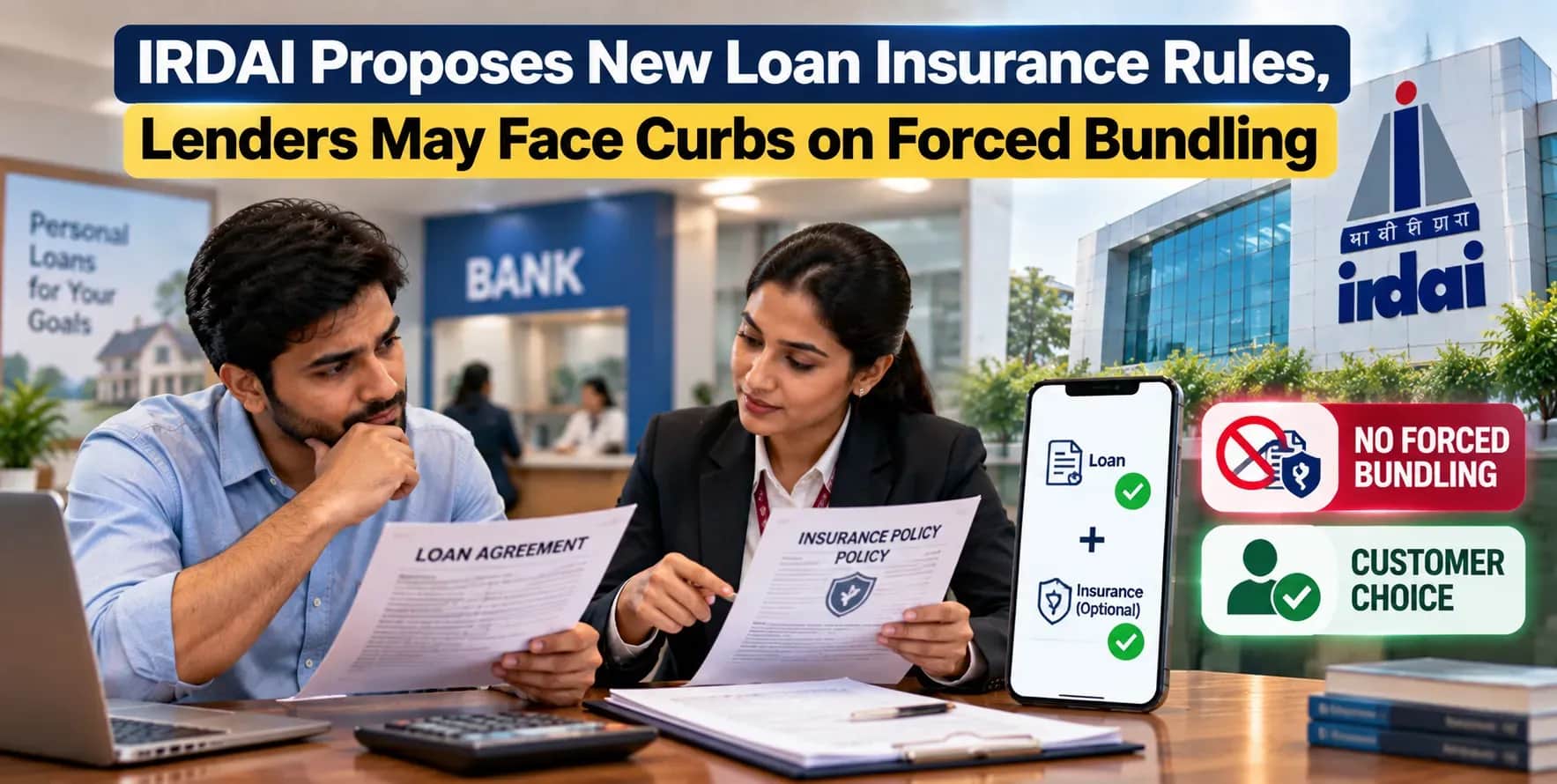
IRDAI has proposed new safeguards for loan-linked insurance that could curb forced bundling, require separate premium payments, preserve insurer choice and show borrowers loan rates with and without insurance cover.
The Insurance Regulatory and Development Authority of India released its public consultation paper, Recalibrating Economics of Insurance Distribution, on September 23, 2026. Among its proposals is a restriction on compulsory insurance bundling by banks and NBFCs registered as Insurance Distribution Entities. For a borrower, that could mean a home loan, motor loan or another credit product cannot be offered only on the condition that an insurance policy is also purchased.
The change could be felt fastest during loan processing and disbursal. Borrowers may get a better view of the interest rate with insurance and without it, along with freedom to arrange the required cover elsewhere. The downside falls largely on distribution models built around insurance cross-selling, since lower attachment of policies could affect fee income. The proposals are still under consultation, with stakeholder feedback invited until October 25, 2026.
For households, the proposal deals with a common pressure point. IRDAI has not proposed stopping lenders from offering insurance-backed loan packages altogether. Such an offer may continue where the lender can demonstrate a specific benefit for the borrower, including an interest-rate benefit linked to term-life or property protection. The customer, however, should be shown the rate available with that additional protection and the rate available without it.
Choice is another part of the proposal. A borrower should not be bound to purchase the additional cover from the bank or NBFC giving the loan. The premium should also be paid separately and directly by the customer from an account, debit card or credit card, rather than being taken from the loan amount. That distinction can help a borrower see the insurance cost before accepting it.
The consultation paper focuses on how insurance is presented during the lending process. IRDAI wants a loan and an insurance product to remain identifiable as separate financial decisions, even where both appear in the same package.
The proposed borrower-facing changes are summarised below.
The proposal on critical illness cover is narrower than a ban on health insurance. IRDAI specifically says packaging health benefit cover against critical illness with home or motor loans should be discouraged where it is likely to be cost-inefficient. Borrowers may therefore need to look at the policy itself, not simply accept the cover because it arrived beside the loan papers.
Brokerages have focused on the income impact for lenders that earn commissions by distributing insurance. On September 24, 2026, Jefferies said the proposals would be a “tad negative” for bank bancassurance fees, particularly credit-protection premiums, which are often single-premium products with higher commissions. The brokerage identified a larger earnings exposure among some private lenders while saying several public-sector banks had lower exposure.
From a borrower’s side, the proposed answer is more direct. Show both loan choices before consent, let the customer choose the insurer and keep the insurance payment outside the loan proceeds. A related LoansJagat report published on May 20, 2026, had also highlighted how insurance is often introduced around the home-loan disbursal stage, when borrowers may have little time to compare cover.
The LoansJagat view here is that rate disclosure may become the most useful borrower check if it reaches the loan offer itself. A customer can then compare the benefit offered for buying insurance against the actual premium, cover conditions and alternatives. Merely describing a policy as protection does not tell a borrower whether that particular product fits the loan.
The issue predates the 2026 consultation. On August 1, 2016, IRDAI issued circular IRDA/CAGTS/CIR/MSL/152/08/2016, titled Complaints of Mis-selling / Unfair Business Practices by Banks/NBFCs. The official circular recorded a series of policyholder complaints involving banks and NBFCs acting as corporate agents.
One complaint category was particularly relevant. IRDAI said customers approaching lenders for housing or other loans had reported compulsory insurance bundling despite expressly saying they did not want the policy. The circular referred to Regulation 21(2) of the IRDAI Registration of Corporate Agents Regulations, 2015, under which a corporate agent could not compel a customer to buy insurance.
That history makes the September 2026 paper more than a fresh warning about sales behaviour. The latest proposal describes how an insurance-linked loan package may still work but adds specific safeguards around rates, insurer choice and premium payment.
India’s broader insurance law was amended before the latest distribution consultation. Parliament passed the Sabka Bima Sabki Raksha (Amendment of Insurance Laws) Bill, 2025, on December 17, 2025. A Finance Ministry release dated December 18, 2025, said the legislation sought stronger policyholder protection, wider insurance coverage and improved regulatory oversight.
The Act received Presidential assent on December 20, 2025. Separately, the Department of Financial Services published draft rules under the amended insurance laws on July 23, 2026. These measures form part of the wider reform background. The specific loan-insurance bundling proposal, however, comes from IRDAI’s September 23, 2026 distribution consultation.
The proposed changes are not final operating rules. IRDAI has invited public and stakeholder comments until October 25, 2026 on the problems identified, objectives, proposed reforms and implementation approach.
For borrowers, the useful action remains straightforward. Loan papers should be checked for the insurance premium, who provides the policy, how it is paid and whether the quoted interest rate changes when insurance is declined or arranged independently.
IRDAI’s September 23, 2026, proposal takes a more detailed approach to loan-linked insurance. Banks and NBFCs could continue offering an insurance-backed package when it carries a demonstrable borrower benefit, but compulsory bundling would face a proposed restriction.
The larger change is at the point of consent. The borrower would see rates with and without additional cover, retain insurer choice and pay the premium separately. IRDAI had flagged forced selling with loans back in 2016. The present consultation attempts to put more specific checks around that old problem.
No. The proposal allows insurance-linked packages where there is a specific and demonstrable customer benefit, subject to borrower safeguards.
Under the proposal, the borrower should not be bound to purchase the additional insurance from the bank or NBFC providing the loan.
IRDAI proposes that the premium be paid separately by the customer and should not come from the loan proceeds.
IRDAI’s 2016 circular already prohibited corporate agents from compelling customers to buy insurance. The 2026 paper proposes further safeguards against compulsory loan-insurance bundling.
The September 2026 proposal defines compulsory bundling as providing a loan only when insurance is necessarily purchased. Borrowers should check the written sanction and loan terms.









.png&w=3840&q=75)


