
By continuing, you agree to LoansJagat's Credit Report Terms of Use, Terms and Conditions, Privacy Policy, and authorize contact via Call, SMS, Email, or WhatsApp
Disclaimer: The information published on LoansJagat is intended for general informational and educational purposes only and should not be considered financial, legal, or investment advice. Interest rates, loan terms, statistics, and other data may change over time and may vary by lender or source. Please verify the latest information and consult a qualified financial advisor or the respective Bank/NBFC before making any financial decisions.
Subscribe Now
About the author

Arshathul Afia
Arshathul Afia is a journalism graduate and fintech content writer with 4+ years of experience in digital publishing and research-led writing. She has written 200+ articles covering personal finance, lending, banking, digital payments, credit, insurance, and major financial developments in India. At LoansJagat, she focuses on simplifying complex fintech news, RBI updates, loan-related changes, policy developments, and industry trends for everyday readers. Her journalism background helps her approach stories with research, context, and clarity, while her SEO experience ensures content remains discoverable and relevant. She aims to make financial news easier to understand, practical, and useful for readers across India.
Related Blog Post
Simplify All Your Loans Into One Affordable EMI

Customers Served

Debt Consolidated

1200+ Reviews

Locations in India
Club all Loans & Credit Card Bills into Single EMI

Quick Apply Loan
Consolidate your debts into one easy EMI.

Takes less than 2 minutes. No paperwork.

10 Lakhs+
Trusted Customers

2000 Cr+
Loans Disbursed

4.7/5
Google Reviews

50+
Banks & NBFCs Offers
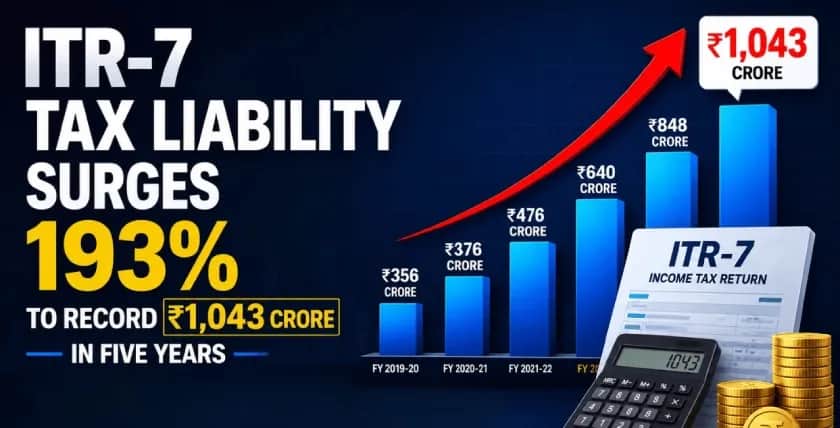
The surged ITR-7 filings report an expected tax liability of ₹1,043 crore for AY 2025–26, which is almost three times the number reported for the last five years combined by the Ministry of Finance and reported to the Parliament on Tuesday.
For AY 2025–26, trusts, parties and specified academic or research institutions reported an income tax liability of ₹1,043 crore, the ministry reported to Rajya Sabha on 11 August 2026. This is an increment of ₹687 Crore from the reported tax liability of ₹356 Crore for AY 2021–22. The Ministry has not linked this increment of tax liability to a change in tax rates.
Until pre-tax profit income is exempt, the burden of this tax will primarily fall on those organizations. A smaller trust will have relatively less money to fund scholarships or undertake other charitable activities. Over the years, the government is likely to impose tax on legitimate organizations where donations have been filed incorrectly, there are lapses in registrations, or audit reports have been filed well beyond the due dates.
The latest total was provided by Minister of State for Finance Pankaj Chaudhary in a written answer to Rajya Sabha. The response indicated that liability reported through ITR-7 increased from Rs. 356 crore in AY 2021-22 to Rs. 1,043 crore in AY 2025-26. The disclosure was made in New Delhi on 11 August 2026 and covered the entities filing under the provisions pertaining to ITR-7.
The figure does not show that every trust or university paid more tax. It combines several types of filers and offers no return count. More filers, higher taxable income, reduced exemption claims or amended returns could raise the total. Parliament has not supplied a category-wise division, so the data cannot prove widespread tax evasion.
Ordinary taxpayers do not face a higher personal tax bill because the ITR-7 total has risen. A donor’s 80G deduction also does not disappear due to the ₹1,043 crore figure. The filing institution must show valid registration, approved spending and figures that match its audit report.
An indirect impact is possible. If an exemption is denied, a charitable hospital, school or relief organisation may have less money for services. Better compliance can help too. Donors get stronger records, beneficiaries gain protection against misuse, and genuine institutions hold better evidence during a tax check.
Tax advisers generally start with registration and audit records. A trust should confirm its Section 12A or 12AB status, check the purpose for which each payment was made and reconcile donation entries with bank statements. Institutions covered by audit rules must select Form 10B or Form 10BB correctly. The official Income Tax Department guidance, updated on 27 May 2026, says ITR-7 applies to persons filing under Sections 139(4A), 139(4B), 139(4C) and 139(4D).
Institutions should review their approval period, complete the audit before the cut-off and keep proof for donations, spending and accumulated income. Educational and medical bodies should also check Section 10(23C). A LoansJagat explanation of Section 10(23C) provides a practical overview. From a borrower-focused LoansJagat view, the update does not alter personal loan rates or household EMIs. It concerns institutional tax compliance.
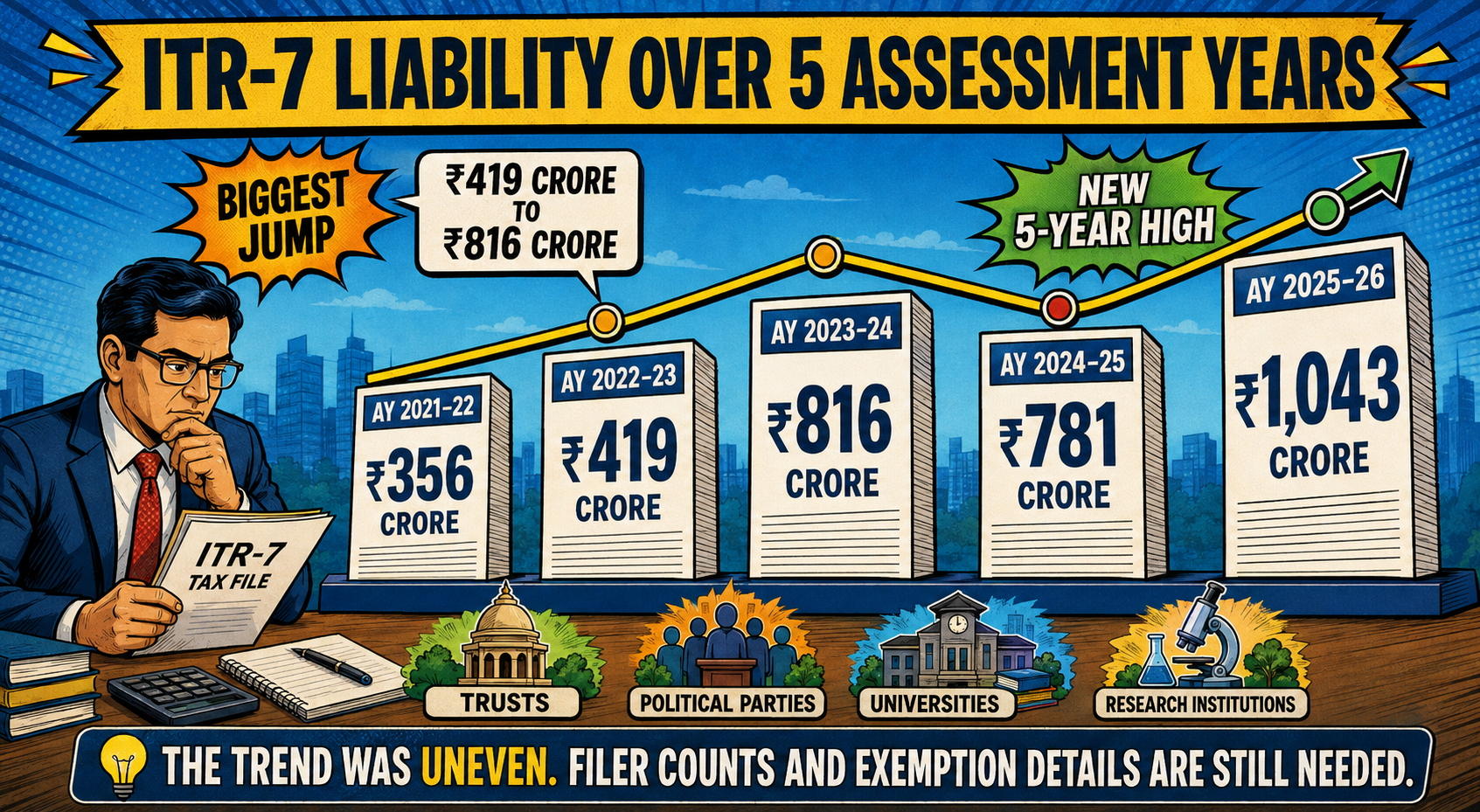
The official sequence does not show a smooth yearly rise. Liability increased moderately in AY 2022–23, jumped in AY 2023–24, declined in the following year and then crossed ₹1,000 crore. The table keeps the government’s figures in their reported form.
The largest movement came between AY 2022–23 and AY 2023–24, when the total rose from ₹419 crore to ₹816 crore. It then fell by ₹35 crore before rising again. These movements show why one broad explanation would be weak. The data needs filer counts and exemption details before the cause can be identified.
The earlier disclosure came through Lok Sabha Unstarred Question No. 4981, titled “Tax Exemption to Religious Institutions.” MP Anil Yeshwant Desai asked whether religious institutions were exempt and sought their tax details. The Finance Ministry answered the question on 23 March 2026. It reported ₹1,041 crore of ITR-7 liability for AY 2025–26, based on records available up to 31 January 2026.
The later Rajya Sabha total is ₹2 crore higher. That small addition appears to reflect information recorded after the January cut-off, although the government did not give a reason for the revision. The March response also provided a 10-year series beginning with AY 2016–17. The latest ₹1,043 crore figure is the highest within that period.
This comparison adds something the headline alone misses. Most of the latest liability had already appeared in the January data. The August disclosure updated the final amount rather than revealing a sudden ₹687 crore increase during 2026. The 193% rise developed across 5 assessment years.
Pankaj Chaudhary told Parliament that income from property held wholly for charitable or religious purposes may receive exemption when the institution meets the prescribed conditions. Eligible trusts must hold the required registration and apply income according to Sections 11 and 12 of the Income Tax Act, 1961. If those conditions fail, or Section 13 applies, part of the income can become taxable.
Political parties file under Section 139(4B), while Section 139(4C) covers specified organisations such as research associations and certain institutions. Section 139(4D) applies to universities, colleges and other bodies referred to under Section 35. Filing ITR-7 records the institution’s income, exemptions and tax calculation. It does not guarantee that every amount entered in the return will receive an exemption.
Jainik Vakil, chairman of the Gujarat Chamber of Commerce and Industry’s direct tax committee, raised a related concern in September 2025. He said repeated registration requirements could produce avoidable hardship and unintended tax risks for genuine charities. His comment dealt with Section 12AB registration periods, not the ₹1,043 crore update. Yet it explains why procedural failures can become expensive even when an institution continues its charitable work.
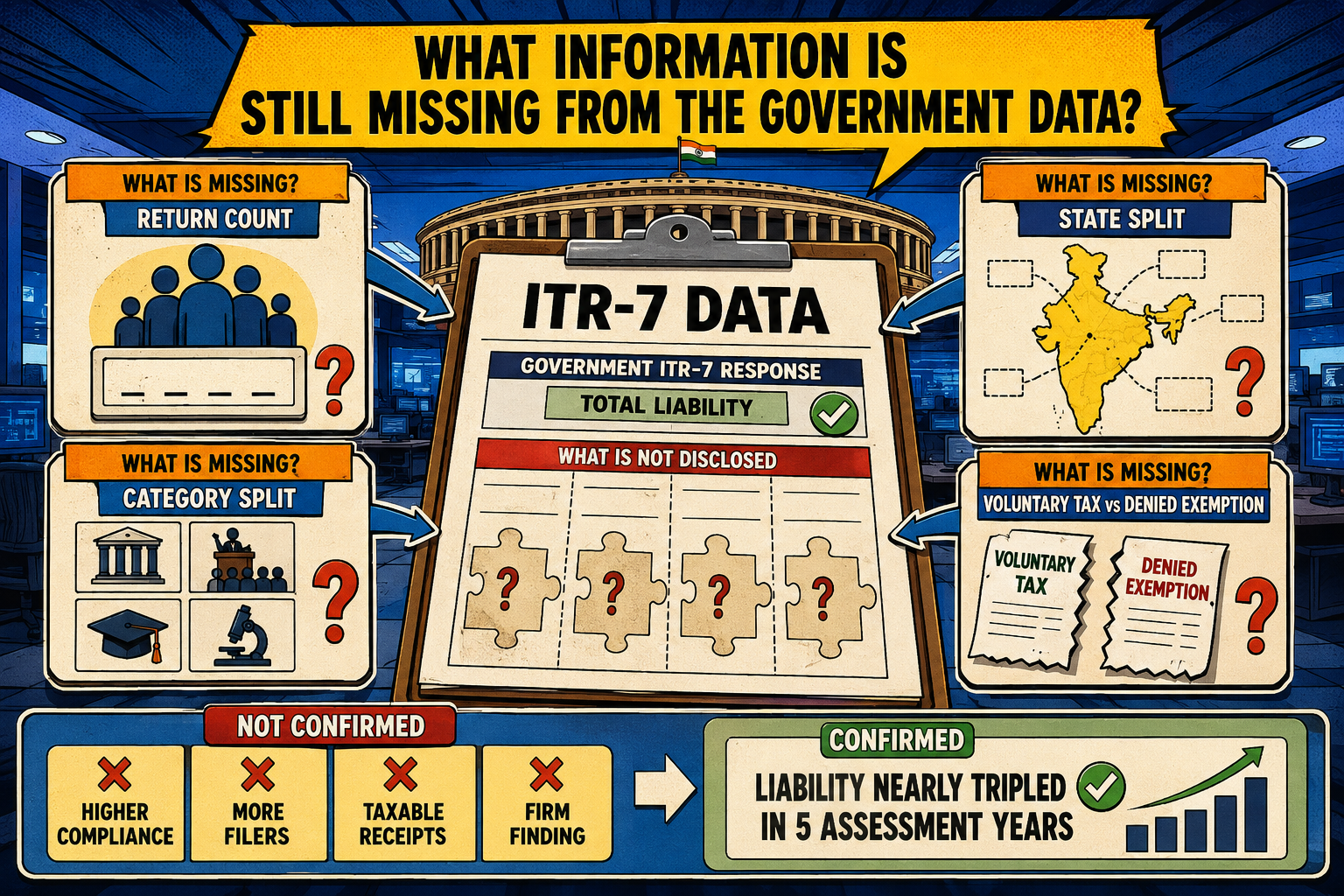
The response does not disclose how many returns produced the ₹1,043 crore total. It gives no state division or separate amount for trusts, political parties, universities and research institutions. It also does not separate voluntarily declared tax from liability after a denied exemption.
Those gaps restrict the conclusions that can be drawn. Higher compliance, additional filers and growth in taxable receipts are all possible reasons. None has been confirmed. A category-wise release would show whether the rise is broad or concentrated among a small number of large institutions. Until then, the data supports one firm finding: combined declared liability nearly tripled in 5 assessment years.
The tax liability for ITR-7 rose to a record high of Rs. 1,043 crores in AY 2025–26, compared to Rs. 356 crores in AY 2021–22, a 193% jump. The latest reply by the Rajya Sabha just confirms the magnitude of the surge but does not name the companies or the reasons behind the surge.
For ITR-7 filers, the useful response is practical. Registrations should remain valid, audit forms should match the case, and every exemption claim needs records behind it. For the public, the figure points to greater tax exposure among specified institutions, though it does not change personal tax rates or borrowing costs. More specific government data is needed to determine if the recent increase is attributable to enforcement, more people working, or an increase in exemption failures.
ITR-7 is used by specified trusts, political parties, research bodies, universities, colleges and other eligible institutions.
No. It is a combined declared liability across ITR-7 filers and does not provide organisation-wise tax payments.
Tax may apply when income falls outside an exemption or the trust fails prescribed registration, spending, audit or filing conditions.
No direct change follows. The update does not revise individual tax rates, lending rates, loan instalments or 80G rules.
The Finance Ministry reported ₹1,041 crore up to 31 January 2026 before the total reached ₹1,043 crore.








.png&w=3840&q=75)


