

By continuing, you agree to LoansJagat's Credit Report Terms of Use, Terms and Conditions, Privacy Policy, and authorize contact via Call, SMS, Email, or WhatsApp
Disclaimer: The information published on LoansJagat is intended for general informational and educational purposes only and should not be considered financial, legal, or investment advice. Interest rates, loan terms, statistics, and other data may change over time and may vary by lender or source. Please verify the latest information and consult a qualified financial advisor or the respective Bank/NBFC before making any financial decisions.
Subscribe Now
About the author

Arshathul Afia
Arshathul Afia is a journalism graduate and fintech content writer with 4+ years of experience in digital publishing and research-led writing. She has written 200+ articles covering personal finance, lending, banking, digital payments, credit, insurance, and major financial developments in India. At LoansJagat, she focuses on simplifying complex fintech news, RBI updates, loan-related changes, policy developments, and industry trends for everyday readers. Her journalism background helps her approach stories with research, context, and clarity, while her SEO experience ensures content remains discoverable and relevant. She aims to make financial news easier to understand, practical, and useful for readers across India.
Related News
Simplify All Your Loans Into One Affordable EMI

Customers Served

Debt Consolidated

1200+ Reviews

Locations in India
Club all Loans & Credit Card Bills into Single EMI

Quick Apply Loan
Consolidate your debts into one easy EMI.

Takes less than 2 minutes. No paperwork.

10 Lakhs+
Trusted Customers

2000 Cr+
Loans Disbursed

4.7/5
Google Reviews

50+
Banks & NBFCs Offers
India’s Income Tax Department says non-audit social media creators reporting business or professional income must file AY 2026-27 returns by August 31, 2026, to avoid penalties.
YouTubers, Instagram influencers, podcasters and other Indian creators who regularly earn from content now face a filing job. AdSense receipts, brand fees, affiliate commissions, memberships, merchandise income and digital products can fall under “Profits and Gains of Business or Profession." For FY 2025-26, reported in AY 2026-27, the due date is August 31, when the creator is not liable for tax audit. This is an India-wide date, not a platform deadline.
Missing the date can bring a late fee of ₹1,000 where total income does not exceed ₹5 lakh and ₹5,000 in other cases, plus interest where tax remains unpaid. A belated return can generally be filed by December 31, 2026, or before assessment is completed, whichever comes first. Poor records may also weaken a loan file, create TDS disputes and leave foreign receipts or barter deals unexplained.
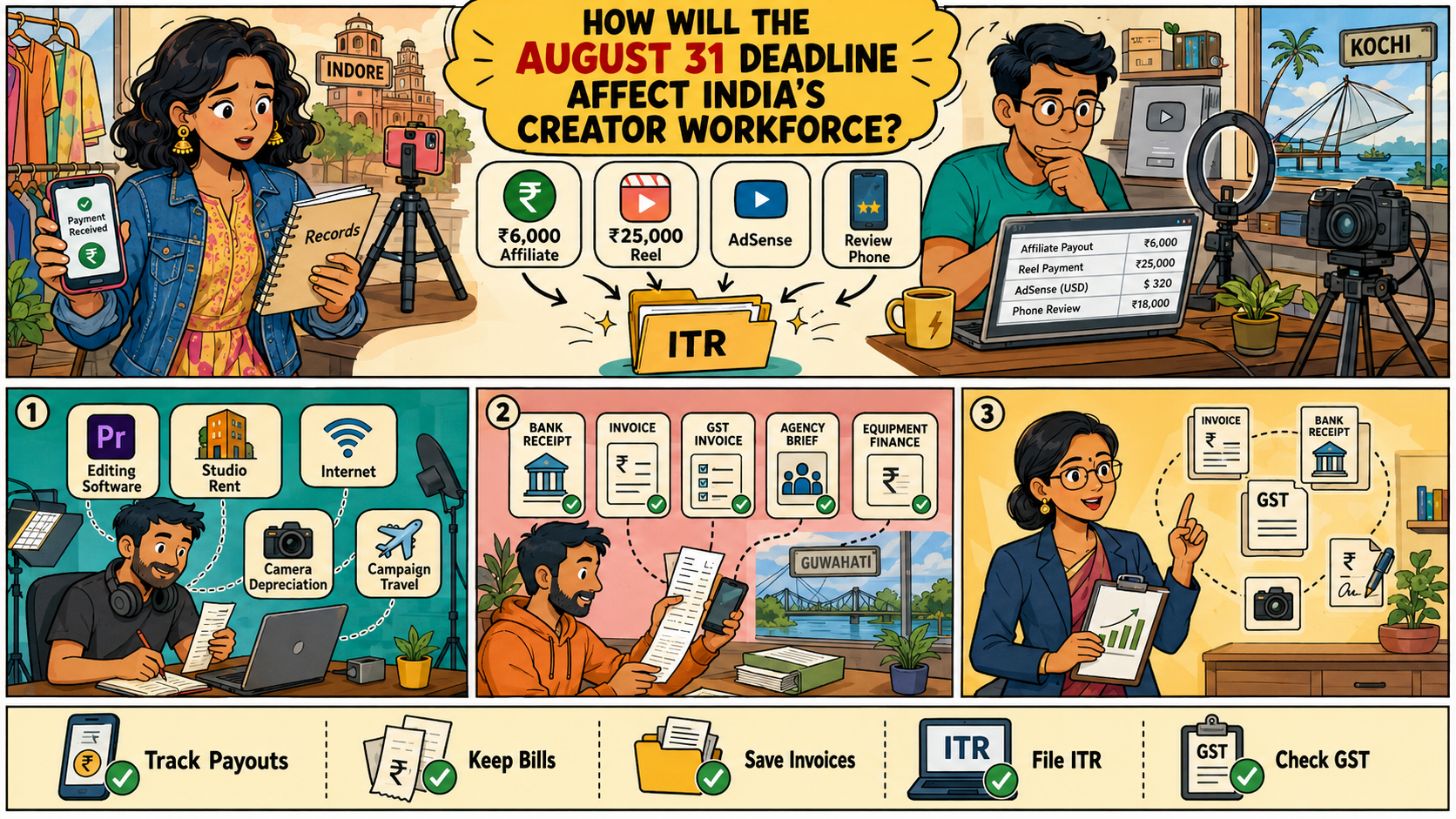
For small creators, the deadline pushes casual tracking towards basic business records. A ₹6,000 affiliate payout, a ₹25,000 Reel, foreign AdSense and a retained review phone may arrive through different channels. All can affect the return. Recording each item also helps creators claim genuine costs such as editing software, studio rent, internet charges, camera depreciation and campaign travel, backed by proof.
Regular invoices, banked receipts and filed returns also build an income trail. A creator in Indore, Kochi or Guwahati may not have a salary slip, but properly reported income can show earning continuity when agencies demand GST invoices or equipment finance is needed.
ITR-3 normally applies to an individual or Hindu Undivided Family with business or professional income who cannot use ITR-1, ITR-2 or ITR-4. It reports actual income, eligible expenses, depreciation and other income heads. A creator with capital gains, foreign assets, foreign-source income or carried-forward losses should examine ITR-3 instead of forcing a shorter form.
ITR-4, or Sugam, is optional. It is available to eligible resident individuals, HUFs and resident firms other than LLPs with total income up to ₹50 lakh and qualifying presumptive income. Short-term capital gains, foreign assets and foreign-source income can block its use. The snapshot below separates the main filing checks.
Classification is the difficult part. Section 44AD generally deems 8% of eligible business receipts as income, reduced to 6% for qualifying digital receipts, subject to limits and exclusions. Those are presumptive levels, not a universal influencer tax rate. Commission or brokerage is excluded from Section 44AD, so affiliate earnings need separate review. Section 44ADA covers only notified professions. Social media creation is not automatically one of them.
Cash is only one form of creator income. CBDT Circular No. 12/2022, issued on June 16, 2022, explains Section 194R. A product returned after promotion should not be treated as a benefit under this provision. If the influencer keeps it, the brand may need to deduct 10% TDS once the annual value threshold of ₹20,000 is crossed.
Creators should record the product, value, campaign agreement and return status. They should compare deductions with AIS and Form 26AS. TDS is a credit, not the final income figure. If a brand deducts tax from ₹1 lakh but the creator reports only the ₹90,000 bank receipt, income is understated and the payer’s record will not match.
Read Also:
According to Circular No. 177/09/2022-TRU, dated August 3, 2022, service providers are required to obtain registration when aggregate turnover for a financial year exceeds ₹20 lakhs. For special category states, it is ₹10 lakhs. Generally, domestic advertising and promotional services are chargeable to GST of 18% upon registration, subject to the contract and the place of supply being examined.
Payments from YouTube, an overseas brand or a foreign platform are not export income by default. Export treatment depends on the supplier, recipient, place of supply, permitted foreign exchange and other statutory conditions. A registered creator may furnish a letter of Undertaking and export services without paying integrated tax. Bank remittance papers, contracts and invoices should support the claim.
A creator may receive 4 or 5 kinds of income in one month, while each platform and agency follows a different payment cycle. The creator’s concern is missing a small receipt. The tax adviser’s concern is classification. A brand faces a separate job when it deducts and reports TDS. One working ledger must connect each invoice, gross receipt, deduction and bank credit before the return is prepared.
The LoansJagat view is that a creator should build one monthly income sheet before filing, rather than start with the ITR form. Each row should identify the payer, gross amount, TDS, GST treatment, receipt date and invoice number. That simple step exposes missing credits early and produces a usable earning record for future borrowing. Where affiliate commissions, foreign assets, large barter deals or presumptive taxation are involved, a chartered accountant should review the classification before submission.
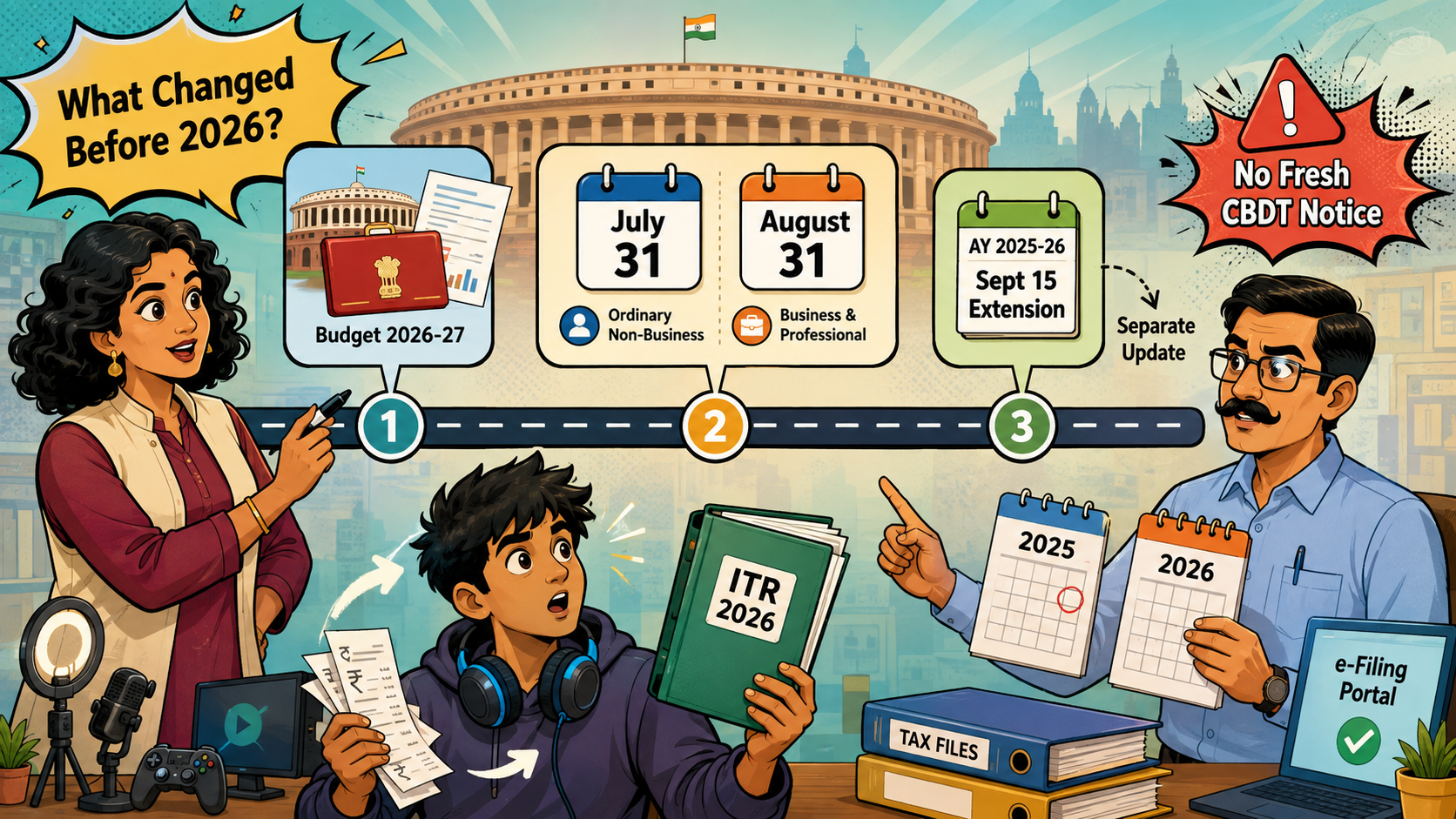
The present schedule grew out of the Union Budget 2026-27. In its February 1, 2026 summary, the Press Information Bureau said return timelines would be staggered. Ordinary non-business returns retained the July 31 date, while applicable non-audit business and professional returns moved to August 31. The change gave creators and other self-employed taxpayers another month to collect business records, but it also created confusion among people who assumed every individual still had the same date.
The previous filing season followed a different course. On May 27, 2025, CBDT extended the AY 2025-26 due date from July 31 to September 15 because of extensive ITR changes, system readiness and the rollout of utilities. That past extension does not shift the current deadline. As of August 20, 2026, creators covered by the non-audit date should work on August 31 unless CBDT issues a fresh notification.
The August 31 deadline is a filing date, but the real job begins with collecting the full year’s creator income. Platform payouts, sponsorships, affiliate commissions and retained products need one reconciled record, followed by the correct ITR and a separate GST review. Creators who finish that work before submitting can avoid mismatches now and carry a stronger income trail into later brand contracts, credit applications and business growth.
August 31, 2026, applies to FY 2025-26 income reported in AY 2026-27 where a creator has applicable business or professional income and no tax audit requirement. Audit cases generally follow October 31, 2026.
ITR-3 is the regular choice for business or professional income. ITR-4 is available only to an eligible resident taxpayer using a permitted presumptive scheme and meeting every income, status and disclosure condition.
A product retained after promotional use can be a taxable business receipt and may attract Section 194R TDS. A product returned to the brand after use is treated differently under CBDT’s June 16, 2022 guidance.
Business use can support a deduction, often through depreciation rather than a full immediate claim. Personal use must be separated, and the creator should retain invoices, payment proof and an asset record.
Foreign payment alone does not settle the issue. The creator must review aggregate turnover, compulsory-registration rules and whether every export-of-services condition is met. LUT and remittance documents may also be needed after registration.









.png&w=3840&q=75)


