
By continuing, you agree to LoansJagat's Credit Report Terms of Use, Terms and Conditions, Privacy Policy, and authorize contact via Call, SMS, Email, or WhatsApp
Disclaimer: The information published on LoansJagat is intended for general informational and educational purposes only and should not be considered financial, legal, or investment advice. Interest rates, loan terms, statistics, and other data may change over time and may vary by lender or source. Please verify the latest information and consult a qualified financial advisor or the respective Bank/NBFC before making any financial decisions.
Subscribe Now
About the author

Arshathul Afia
Arshathul Afia is a journalism graduate and fintech content writer with 4+ years of experience in digital publishing and research-led writing. She has written 200+ articles covering personal finance, lending, banking, digital payments, credit, insurance, and major financial developments in India. At LoansJagat, she focuses on simplifying complex fintech news, RBI updates, loan-related changes, policy developments, and industry trends for everyday readers. Her journalism background helps her approach stories with research, context, and clarity, while her SEO experience ensures content remains discoverable and relevant. She aims to make financial news easier to understand, practical, and useful for readers across India.
Related News
Simplify All Your Loans Into One Affordable EMI

Customers Served

Debt Consolidated

1200+ Reviews

Locations in India
Club all Loans & Credit Card Bills into Single EMI

Quick Apply Loan
Consolidate your debts into one easy EMI.

Takes less than 2 minutes. No paperwork.

10 Lakhs+
Trusted Customers

2000 Cr+
Loans Disbursed

4.7/5
Google Reviews

50+
Banks & NBFCs Offers
According to the Income Tax Department, taxpayers who receive a notice after filing in 2026 should check its section, deadline and DIN before replying online.
For a taxpayer waiting on a refund, the immediate problem is delay. Ignoring the communication may lead to a harder outcome. A defective return can become invalid, or a demand can continue to collect interest. The section printed on the document decides the next move. Guesswork does not help.
Before replying, the taxpayer needs to find what the department has questioned. This short review can prevent an unnecessary revision or missed date.
For a salaried worker in Pune, TDS may appear in Form 16 but remain missing from Form 26AS. A retired teacher in Jaipur could report interest from 1 bank while overlooking another deposit. Small traders may select the wrong ITR form. Each situation needs a different fix.
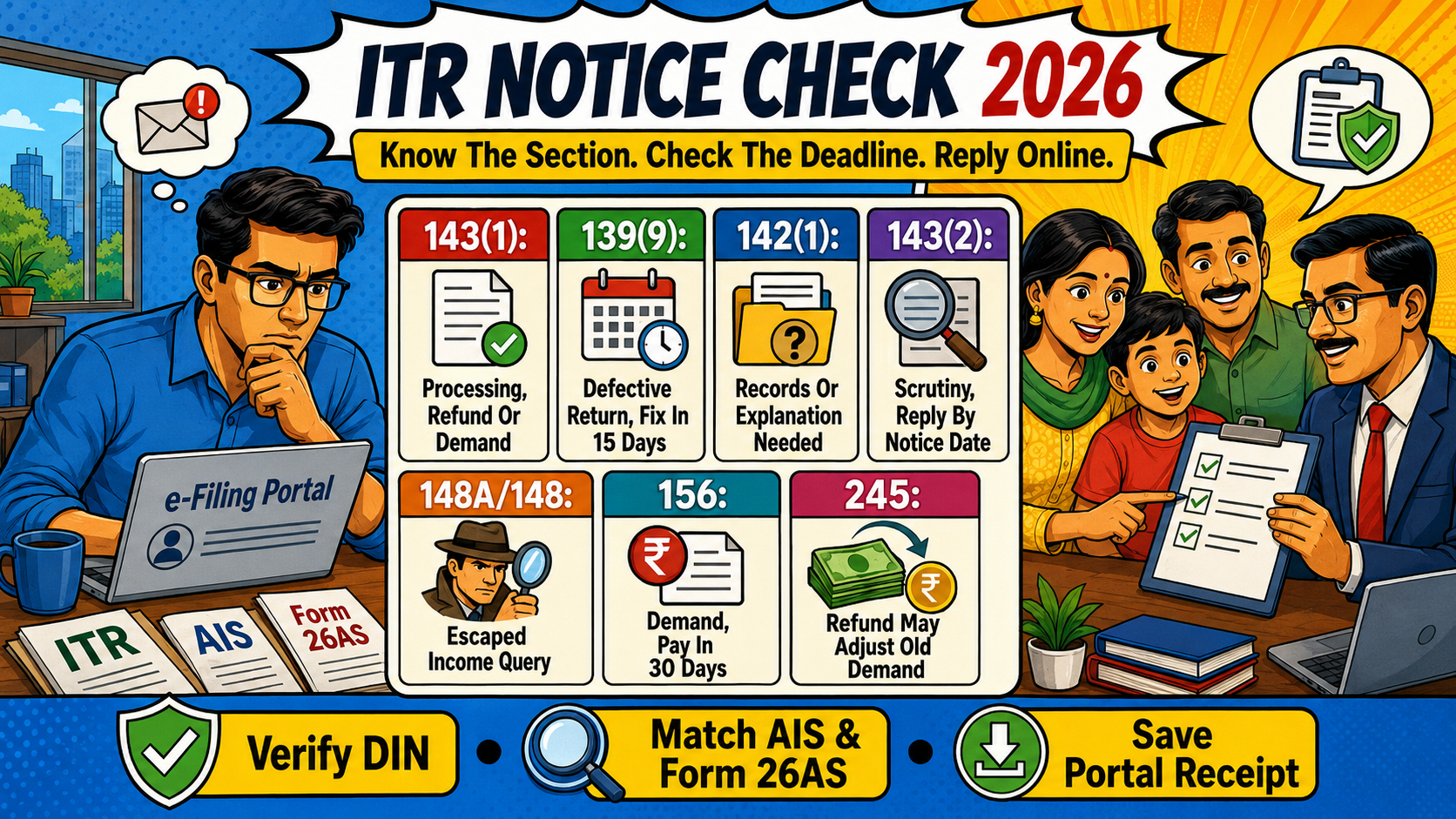
The table below sorts the common communications by purpose and response. If the date printed on the taxpayer’s notice differs from a general timeline, the date on that document should be followed.
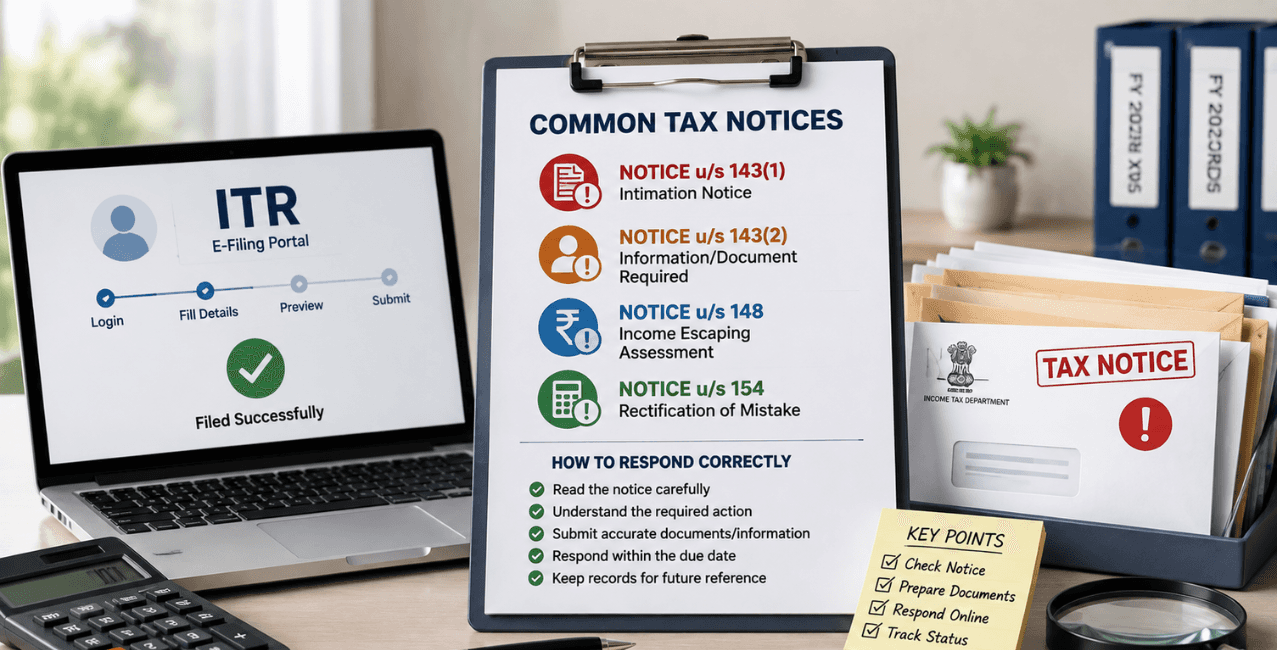
Most replies now move through the portal, saving travel and leaving a dated trail. A Section 143(1) intimation showing no change may need nothing further. Sections 143(2) and 148 need records arranged around the questions raised.
Tax advisers start with the source of the disputed figure. An unfamiliar AIS interest entry could belong to a joint account, appear twice or carry the wrong period. Bank statements and Form 26AS should be checked before changing the ITR. A wrong entry may need AIS feedback. Genuinely missed income may need correction.
Sometimes a bank or employer must revise its TDS statement. A CPC calculation error may qualify for rectification under Section 154. For scrutiny, an issue-wise reply works better than unexplained files. The LoansJagat report published on August 6, 2026 flags missed FD interest, unsupported deductions, the wrong ITR form and AIS differences as filing risks.
A useful way to read a notice is in 3 passes. Pass 1 checks identity: PAN, assessment year and DIN. Pass 2 traces the disputed number to CPC, an employer, a bank or another reporting entity. Pass 3 chooses the remedy. That may be correction, rectification, payment, disagreement or appeal. Many poor responses begin at pass 3, before anyone has found where the disputed figure came from.
The notice can surface during a loan application. Banks and NBFCs review ITRs for home, business and larger personal loans. A pending demand does not prove fraud or repayment trouble, but it can prompt another question. A challan, rectification receipt or submitted reply gives the applicant a dated record. A verbal assurance carries less weight.
India’s new direct-tax law took effect on April 1, 2026, while the present return cycle covers income earned earlier. AY 2026–27 and older proceedings continue under the Income-tax Act, 1961. Current documents can therefore refer to Sections 139(9), 142(1), 143(2), 148 and 156.
Verification remains another source of trouble. Uploading the return is only part of filing. The taxpayer must complete electronic verification or send ITR-V within the permitted period. CPC generally takes up the return after valid verification. An ITR waiting for verification should not be confused with one that has been processed and adjusted.
Employers, banks, brokers and property-reporting entities send transaction information to the department. CPC compares salary, interest, securities and property entries with the ITR. This can find omissions, though reporting entities also make mistakes. An unfamiliar AIS figure needs checking.
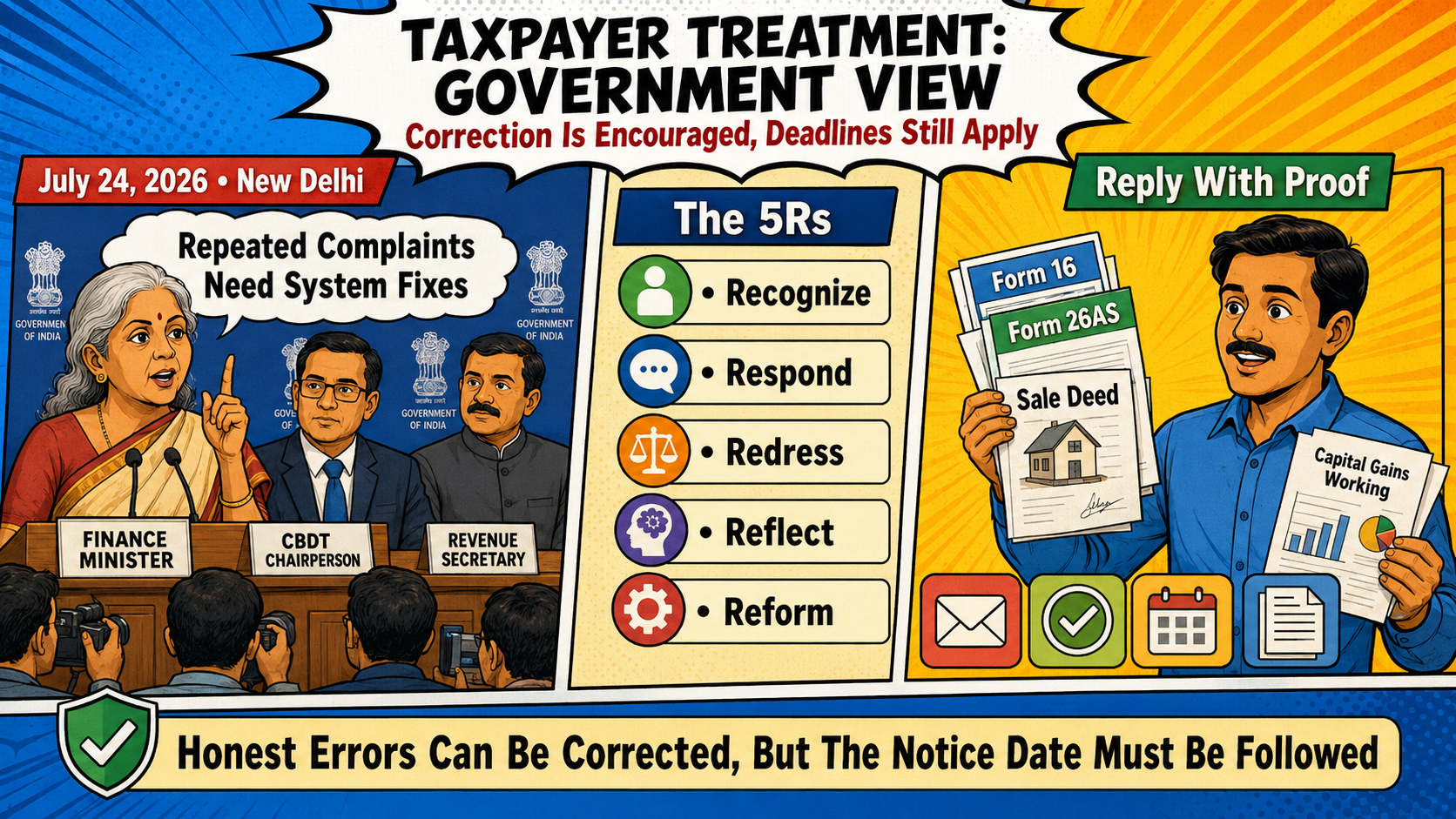
Finance Minister Nirmala Sitharaman spoke at the 167th Income Tax Day function in New Delhi on July 24, 2026. According to the Press Information Bureau, she urged the department to consider the systemic issues behind repeated taxpayer complaints rather than closing each complaint as a separate case.
The 5Rs: Recognize, Respond, Redress, Reflect and Reform were also discussed. The focus should be on providing honest taxpayers the ability to correct their own mistakes. CBDT Chairman Ravi Agrawal and Revenue Secretary Arvind Shrivastava spoke about the need for quicker processes and diminishing litigation. Easier litigation was discussed by the chairman of CBDT.
That policy tone favours correction where an error is genuine. It does not cancel a response date. When CPC questions TDS, Form 16 and the relevant Form 26AS entry should go with the reply. A property-sale query calls for the sale deed, acquisition cost and capital-gains working. A response earns attention when it answers the transaction named in the notice.
The section number tells a taxpayer what sort of income tax communication has arrived. Section 143(1) may only confirm processing. Section 139(9) asks for a defect to be removed. Sections 143(2) and 148 go further, and a Section 156 demand cannot be left unread while interest builds.
The practical route is short. Authenticate the document, read its annexures, trace every questioned figure and submit the right response before expiry. Cases involving foreign assets, reassessment, unexplained bank credits or a large demand may need help from a tax professional. Whatever route is chosen, the taxpayer should retain the final reply and portal receipt.
No. Where CPC accepts the filed figures and requests no action, the taxpayer usually has nothing to submit.
Yes. Processing and refund under Section 143(1) do not block a valid Section 143(2) notice later.
Section 139(9) generally allows 15 days from receipt, unless the communication provides another date.
Yes. AIS feedback can be submitted, backed by records from the bank, broker, employer or other reporting entity.
It may help with scrutiny, reassessment, foreign assets, unexplained credits or a sizable disputed demand.









.png&w=3840&q=75)


