

By continuing, you agree to LoansJagat's Credit Report Terms of Use, Terms and Conditions, Privacy Policy, and authorize contact via Call, SMS, Email, or WhatsApp
Disclaimer: The information published on LoansJagat is intended for general informational and educational purposes only and should not be considered financial, legal, or investment advice. Interest rates, loan terms, statistics, and other data may change over time and may vary by lender or source. Please verify the latest information and consult a qualified financial advisor or the respective Bank/NBFC before making any financial decisions.
Subscribe Now
About the author

Arshathul Afia
Arshathul Afia is a journalism graduate and fintech content writer with 4+ years of experience in digital publishing and research-led writing. She has written 200+ articles covering personal finance, lending, banking, digital payments, credit, insurance, and major financial developments in India. At LoansJagat, she focuses on simplifying complex fintech news, RBI updates, loan-related changes, policy developments, and industry trends for everyday readers. Her journalism background helps her approach stories with research, context, and clarity, while her SEO experience ensures content remains discoverable and relevant. She aims to make financial news easier to understand, practical, and useful for readers across India.
Related News
Simplify All Your Loans Into One Affordable EMI

Customers Served

Debt Consolidated

1200+ Reviews

Locations in India
Club all Loans & Credit Card Bills into Single EMI

Quick Apply Loan
Consolidate your debts into one easy EMI.

Takes less than 2 minutes. No paperwork.

10 Lakhs+
Trusted Customers

2000 Cr+
Loans Disbursed

4.7/5
Google Reviews

50+
Banks & NBFCs Offers
Eligible non-audit business and professional taxpayers have until August 31, 2026, to file AY 2026-27 returns, while late filing can trigger fees, interest and restrictions.
India’s next major income tax return deadline falls on August 31, 2026. It applies to eligible taxpayers with profits or gains from business or profession whose accounts are not required to be audited, along with partners of qualifying non-audit firms and specified spouse cases. The rule covers AY 2026-27, linked to income earned in FY 2025-26. The Income Tax Department’s Return of Income guidance lists August 31 for this category. Most ordinary ITR-1 and ITR-2 taxpayers had July 31 as their regular date.
For small businesses, consultants, freelancers and some market traders, the extra month gives more time to reconcile invoices, TDS credits, AIS entries and broker reports. The downside begins after the applicable due date. A belated return remains available, but late fees, interest on unpaid tax and restrictions on specified loss carry-forward can follow. For a trader or business owner reporting a sizable loss, the future tax impact may exceed the late fee itself.
The August date depends on income and audit status. A doctor using an eligible presumptive route, a consultant, a small proprietor or a partner in a non-audit firm may qualify. A salaried person with regular F&O income can also move into a business-income return category. The ITR form alone does not decide the deadline.
The due-date split below shows why taxpayers should identify their category before filing. Someone who should have filed by July 31 cannot adopt August 31 because another taxpayer uses ITR-3 or ITR-4.
Income Tax Department guidance gives similar examples. A doctor using Section 44ADA gets August 31 where an audit is not required. A non-audit partnership firm and its partner can also fall under August 31.
Missing August 31 does not preclude completion of the AY 2026-27 filing process. Section 139(4) permits a filing of a return by December 31, 2026, or before the assessment is completed, whichever is earlier. The Section 234F fee is Rs. 1,000 where total income is less than or equal to Rs. 5,00,000 and Rs. 5,000 in other cases. In the event of a failure to pay tax, Section 234A can levy interest of 1% for each month or part of a month for which the tax is unpaid.
Losses can create a bigger problem. Income Tax Department guidance says a loss other than house-property loss generally cannot be carried forward when the return is not filed within the prescribed time. This can affect specified business and capital losses. LoansJagat’s August 6 report on the AY 2026-27 belated ITR window highlights the practical risk: a ₹5,000 fee may be smaller than the future tax cost where an eligible carry-forward benefit is lost.
The extra month helps taxpayers with records from several places. A freelancer may receive payments from many clients, an F&O trader may need broker-ledger calculations, and a salaried consultant can have salary and professional receipts.
Taxpayers can use the remaining period to compare AIS, Form 26AS, bank statements, GST returns where applicable, broker records and tax challans. The return also needs verification after filing. Waiting until the final evening leaves little room if a challan is missing, a bank account needs validation or the taxpayer discovers that another ITR form is required.
According to The Economic Times, freelancers should reconcile receipts with bank statements and invoices and GST returns, where they have been registered, said Deloitte India Partner Divya Baweja on August 17, 2026. She also advised F&O and intraday traders to match turnover, profit or loss calculations and brokerage statements with return disclosures. That is useful advice for taxpayers with several income streams because mismatched records can lead to queries or slower processing.
Chartered accountant Suresh Surana, quoted in the same report, advised taxpayers to ensure salary figures match employer disclosures and freelance receipts line up with TDS reported by clients. He also said F&O and intraday equity transactions should be identified separately. The workable approach before August 31 is to classify income first, reconcile the supporting records, pay any balance tax and then submit and verify the return.
The staggered timetable was introduced in the Union Budget 2026-27 by Finance Minister Nirmala Sitharaman on February 1, 2026. The Press Information Bureau’s budget summary released on the same day stated that timelines for filing taxes were to be staggered. The budget also proposed extending the deadline for submitting a revised return from December 31 to March 31, along with a prescribed fee in such situations.
The changes were adopted by Parliament later during the Finance Act, 2026. After obtaining the President's assent, the Ministry of Law and Justice published the Finance Act, 2026, No. 4 of 2026, on March 30, 2026. Consequently, 31 August falls under the framework for such filings. This is not a provision for a temporary filing extension due to traffic on the portal.
AY 2026-27 also falls during a tax-law transition. The Income Tax Act, 2025, came into force from April 1, 2026, but returns for FY 2025-26 remain governed by the Income Tax Act, 1961.
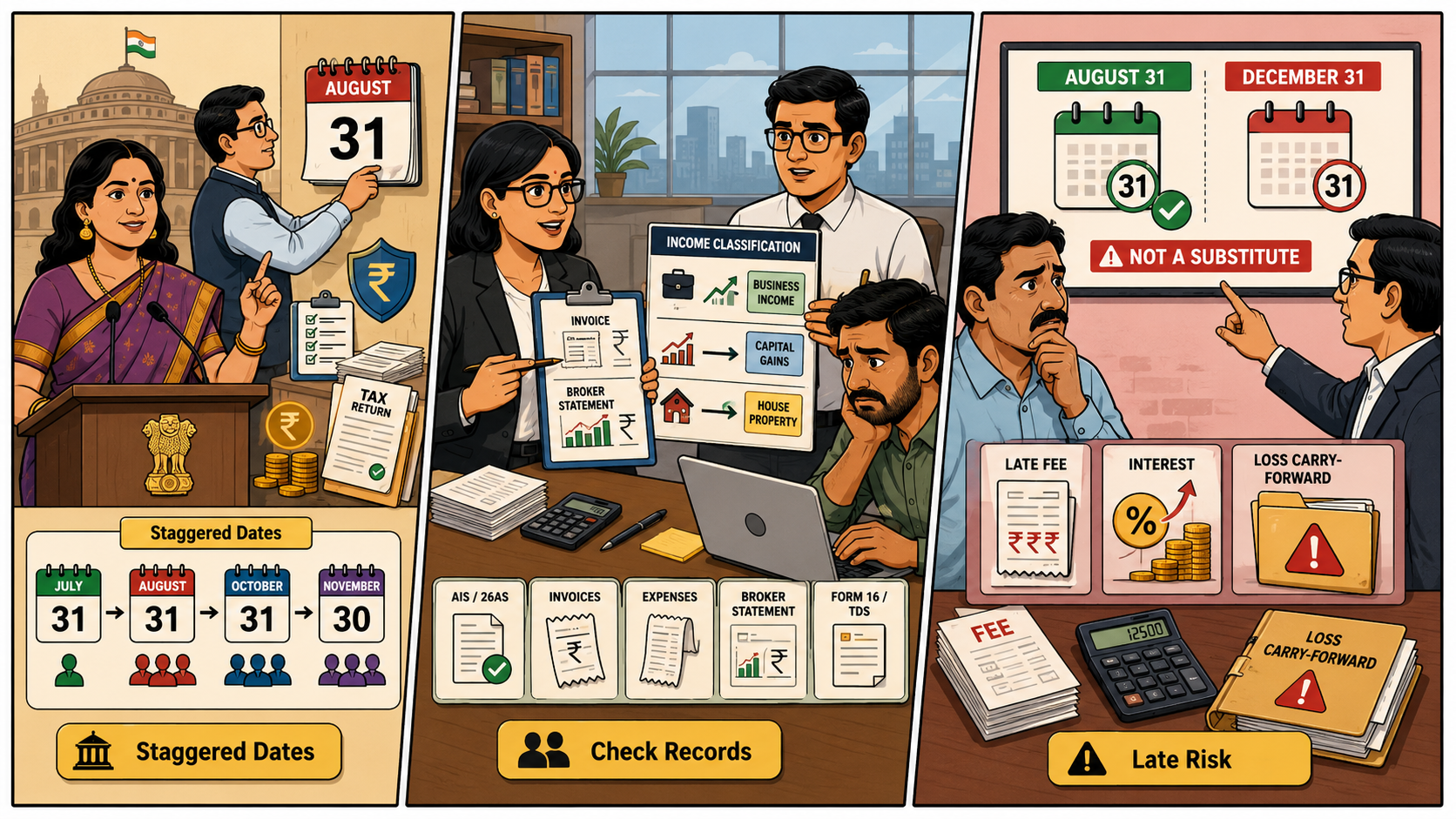
The government’s approach is to spread filing dates across taxpayer groups instead of placing every return at 1 cut-off. For non-audit businesses and professionals, that gives another month after July 31 to finish calculations involving receipts, expenses and several income streams. The February 1, 2026, budget announcement placed the staggered timetable within a wider set of direct-tax compliance changes.
Tax professionals are using that extra period to push taxpayers towards better reconciliation. Baweja’s focus on invoices and broker statements, and Surana’s focus on correct income classification, both point to the same risk. A wrong form or mismatched figure can create follow-up work even when the return is submitted before August 31. Taxpayers should identify the right category early rather than treating the final date as preparation day.
The LoansJagat reading adds another angle to the stakeholder discussion. Its August 6 analysis argues that taxpayers should not view December 31 as a replacement for their original deadline. A person with all tax already deducted may mainly face a filing fee or refund delay, while a trader or business taxpayer with losses has more at stake because carry-forward eligibility can be affected.
August 31, 2026, gives eligible non-audit business and professional taxpayers extra filing time for AY 2026-27. It does not reopen July 31 for ordinary salaried filers. Businesses, consultants, professionals and traders covered by the later date should use the remaining days to reconcile AIS, Form 26AS, invoices, bank records and trading statements before filing.
Those who missed August 31 still have the belated-return route up to December 31, 2026, in general cases. That route comes with costs and restrictions. The late fee can reach ₹5,000, unpaid tax can attract 1% monthly interest and some losses may no longer be available for future set-off. Filing by the correct original due date can therefore protect tax benefits that a December filing may not restore.
No. August 31 applies to specified non-audit business and professional cases. Most ordinary ITR-1 and ITR-2 taxpayers had July 31, 2026, as their regular deadline.
Section 234F can levy ₹1,000 where total income is up to ₹5,00,000 and ₹5,000 in other cases. Interest may also apply if tax remains unpaid.
Specified business and capital losses generally need a return filed within the applicable Section 139(1) due date for carry-forward. House property loss and unabsorbed depreciation have different treatments.
Regular F&O activity is generally treated as business income. A salaried taxpayer with such income may need ITR-3 and may fall under the August 31 deadline, depending on audit requirements and the person’s facts.
A return submitted after the applicable due date is late even if the delay is only a few hours. The taxpayer generally moves to the belated-return route, with fee or interest depending on the case. A recent r/IndiaTax discussion reported a filer missing the deadline by 2.5 hours and encountering a ₹5,000 late fee.









.png&w=3840&q=75)


