
By continuing, you agree to LoansJagat's Credit Report Terms of Use, Terms and Conditions, Privacy Policy, and authorize contact via Call, SMS, Email, or WhatsApp
Disclaimer: The information published on LoansJagat is intended for general informational and educational purposes only and should not be considered financial, legal, or investment advice. Interest rates, loan terms, statistics, and other data may change over time and may vary by lender or source. Please verify the latest information and consult a qualified financial advisor or the respective Bank/NBFC before making any financial decisions.
Subscribe Now
About the author

Arshathul Afia
Arshathul Afia is a journalism graduate and fintech content writer with 4+ years of experience in digital publishing and research-led writing. She has written 200+ articles covering personal finance, lending, banking, digital payments, credit, insurance, and major financial developments in India. At LoansJagat, she focuses on simplifying complex fintech news, RBI updates, loan-related changes, policy developments, and industry trends for everyday readers. Her journalism background helps her approach stories with research, context, and clarity, while her SEO experience ensures content remains discoverable and relevant. She aims to make financial news easier to understand, practical, and useful for readers across India.
Related News
Simplify All Your Loans Into One Affordable EMI

Customers Served

Debt Consolidated

1200+ Reviews

Locations in India
Club all Loans & Credit Card Bills into Single EMI

Quick Apply Loan
Consolidate your debts into one easy EMI.

Takes less than 2 minutes. No paperwork.

10 Lakhs+
Trusted Customers

2000 Cr+
Loans Disbursed

4.7/5
Google Reviews

50+
Banks & NBFCs Offers
Returns processed for AY 2026-27 tax filings generally get refunds within 4 to 5 weeks. This year, there are record matching issues and bank failures, which means longer waits for taxpayers across the country.
The immediate impact falls on people who had planned to use the refund for rent, school fees, medical expenses or an approaching EMI. A longer wait can also expose a filing gap that needs action, such as missing interest income or TDS reported incorrectly by an employer. Yet a refund taking longer than expected does not prove that CPC has opened scrutiny. The portal status, rather than the calendar alone, shows what happened next.
For a salaried employee, the refund may represent excess TDS deducted because the employer could not consider every eligible claim. A pensioner may be waiting for tax deductions on bank interest. Freelancers and small businesses can also build up excess credits when several clients deduct TDS during the year. In all these cases, the money becomes available only after CPC accepts the tax calculation and sends the approved refund.
There is one useful feature in the digital process. Each stage leaves a visible status. A taxpayer whose return says “Successfully e-Verified” knows CPC received it, while “Refund Failed” points towards the bank account or PAN status. That difference prevents wasted effort. It also helps families decide whether the delay is likely to need paperwork, a response from an employer or simply more processing time.
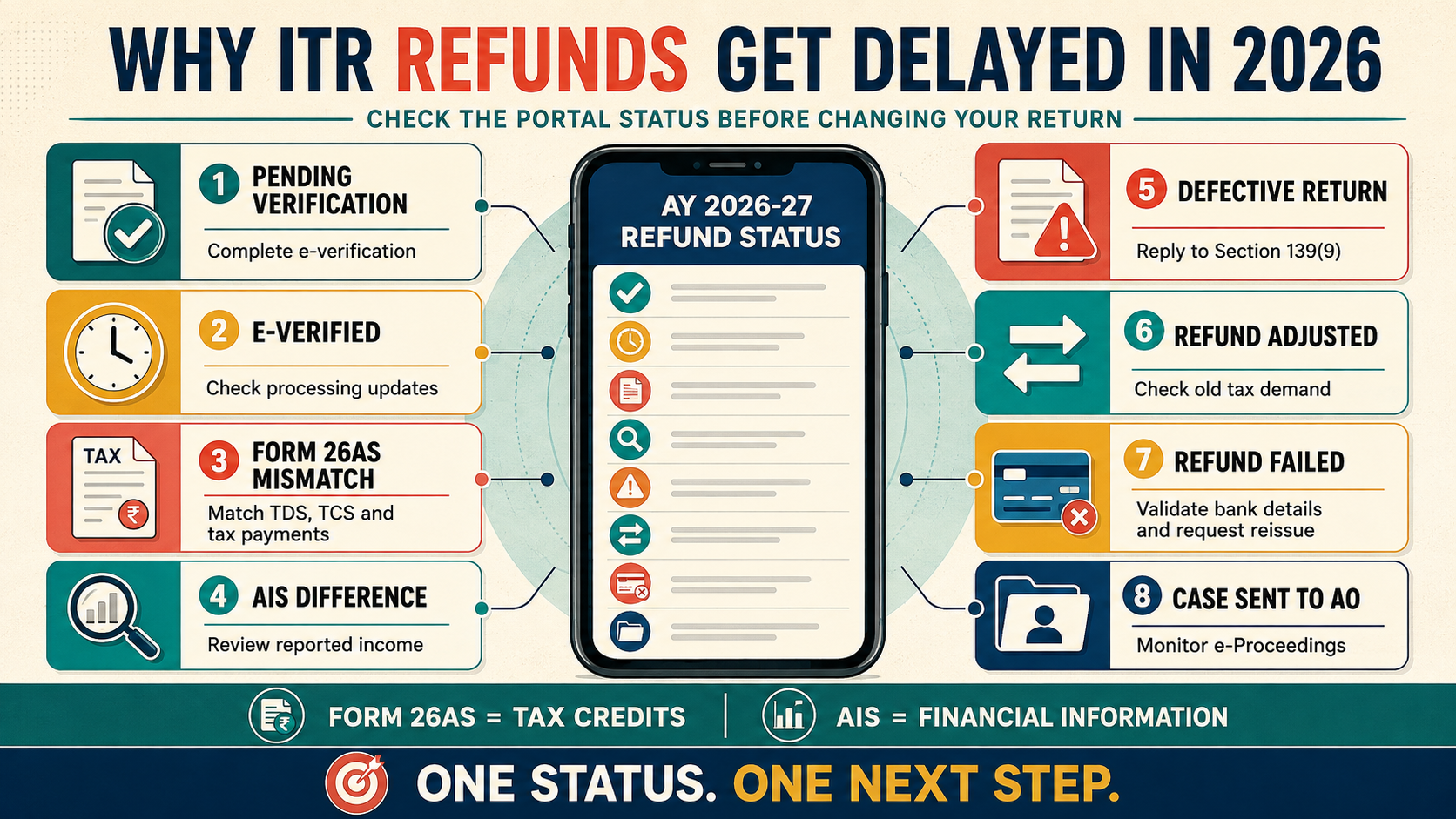
The August 13 NDTV report identified pending verification, differences across AIS and Form 26AS, incorrect bank details, PAN-Aadhaar issues, old demands and filing errors as the leading causes. Additional checks may arise where a return contains income gaps, unsupported deductions or tax credits that do not match the department’s records. Heavy filing-season volumes can slow some cases, though no official payment date applies equally to every return.
Taxpayers should read the exact AY 2026-27 status before changing the return. The table below shows the common messages and the next practical step. It separates a processing wait from a refund that CPC has already tried to pay.
The table helps because one correction cannot solve every status. Revalidating a bank account will not repair missing TDS credit. Filing a revised return will not reopen a closed bank account. If CPC has adjusted the refund against an older demand, the taxpayer must first read that demand and decide whether to accept or dispute it.
Form 26AS and AIS also serve different purposes. Form 26AS shows available tax credits, including TDS and TCS. AIS carries a broader record of financial information reported by banks, employers and other entities. A taxpayer may need an employer or bank to revise a TDS statement, but an incorrect AIS entry can be addressed through feedback. The return should not be changed blindly just because one figure appears unfamiliar.
The verification rule predates the current refund wait. Income Tax Department Notification No. 2/2024 was issued on March 31, 2024, and took effect on April 1, 2024. It gives taxpayers 30 days from filing to e-verify the return or send ITR-V. When verification happens after that period, the verification date may be treated as the filing date, with applicable late-filing consequences. A return left unverified can be treated as invalid.
Expectations of quicker service rose in 2026. At the 167th Income Tax Day celebration in New Delhi, Finance Minister Nirmala Sitharaman referred to improved return processing, prompt refunds and progress in grievance redressal. The Press Information Bureau release dated July 24, 2026, also recorded her instruction that the department should study recurring taxpayer problems instead of only disposing of individual complaints.
Revenue Secretary Arvind Shrivastava praised technology-led taxpayer services at the same event. CBDT Chairman Ravi Agarwal spoke about progress in return processing, refunds and grievance handling. Those statements show the government’s service goal. They do not promise that each refund will arrive on the same date, particularly where a return or bank account needs correction.
Personal finance expert Sanket Mishra, cited by NDTV on August 13, advised filers to complete e-verification quickly, pre-validate the selected bank account, compare the return with AIS and Form 26AS, and check PAN-Aadhaar compliance. The order is practical. It begins with actions the taxpayer controls, then moves to records that may need help from an employer, bank or tax professional.
A LoansJagat analysis published on August 6, 2026, flags TDS differences, omitted AIS income, unsupported deductions, selection of the wrong ITR form and incorrect bank details. Its borrower-focused view adds another point. A delayed refund should not become the only repayment plan for an EMI due next week. Taking an expensive short-term loan based on an assumed refund date can turn a tax-processing delay into a borrowing cost. Taxpayers should first identify the status, complete the required correction and avoid spending money that has not reached the bank.
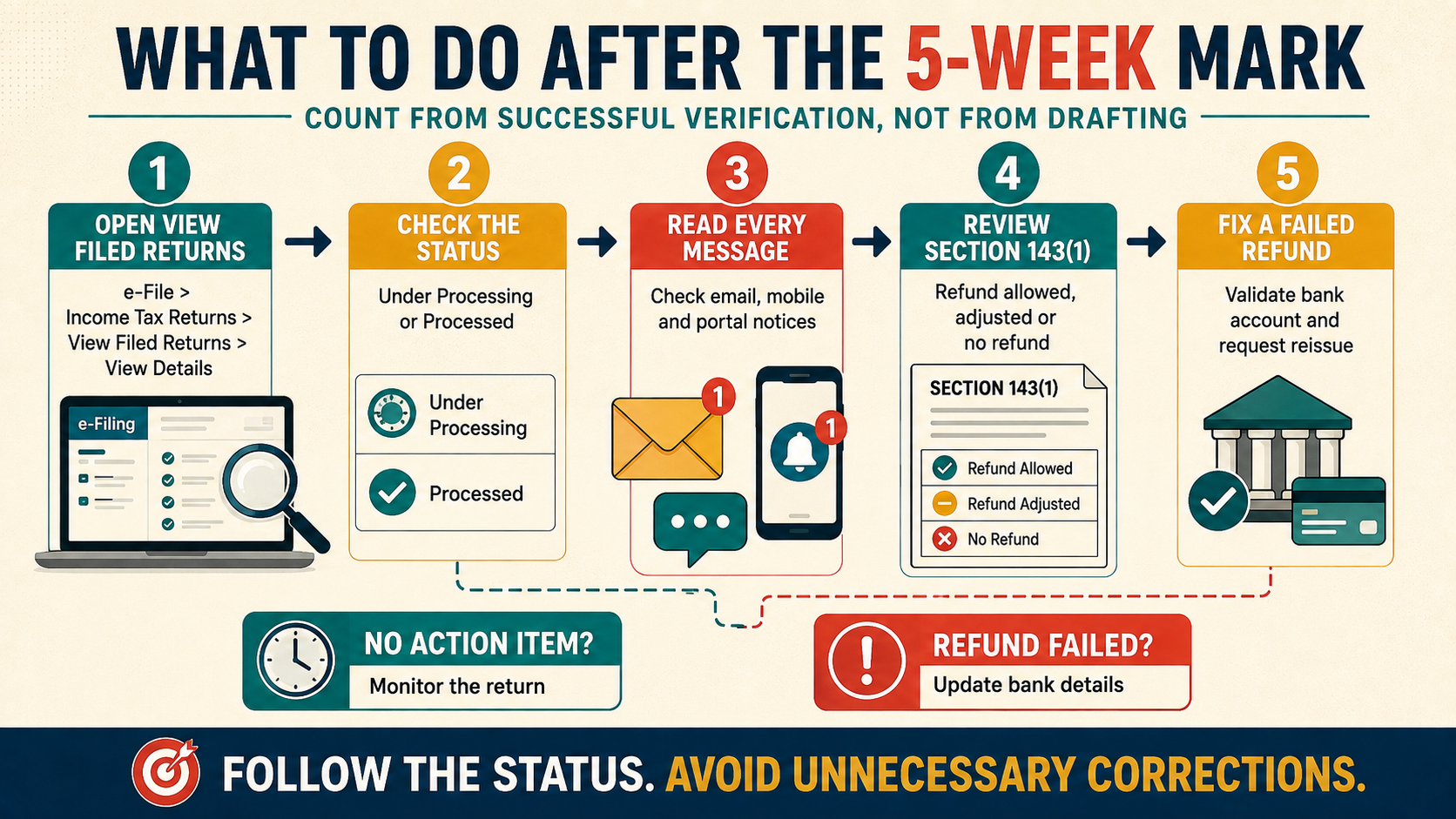
The first step is to count from successful verification, not from the day the return was drafted. The taxpayer can then open e-File → Income Tax Returns → View Filed Returns → View Details. This page shows the return’s life cycle, notices and refund status. Registered email and mobile messages should also be checked because CPC may have asked for a response.
If the return remains under processing and shows no action item, the taxpayer can monitor it rather than file unnecessary corrections. A processed return needs a review of the Section 143(1) intimation. That document may show the refund allowed, an adjustment or no refund. Where the status says “Refund Failed," the taxpayer should update and validate an eligible bank account before using the refund reissue service.
An AY 2026-27 refund pending beyond 4 to 5 weeks needs a status-led check. Verification comes first, followed by Form 26AS, AIS, the Section 143(1) intimation, previous demands and the nominated bank account. Each record answers a different part of the delay.
Most correctable cases leave a trail on the e-Filing portal. An unverified return needs verification. A TDS gap may need the deductor’s correction. A failed payment needs valid bank details and a refund reissue. Acting on the exact portal message is safer than guessing why the money has not arrived.
The department says refunds usually arrive within 4 to 5 weeks after successful return verification.
Yes. CPC may need corrected income details, tax credits or a revised statement from the deductor.
The return may await CPC processing, record verification, an outstanding-demand response or action on a notice.
The taxpayer should validate bank details, check PAN status and submit a refund reissue request.
No. Verification delays, tax-credit differences and failed bank transfers can hold refunds without scrutiny.









.png&w=3840&q=75)


