
By continuing, you agree to LoansJagat's Credit Report Terms of Use, Terms and Conditions, Privacy Policy, and authorize contact via Call, SMS, Email, or WhatsApp
Disclaimer: The information published on LoansJagat is intended for general informational and educational purposes only and should not be considered financial, legal, or investment advice. Interest rates, loan terms, statistics, and other data may change over time and may vary by lender or source. Please verify the latest information and consult a qualified financial advisor or the respective Bank/NBFC before making any financial decisions.
Subscribe Now
About the author

Arshathul Afia
Arshathul Afia is a journalism graduate and fintech content writer with 4+ years of experience in digital publishing and research-led writing. She has written 200+ articles covering personal finance, lending, banking, digital payments, credit, insurance, and major financial developments in India. At LoansJagat, she focuses on simplifying complex fintech news, RBI updates, loan-related changes, policy developments, and industry trends for everyday readers. Her journalism background helps her approach stories with research, context, and clarity, while her SEO experience ensures content remains discoverable and relevant. She aims to make financial news easier to understand, practical, and useful for readers across India.
Related Blog Post
Simplify All Your Loans Into One Affordable EMI

Customers Served

Debt Consolidated

1200+ Reviews

Locations in India
Club all Loans & Credit Card Bills into Single EMI

Quick Apply Loan
Consolidate your debts into one easy EMI.

Takes less than 2 minutes. No paperwork.

10 Lakhs+
Trusted Customers

2000 Cr+
Loans Disbursed

4.7/5
Google Reviews

50+
Banks & NBFCs Offers
Other services mentioned in this article
Joint home loans are helping Indian families use 2 incomes for higher eligibility, but shared EMI responsibility can become risky without planning.
Joint home loans have become a useful route for Indian homebuyers who want a higher loan amount but do not qualify comfortably on 1 income. The latest reference report on joint home loans said Bajaj Finance offers loan amounts of up to ₹15 crore, starting rates from 7.25% p.a. for eligible salaried applicants and repayment tenures of up to 32 years. The main story is simple: eligible co-applicants can improve borrowing capacity when both financial profiles support the loan.
This can help in the short term when a buyer needs a larger sanction for a flat, villa or family home. In the long term, it can also support better location choice, school access and workplace travel. The weak side needs equal attention. If a co-applicant loses income, exits the family arrangement or delays payment, the EMI burden may shift to others named in the loan.
For many salaried families, a joint home loan can increase buying capacity without waiting years to build a larger income base. A borrower who qualifies for a smaller loan alone may become eligible for a bigger sanction when an earning spouse or parent joins the application. That can change the property search in cities like Mumbai, Pune, Bengaluru, Delhi-NCR, Hyderabad and Chennai, where location often decides school access, commute time and resale prospects.
The positive impact comes only when the second applicant has steady income, fewer liabilities and a healthy credit record. If the co-applicant already has credit-card dues, personal loans or unstable income, the lender may not treat the file as stronger. Families should first compare loan eligibility with and without the co-applicant. A bigger sanction is helpful only when the EMI stays payable through job changes, family needs and interest-rate shifts.
The credit environment explains why this product is getting attention. Buyers are dealing with bigger household borrowing, stricter eligibility checks and high-value home budgets. The numbers below give the article its lending background without loading it with too many facts.
The table shows why the borrower’s full profile now carries more weight. Joint income can improve eligibility, but existing EMIs can reduce it. Tax claims can help, but only when ownership and repayment are properly recorded.
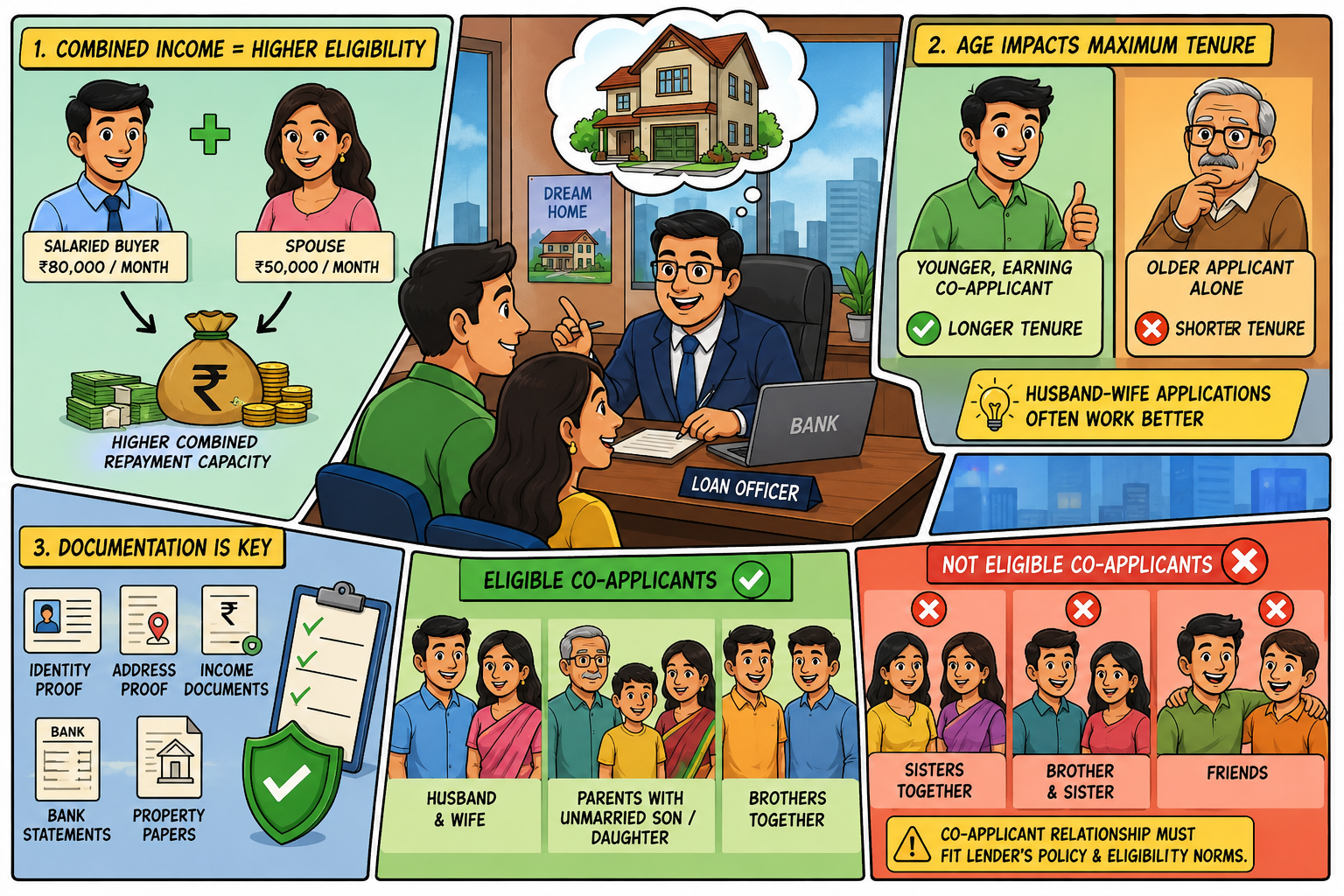
Lenders assess repayment capacity before giving a home loan. In a joint application, they may consider the income of all eligible applicants. For example, a salaried buyer with ₹80,000 monthly income may qualify for 1 loan amount alone. If a spouse earning ₹50,000 joins the file, the lender may assess a higher combined repayment capacity after deducting existing EMIs and living costs.
Age also plays a role. In many joint loans, the older applicant’s age can affect the maximum tenure. A younger, earning co-applicant may help the case if the lender accepts that repayment can continue for a longer period. That is why husband-wife applications often work better than cases where an elderly parent is added only for property ownership convenience.
Documentation is another filter. Each co-applicant must submit identity proof, address proof, income documents, bank statements and property-related papers. Lenders also check whether the relationship fits their policy. The reference report said Bajaj Finance permits joint applications from eligible husbands and wives, parents with unmarried sons or daughters, and brothers applying together, subject to eligibility norms. It also said sisters applying together, brothers and sisters, and friends are not eligible under the lender’s stated policy.
The previous lending background came from the Ministry of Finance’s credit update. PIB’s 5 May 2026 release said scheduled commercial banks recorded 15.9% year-on-year credit growth in FY 2025-26. It also placed aggregate credit outstanding at ₹212.9 lakh crore in March 2026. This official update showed that bank lending continued to expand across sectors, with personal loans also rising.
That previous update connects directly with joint home loans. When personal loans grow, many borrowers reach lenders with existing obligations. A credit-card EMI, car loan, education loan or gold loan can reduce available home-loan capacity. In such cases, adding a suitable co-applicant may improve the file, but only if the second borrower brings stable income and limited debt.
Lenders present joint home loans as a borrowing-capacity tool, but they do not treat every co-applicant equally. A strong second borrower can help. A weak one can hurt. This is why loan advisors usually ask families to check credit scores, active EMIs, income documents and property title before submitting the file. LoansJagat’s view fits this point naturally. Its co-application guide says lenders prefer close family members and verified co-owners, while friends or distant relatives may face rejection or tighter checks.
Tax professionals add another warning. A person cannot assume tax benefits only because that person is named in the loan. The Income Tax Department says co-owners can claim a home-loan interest deduction according to repayment contribution when shares are definite. For a self-occupied property, the deduction on interest can go up to ₹200,000, subject to the conditions stated under the Income Tax rules. Buyers who want tax benefits should align ownership share, EMI payment and loan documents from day 1.
The solution is not complicated, but it needs paperwork. Families should decide the EMI split in writing, keep bank transfers traceable and avoid casual cash contributions. If 2 people plan to claim deductions, both should be co-owners and both should contribute through bank accounts. Couples should also decide what happens if 1 person leaves a job, moves abroad or wants to exit the loan later.
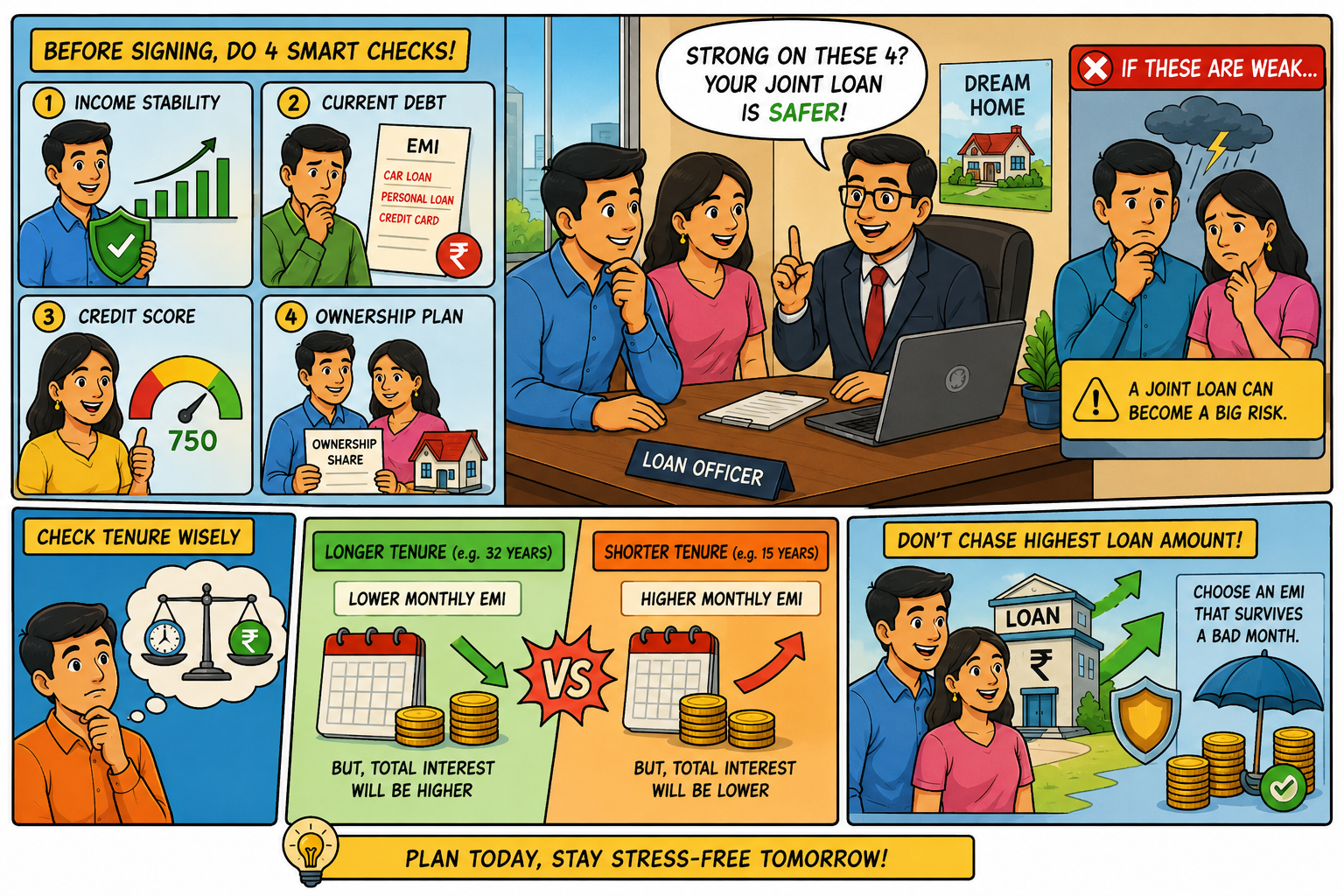
Borrowers should begin with 4 checks: income stability, current debt, credit score and ownership plan. If these 4 are weak, a joint loan may only create a larger liability. The lender may still sanction the loan, but the family may struggle later if the EMI is stretched too far.
A second check is tenure. A 32-year tenure can reduce monthly EMI, but it may increase the total interest paid across the loan period. A shorter tenure can save interest but raise monthly pressure. Borrowers should not chase the highest sanction only because 2 incomes are available. The safer route is to choose an EMI that survives a bad month.
Joint home loans can raise borrowing capacity for eligible applicants when the co-applicant brings income strength, credit quality and proper ownership alignment. The product can help Indian families buy a better home or improve location choice, especially when 1 income does not meet lender eligibility.
The safer route is planning before signing. Buyers should check who owns the property, who pays the EMI, who claims tax benefits and what happens if 1 borrower exits. A bigger loan can help only when repayment remains manageable for years, not just on the approval date.
A joint home loan is a housing loan taken by 2 or more eligible applicants for the same property.
Lenders usually prefer close family members such as spouses, parents, children or siblings, subject to their own rules.
Yes, it can increase eligibility if the co-applicant has stable income, fewer liabilities and a strong repayment record.
Both can claim tax benefits only if they are co-owners and contribute to repayment, subject to income tax rules.
The biggest risk is shared repayment liability. If EMIs are missed, all co-applicants may face credit impact.









.png&w=3840&q=75)


