
By continuing, you agree to LoansJagat's Credit Report Terms of Use, Terms and Conditions, Privacy Policy, and authorize contact via Call, SMS, Email, or WhatsApp
Disclaimer: The information published on LoansJagat is intended for general informational and educational purposes only and should not be considered financial, legal, or investment advice. Interest rates, loan terms, statistics, and other data may change over time and may vary by lender or source. Please verify the latest information and consult a qualified financial advisor or the respective Bank/NBFC before making any financial decisions.
Subscribe Now
About the author

Arshathul Afia
Arshathul Afia is a journalism graduate and fintech content writer with 4+ years of experience in digital publishing and research-led writing. She has written 200+ articles covering personal finance, lending, banking, digital payments, credit, insurance, and major financial developments in India. At LoansJagat, she focuses on simplifying complex fintech news, RBI updates, loan-related changes, policy developments, and industry trends for everyday readers. Her journalism background helps her approach stories with research, context, and clarity, while her SEO experience ensures content remains discoverable and relevant. She aims to make financial news easier to understand, practical, and useful for readers across India.
Related Blog Post
Simplify All Your Loans Into One Affordable EMI

Customers Served

Debt Consolidated

1200+ Reviews

Locations in India
Club all Loans & Credit Card Bills into Single EMI

Quick Apply Loan
Consolidate your debts into one easy EMI.

Takes less than 2 minutes. No paperwork.

10 Lakhs+
Trusted Customers

2000 Cr+
Loans Disbursed

4.7/5
Google Reviews

50+
Banks & NBFCs Offers
Other services mentioned in this article
With ITRs crossing 5 crores for AY 2026-27, salaried taxpayers now have less than 40 hours to file and verify ITRs and avoid paying late penalties by July 31.
Key Highlights
As per the notice issued by the Income Tax Department, over 5 crore income tax returns have been filed for AY 2026-27. There are less than 40 hours left for salaried tax filers, pensioners, and non-audit tax filers to file tax returns for the income tax year 2026-27, by the deadline of July 31, 2026. This announcement mainly concerns salaried tax filers, pensioners, and non-audit tax filers of India, who typically file ITR-1 or ITR-2. Through the official update of the Income Tax Department, the department requested tax filers to match their tax filing details and not wait until the last hour to file their tax returns.
The impact is immediate. A late return can bring a fee, interest if tax is payable, refund delay and extra follow-up if income details do not match AIS or Form 26AS. The longer-term effect is also visible during home loan processing, visa paperwork, education loan checks and financial verification, where a properly filed ITR often works as income proof. A rushed return, on the other hand, can create correction work later.
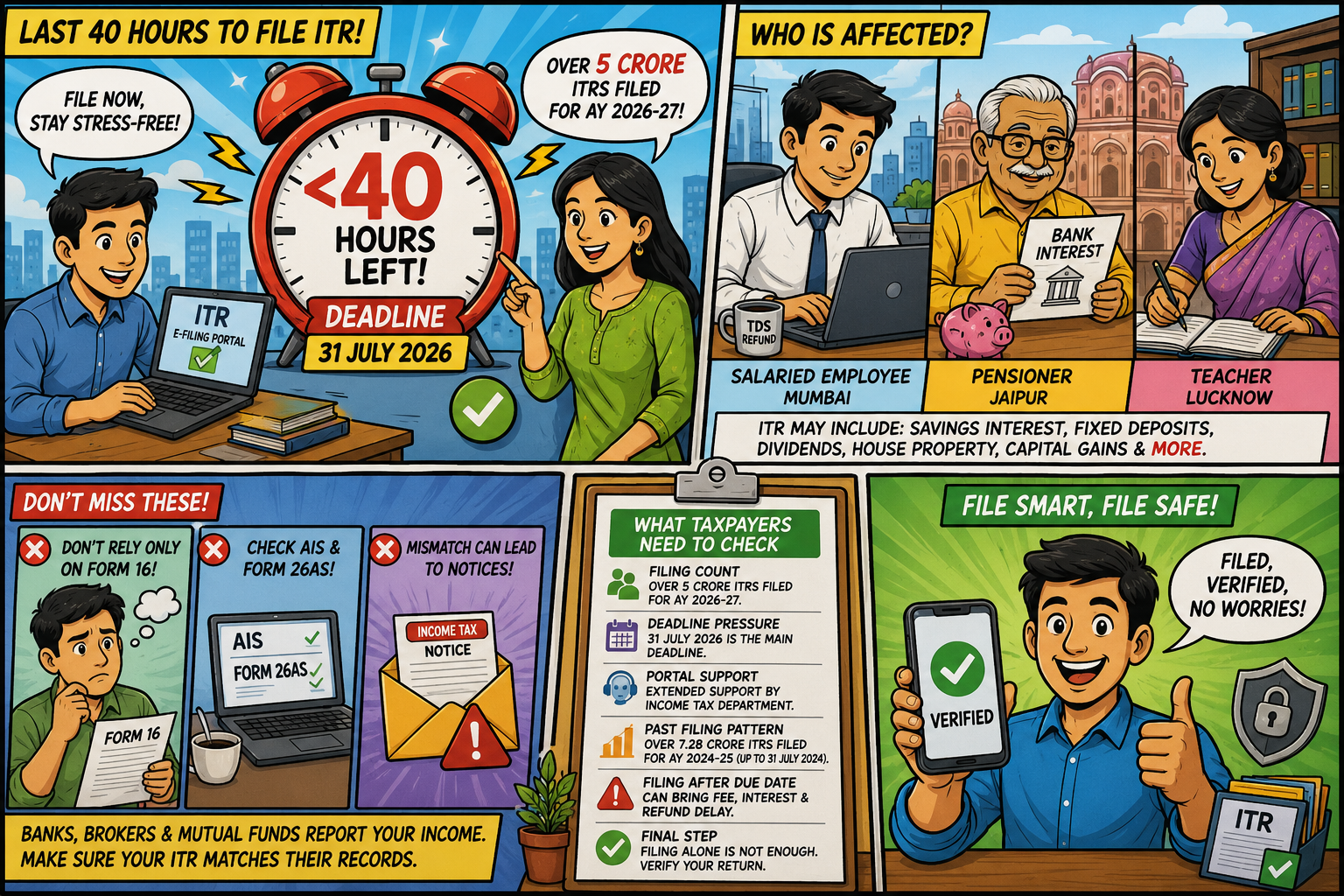
The last 40 hours will affect ordinary taxpayers first. A salaried employee in Mumbai waiting for a TDS refund, a pensioner in Jaipur filing bank interest details, or a teacher in Lucknow claiming deductions cannot treat filing as a quick upload anymore. Even a simple ITR may carry small entries from savings interest, fixed deposits, dividends, house property or capital gains from mutual funds.
The positive side is that early and accurate filing helps refunds move faster and reduces later notices. The problem starts when people depend only on Form 16 and skip AIS or Form 26AS. A bank may have reported interest. A broker may have reported the sale of shares. A mutual fund platform may show capital gains. If the return misses these entries, the taxpayer may receive a mismatch alert after filing.
Before checking the table, taxpayers should remember one thing. The department’s filing count is high, but the last day usually brings a heavy load on the portal, helplines and verification systems. That is when errors become expensive.
After the table, the message is simple enough. Taxpayers should not look only at the filing count and assume everything is moving smoothly. The final hours are when small mistakes rise. Wrong form selection, missing bank validation, skipped interest income, old mobile number, Aadhaar OTP issue or delayed e-verification can hold up the return.
Tax professionals usually advise taxpayers to slow down for 20 minutes before pressing submit. That short check can save weeks of correction later. The safest sequence is basic: match Form 16 with AIS, compare TDS with Form 26AS, add bank interest, check capital gains, choose the correct ITR form, validate the refund bank account and complete e-verification.
A LoansJagat filing guide also explains that ITR is not complete until the taxpayer verifies it through the available routes such as Aadhaar OTP, net banking or other permitted options on the e-filing system. This point is often missed by last-minute filers. A return uploaded at 11:30 pm may still create trouble if the filer forgets the verification step. For borrowers, this has a direct finance angle too. A clean ITR record can help during personal loan, home loan or business loan checks, while an unverified or delayed return may slow document approval.
The tax desk reading is plain. The ITR deadline is no longer only about tax payment. It is now linked with digital financial records. Lenders, landlords, embassies, employers and government agencies may ask for ITR acknowledgement or processed return details. That makes accurate filing more useful than hurried filing.
Also Read: ITR Last Date 2026: July 31 Deadline Nears As Late Filers Risk ₹5,000 Penalty
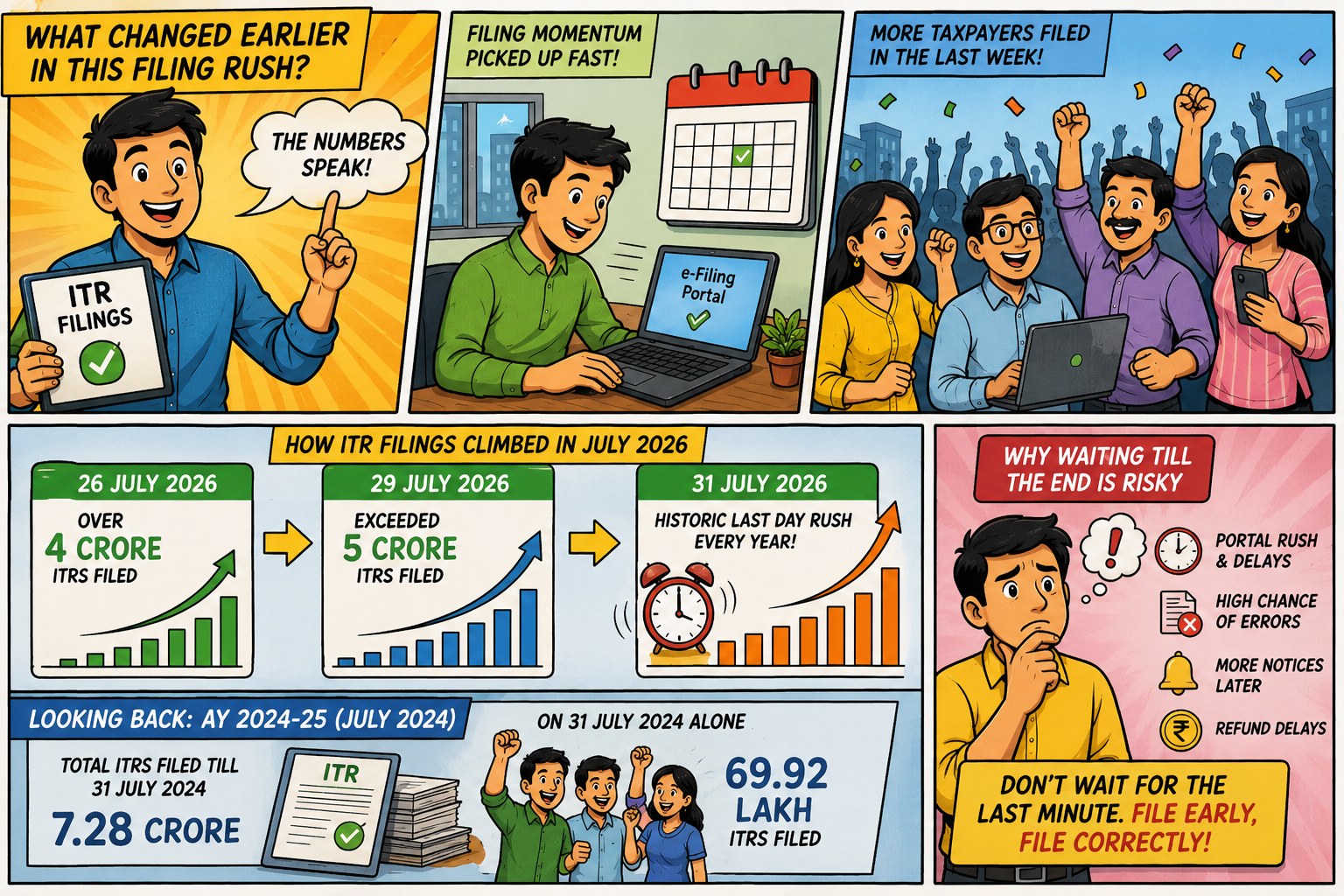
The last update recorded over 4 crore ITR filings on 26 July 2026. By 29 July, filings exceeded 5 crore. That means a large group of taxpayers filed returns during the last week. While this is a repeated phenomenon, filing complex returns at the last minute poses greater risk.
The earlier data also clarifies the filing pattern. For AY 2024-25, PIB recorded that as of July 2024, 7.28 crore returns were filed and that 69.92 lakh returns were filed on 31 July 2024 alone. That earlier filing season establishes the basis on which the department keeps requesting taxpayers not to wait till the deadline.
The Income Tax Department’s message was direct. It said over 5 crore ITRs had already been filed for AY 2026-27 and asked taxpayers to reconcile details before filing ITR-1 or ITR-2. The department has also been using reminders, portal messages, and taxpayer support lines during the final stretch.
During the 167th Income Tax Day event on July 24, 026, in New Delhi, Union Finance Minister Nirmala Sitharaman stated that the department is advancing in the direction of fair, efficient, transparent and taxpayer-focused administration. The Press Information Bureau also stated that CBDT Chairman Ravi Agrawal referenced rapid return processing and refund issuance, complaint redressal, and technology-based taxpayer services.
For taxpayers, the stakeholder message comes down to accuracy. The department wants clean data. The taxpayer wants a refund, proof of income and no notice. Both sides gain when the return is checked properly before filing.
The ITR filing clock is now close to the deadline, and the 5 crore figure shows how quickly taxpayers are moving in the final week. For ITR-1 and ITR-2 filers, the next step should not be panic filing. It should be careful filing.
The better route is short but useful. Check AIS. Match Form 26AS. Review Form 16. Add bank interest and capital gains where needed. Validate the refund account. File the correct form. Then verify the return. Those small steps can decide whether the taxpayer gets a clean acknowledgement or a notice-linked headache later.
31 July 2026 is the key due date for many salaried and non-audit individual taxpayers.
Over 5 crore ITRs have been filed for AY 2026-27 before the 31 July deadline.
Taxpayers with bank interest, capital gains, rent income, multiple Form 16s or incomplete Form 16s, along with salaried individuals, should check their details again.
No. A return can be filed but it is mandatory to verify the return using Aadhaar OTP, net banking and other prescribed modes.
Filing beyond the due date will attract a penalty, interest, delay in receiving refund and loss of certain tax advantages









.png&w=3840&q=75)


