
By continuing, you agree to LoansJagat's Credit Report Terms of Use, Terms and Conditions, Privacy Policy, and authorize contact via Call, SMS, Email, or WhatsApp
Disclaimer: The information published on LoansJagat is intended for general informational and educational purposes only and should not be considered financial, legal, or investment advice. Interest rates, loan terms, statistics, and other data may change over time and may vary by lender or source. Please verify the latest information and consult a qualified financial advisor or the respective Bank/NBFC before making any financial decisions.
Subscribe Now
About the author

Arshathul Afia
Arshathul Afia is a journalism graduate and fintech content writer with 4+ years of experience in digital publishing and research-led writing. She has written 200+ articles covering personal finance, lending, banking, digital payments, credit, insurance, and major financial developments in India. At LoansJagat, she focuses on simplifying complex fintech news, RBI updates, loan-related changes, policy developments, and industry trends for everyday readers. Her journalism background helps her approach stories with research, context, and clarity, while her SEO experience ensures content remains discoverable and relevant. She aims to make financial news easier to understand, practical, and useful for readers across India.
Related News
Simplify All Your Loans Into One Affordable EMI

Customers Served

Debt Consolidated

1200+ Reviews

Locations in India
Club all Loans & Credit Card Bills into Single EMI

Quick Apply Loan
Consolidate your debts into one easy EMI.

Takes less than 2 minutes. No paperwork.

10 Lakhs+
Trusted Customers

2000 Cr+
Loans Disbursed

4.7/5
Google Reviews

50+
Banks & NBFCs Offers
Taxpayers who have not claimed TCS credit in their ITRs due to a mistake in filing on or before 31st July, 2024 can revise their ITRs to avail the applicable TCS credit till 31st March, 2027.
Taxpayers who missed a TCS credit while filing their return still have time to correct it. For AY 2026-27, Section 139(5) of the Income-tax Act, 1961 allows them to revise the ITR up to 31 March 2027. The window closes earlier if the Income Tax Department completes the assessment before that date. This applies to income earned in FY 2025-26. So, if TCS was collected but left out of the original ITR, the taxpayer can correct the return within the revised filing window and claim the eligible credit.
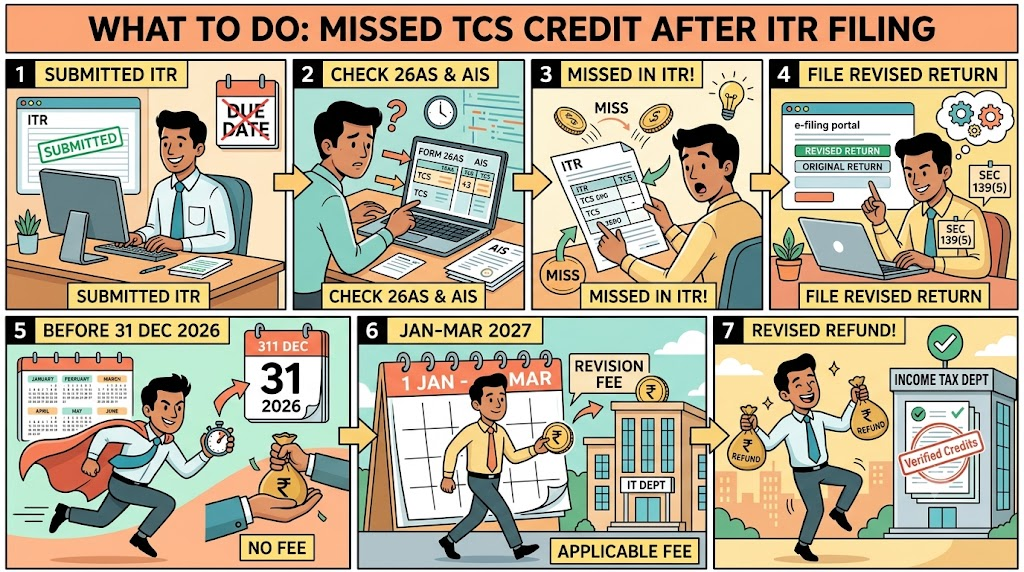
However, refund recipients may see a temporary drop in cash flow because they did not compute a tax credit that may impact the refund amount, and therefore did not receive it. But the cost is delayed, and that is the price that you pay. As per the Section 234I rates, the income tax rate of ₹1,000 per month for an income limit of ₹5 lakh and ₹5,000 per month for an income limit over ₹5 lakh will be effective from 1 January 2027. The extra charge will be levied on updated returns that are submitted after 31 December 2026.
If Form 26AS itself does not show the TCS, the reporting issue should generally be corrected before the taxpayer relies on that amount in the return. The tax department's mismatch service compares TDS, TCS, and tax-payment information reported in the ITR with Form 26AS.
The extra filing window is useful because TCS does not depend only on information entered by the taxpayer. A bank, authorised dealer, tour operator, seller or another collecting entity may be involved in collecting and reporting the tax. If the taxpayer files the ITR before noticing that the credit was omitted, Section 139(5) now leaves more time to put the return right.
This can help salaried taxpayers and other individuals who filed before the July deadline and later reviewed their tax records. The benefit is not an automatic “TCS refund”. TCS is first adjusted as a tax credit against the final income-tax liability. If the eligible tax already collected exceeds the final liability after all adjustments, the excess can form part of the refund. That is why the final refund can be lower than, equal to, or sometimes unaffected by the TCS amount added to the revised return.
Another detail is worth noting. The 31 July 2026 deadline did not apply to every AY 2026-27 taxpayer. The Income Tax Department's transition FAQs state that AY 2026-27 filing dates vary by category, including 31 July and 31 August for non-audit cases, with later dates for specified taxpayers. The revised-return rule, however, gives an eligible taxpayer until the end of the assessment year once a valid original or belated return has been filed.
Tax professionals had sought a longer correction period even before Budget 2026. The Institute of Chartered Accountants of India, in its Pre-Budget Memorandum 2026 presented on 27 October 2025, proposed extending the time for revised and belated returns to 12 months from the end of the relevant tax year. ICAI's position was that taxpayers could discover errors or omissions after the earlier 9-month period had almost expired.
For a taxpayer dealing with missed TCS today, the first job is not filing another return immediately. Form 26AS should be checked against the amount actually collected. AIS can be reviewed alongside it. If there is a mismatch, the taxpayer should identify whether the ITR is wrong or whether the collector's reporting needs correction.
A recent LoansJagat review of ITR refund delays also flags Form 26AS mismatch as a point taxpayers should examine. It advises comparing TDS, TCS and tax payments with credits claimed in the ITR and seeking correction where a reporting statement is wrong.
For a household waiting for a refund, that creates a practical cash-flow angle. A TCS amount has already left the taxpayer's pocket. If the credit is missed in the return, the taxpayer may wait longer to recover the excess. An early Form 26AS check therefore does more than improve paperwork. It can reduce another cycle of correction after the revised return is filed.
Where the TCS is correctly available in the tax records but was omitted from the filed return, the taxpayer can revise the return under Section 139(5). The revised return replaces the earlier filing for processing purposes. The relevant TCS details should be entered correctly, along with the required information from the original return.
The current AY 2026-27 position can be read quickly below.
The taxpayer should then recompute the return rather than simply adding the TCS amount to the expected refund. Income, deductions, TDS, TCS, advance tax, self-assessment tax and existing liabilities all feed into the final figure. The revised return must also be properly submitted and verified.
The timing is equally important. A taxpayer who notices the omission in August or September 2026 gains little by deliberately waiting until January. Fixing it before 31 December avoids the additional Section 234I fee and leaves time to resolve a collector-side mismatch if one appears.
The tax department's Tax Credit Mismatch service specifically compares the TDS, TCS, and income-tax amounts entered in the return with the amounts reflected in Form 26AS. Where the figures do not match, the taxpayer can correct the return or seek correction from the tax deductor or collector.
This becomes especially relevant when a taxpayer has proof that TCS was collected, but the entry is not visible against the PAN. Filing a revised return with an unsupported credit can create another mismatch instead of fixing the first one. The better route is to identify why the credit is missing and have the underlying reporting corrected where required.
This also explains why taxpayers should retain payment records and TCS certificates. They can help locate the transaction when taking up an incorrect entry with the collector, although the final tax-credit position still needs to align with the department's records.
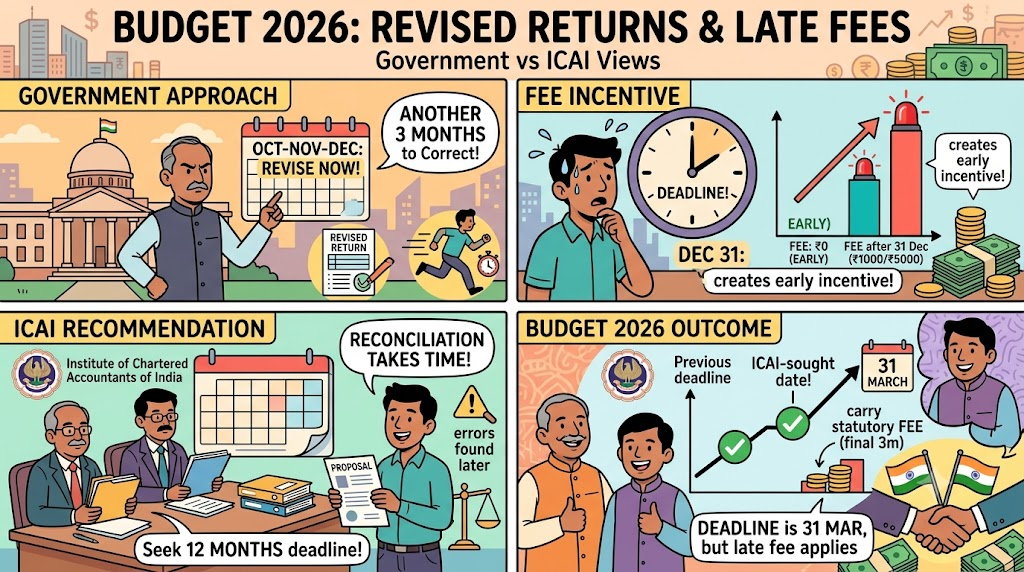
The government's approach gives taxpayers another 3 months to correct an existing return without turning the extended period into an unrestricted delay. The ₹1,000 and ₹5,000 fee structure after 31 December creates an incentive to finish revisions earlier.
ICAI's earlier recommendation approached the issue from the taxpayer's side. Its Pre-Budget proposal sought 12 months because errors and omissions can emerge later, including when information is reconciled after filing. Budget 2026 broadly moved the revised-return deadline to the 31 March date ICAI had sought, although the final 3 months now carry the statutory fee.
For taxpayers with missed TCS, those 2 positions lead to the same action. Use the extra window when it is genuinely required, but do not postpone a correction that is already known.
Taxpayers should not assume that an updated return, commonly called ITR-U, will solve the problem after the revised-return period ends. Income Tax Department guidance says an updated return cannot be filed where it results in or increases a refund.
That restriction makes the Section 139(5) deadline particularly important for someone whose only correction is an overlooked credit that would increase the refund. The revised-return route should therefore be used while it remains legally available.
A taxpayer who filed an AY 2026-27 ITR by 31 July 2026 and later found an eligible TCS credit missing from the return still has time to correct the filing. Section 139(5) now permits a revised return until 31 March 2027 or completion of assessment, whichever happens earlier. The extra period is useful, but waiting beyond 31 December brings a Section 234I fee.
The safer sequence is simple. Check Form 26AS, compare the TCS entry with the filed ITR, resolve any collector-side error, revise the return and verify it. If excess tax has genuinely been collected after the final liability is worked out, the corrected credit can then feed into the refund computation.
Yes. An eligible missed TCS credit can be added through a revised return within the permitted Section 139(5) period.
The deadline is 31 March 2027 or completion of assessment, whichever takes place earlier.
Yes. From 1 January 2027, the fee is ₹1,000 or ₹5,000 depending on total income.
The taxpayer should check the collector's reporting and seek correction before claiming a credit that is not properly reflected.
No. An updated return cannot be used where the filing results in or increases an income-tax refund.









.png&w=3840&q=75)


