

By continuing, you agree to LoansJagat's Credit Report Terms of Use, Terms and Conditions, Privacy Policy, and authorize contact via Call, SMS, Email, or WhatsApp
Disclaimer: The information published on LoansJagat is intended for general informational and educational purposes only and should not be considered financial, legal, or investment advice. Interest rates, loan terms, statistics, and other data may change over time and may vary by lender or source. Please verify the latest information and consult a qualified financial advisor or the respective Bank/NBFC before making any financial decisions.
Subscribe Now
About the author

Arshathul Afia
Arshathul Afia is a journalism graduate and fintech content writer with 4+ years of experience in digital publishing and research-led writing. She has written 200+ articles covering personal finance, lending, banking, digital payments, credit, insurance, and major financial developments in India. At LoansJagat, she focuses on simplifying complex fintech news, RBI updates, loan-related changes, policy developments, and industry trends for everyday readers. Her journalism background helps her approach stories with research, context, and clarity, while her SEO experience ensures content remains discoverable and relevant. She aims to make financial news easier to understand, practical, and useful for readers across India.
Related Blog Post
Simplify All Your Loans Into One Affordable EMI

Customers Served

Debt Consolidated

1200+ Reviews

Locations in India
Club all Loans & Credit Card Bills into Single EMI

Quick Apply Loan
Consolidate your debts into one easy EMI.

Takes less than 2 minutes. No paperwork.

10 Lakhs+
Trusted Customers

2000 Cr+
Loans Disbursed

4.7/5
Google Reviews

50+
Banks & NBFCs Offers
Retirement does not erase mutual fund taxes, but lower income, timed redemptions and the right withdrawal route can reduce the amount an investor legally pays.
This can reduce cash available for medicines, rent and household costs. Over time, poorly timed withdrawals may force the investor to sell more units than planned. Planning before redemption allows a comparison of expected income, unrealised gains and cash required.
The effect differs across India. A pensioner with modest interest income may pay less on a covered debt-fund gain. Another retiree receiving pension, rent, deposit interest and IDCW may enter a higher slab. Equity gains follow separate rates, so age does not decide the outcome.
A LoansJagat calculation prepared for this article shows the gap. Assume an eligible resident retiree has ₹9 lakh of normal taxable income and ₹2 lakh of equity-fund LTCG, with no other gains. After the ₹1.25 lakh threshold, ₹75,000 faces 12.5% tax. That produces ₹9,375 before 4% cess, or ₹9,750 after cess. Income below ₹12 lakh does not make every capital gain tax-free.

Sandeep Bhalla, Partner at Dhruva Advisors, told ET Wealth on 9 September 2026 that lower-bracket retirees may pay less on specified debt-fund gains because slab rates apply. He warned that total taxable income decides the result. Pension, interest and rent can keep a retiree in a higher bracket.
CA Chintan Ghelani, Partner, Direct Tax at N. A. Shah Associates LLP, said IDCW enters normal taxable income, while an SWP contains capital and gain. His solution begins with annual cash needs. The retiree can then compare Growth, IDCW and SWP, check rebate eligibility and choose redemption dates.
A lower tax bill often begins with ordinary paperwork: old purchase statements, the year’s pension and interest figures, and a realistic withdrawal amount. Once retirees check these together, they can time redemptions, use eligible losses and choose a payout route that leaves more of the portfolio intact.
The Press Information Bureau release dated 1 February 2025, Release ID 2098406, announced no tax up to ₹12 lakh for eligible residents under the new regime. It excluded special-rate income such as capital gains. Retirees should calculate slab income separately from specially taxed equity gains.
The ₹1.25 lakh threshold applies to aggregate eligible equity LTCG for the financial year, not each scheme or folio. A retiree needing ₹6 lakh over several months may compare one sale with withdrawals placed on either side of 31 March. Cash needs should still guide the date.
Short-term capital losses can offset short-term or long-term gains. Long-term losses can offset only long-term gains. A retiree using 2 platforms may miss a loss when statements are reviewed separately. Consolidated records can prevent tax being paid on gains eligible for adjustment.
IDCW provides cash, but the full distribution is taxable and the scheme’s net asset value falls after payment. Growth defers tax until redemption and taxes only the gain. IDCW may suit income within rebate conditions, while someone near the limit could face a different result.
An SWP creates monthly cash while tax applies only to the gain in redeemed units. It also sells units during falling markets, so excessive withdrawals can reduce the corpus. The LoansJagat SWP calculator, published on 5 February 2026, compares investment, withdrawal and return assumptions. Results remain estimates.
Debt, equity, gold, international and hybrid funds follow different rules. Units bought before and after 1 April 2023 may also receive different treatment. Investors should verify the scheme’s classification. Gold and international funds are not automatically specified debt funds merely because they hold less than 65% in domestic equity.
Transferring money or units to a spouse can bring resulting income back into the transferor’s return under clubbing provisions. A joint holder may not change beneficial ownership. Retirees should document ownership and seek advice before moving assets mainly to use another family member’s lower slab.
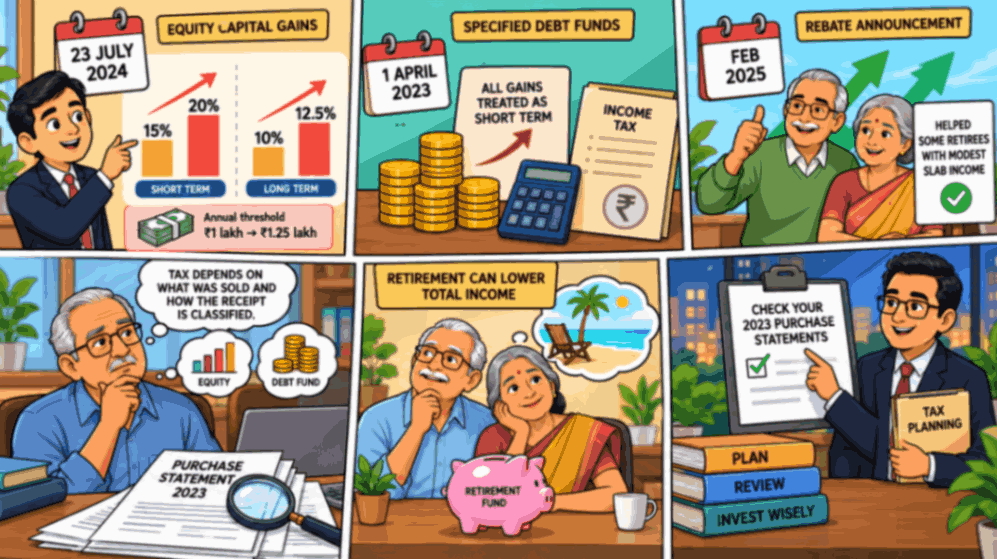
India’s equity capital-gains rates changed from 23 July 2024. The Ministry of Finance FAQ published through PIB on 24 July 2024, Release ID 2036604, recorded short-term tax rising from 15% to 20%. Long-term tax rose from 10% to 12.5%, while the annual threshold increased from ₹1 lakh to ₹1.25 lakh.
Specified debt-fund treatment had shifted for units acquired from 1 April 2023. Covered gains became short-term regardless of holding period and entered the slab calculation. The February 2025 rebate announcement helped some retirees with modest slab income, but did not reverse the 2024 equity rates.
Retirement can lower total income, yet tax depends on what was sold and how the receipt is classified. Purchase statements from 2023 may decide whether a long holding period provides any advantage.
Retirement provides no automatic mutual fund tax holiday. It can reduce normal taxable income, which may help with specified debt-fund gains or IDCW in some cases. Equity gains remain subject to their special rules. A yearly calculation, completed before redemption, gives the retiree a better chance of protecting both cash flow and the remaining corpus.
The strongest plan uses actual purchase dates, consolidated gain statements and realistic household expenses. Spreading eligible gains, using valid losses, selecting the suitable payout route and checking family-transfer rules can reduce avoidable tax. A qualified tax professional should review large withdrawals or older holdings before the investor acts. That review also reduces the risk of filing errors when several folios and bank accounts are involved together.
Not automatically. Retirees follow the same capital-gains rates and holding-period rules as other investors. A lower post-retirement income can reduce tax on receipts charged at slab rates. Equity gains taxed at special rates do not become cheaper merely because the investor no longer earns a salary.
No. The rebate for eligible resident individuals does not eliminate tax on income charged at special rates, including covered equity capital gains. A retiree may have no tax on qualifying normal income and still owe tax on equity LTCG above the ₹1.25 lakh annual threshold.
The withdrawal is not automatically tax-free. Under an SWP or ordinary redemption, the returned investment is not itself a gain, but the gain within redeemed units may be taxable. The rate depends on the fund category, acquisition date and holding period. IDCW follows a different rule because the full distribution enters taxable income.
SWP can be more tax-efficient because only the gain within redeemed units is considered for capital-gains tax. IDCW places the whole distribution in taxable income. Still, an SWP can erode units during a market fall, while IDCW is not guaranteed. The suitable route depends on income, cash needs and portfolio size.
A transfer may not produce the intended saving. Clubbing rules can require income arising from assets transferred to a spouse to be included in the original owner’s return. Ownership records, source of funds and the purpose of the transfer need review before any transaction.








.png&w=3840&q=75)


