
By continuing, you agree to LoansJagat's Credit Report Terms of Use, Terms and Conditions, Privacy Policy, and authorize contact via Call, SMS, Email, or WhatsApp
Disclaimer: The information published on LoansJagat is intended for general informational and educational purposes only and should not be considered financial, legal, or investment advice. Interest rates, loan terms, statistics, and other data may change over time and may vary by lender or source. Please verify the latest information and consult a qualified financial advisor or the respective Bank/NBFC before making any financial decisions.
Subscribe Now
About the author

LoansJagat Team
‘Simplify Finance for Everyone.’ This is the common goal of our team, as we try to explain any topic with relatable examples. From personal to business finance, managing EMIs to becoming debt-free, we do extensive research on each and every parameter, so you don’t have to. Scroll up and have a look at what 15+ years of experience in the BFSI sector looks like.
Related Blog Post
Simplify All Your Loans Into One Affordable EMI

Customers Served

Debt Consolidated

1200+ Reviews

Locations in India
Club all Loans & Credit Card Bills into Single EMI

Quick Apply Loan
Consolidate your debts into one easy EMI.

Takes less than 2 minutes. No paperwork.

10 Lakhs+
Trusted Customers

2000 Cr+
Loans Disbursed

4.7/5
Google Reviews

50+
Banks & NBFCs Offers
Other services mentioned in this article
Key Takeaways
Bank credit grew faster at 17.4% in the same period, meaning NBFCs continue to trail traditional lenders despite gold loans surging 69.9% and retail credit crossing ₹25.2 lakh crore.
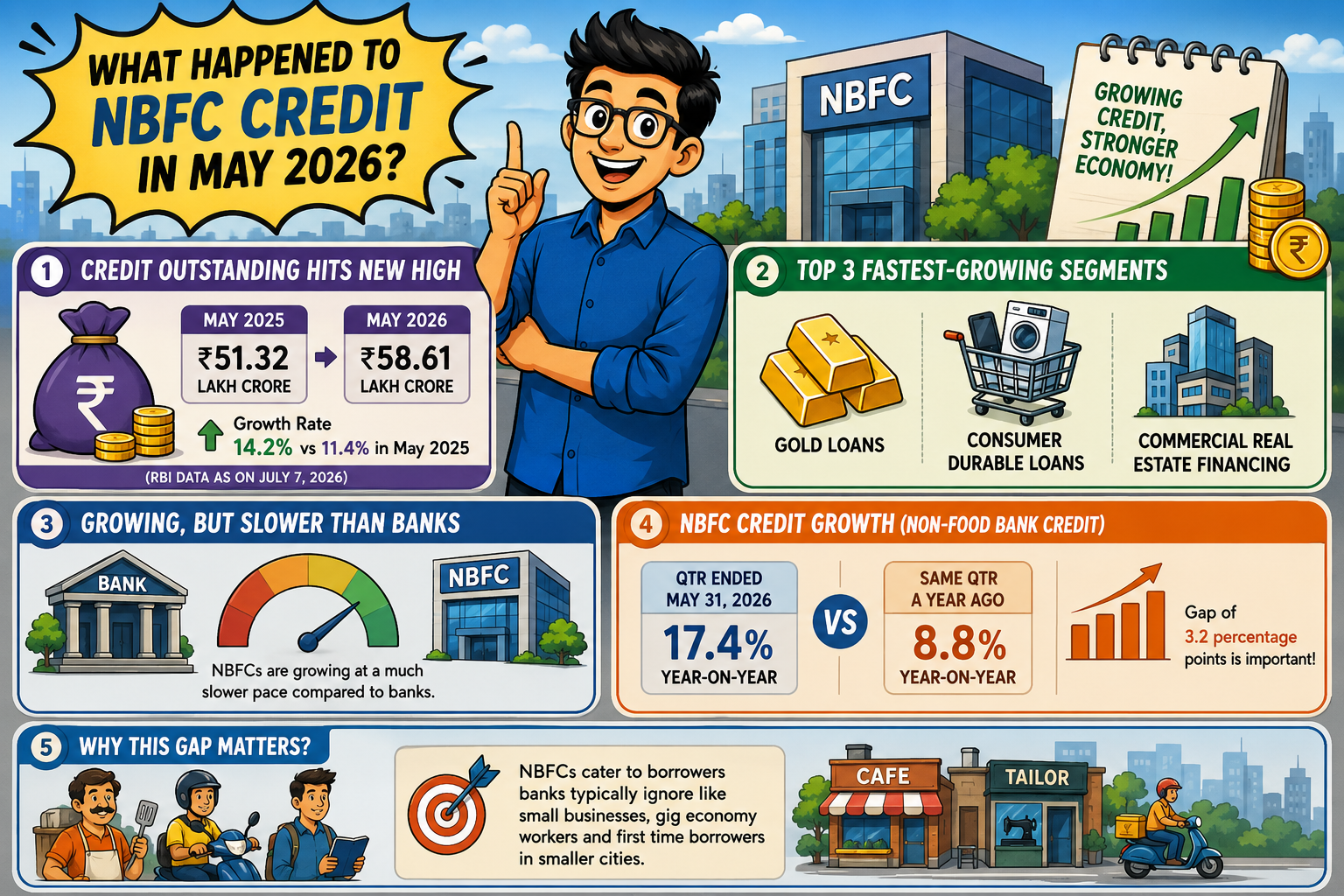
Non-banking financial companies, along with housing finance companies, had a gross credit outstanding balance of ₹58.61 lakh crore by the end of May 2026. This number stands at ₹51.32 lakh crore in May 2025 as per RBI’s latest figures dated July 7, 2026.
The growth rate of credit outstanding was 14.2% as compared to 11.4% in May 2025. Gold loans, consumer durable loans and commercial real estate financing accounted for the three fastest-growing segments of the aforementioned credit portfolio.
It compares favorably to the 8.8% growth rate in the same quarter a year ago. This gap of 3.2 percentage points is important because the NBFCs cater to the borrowers banks typically ignore like small businesses, gig economy workers and first time borrowers in smaller cities.
For an average salaried individual or small traders applying for either a personal or gold loan, the aforementioned numbers carry weight. The retail loans of NBFCs grew at 19.5% to ₹25.20 lakh crore in May 2026, as per the information provided by Business Standard on RBI’s figures.
The segment makes up for almost 43% of the total loan portfolio of NBFCs. The housing loans issued by NBFCs & HFCs saw a growth rate of 10.9% to ₹8.35 lakh crore, much above the 5.1% growth rate observed in May 2025.
The table given below reflects the performance of different loan segments from May 2025 to May 2026:
This is not entirely bad news for households. Gold loans jumping nearly 70% means more families are unlocking cash from idle jewellery instead of turning to informal moneylenders. Consumer durable loans growing 42% suggests more people are financing appliances and electronics through formal NBFC channels rather than credit cards or personal loans at higher rates.
Agriculture credit through NBFCs also picked up sharply, rising 17.9% year-on-year to ₹80,325 crore, compared with just 5% growth a year earlier. RBI attributed this jump to stronger allied lending in dairy, fisheries and horticulture, based on its sectoral deployment data released for the same period. This means more institutional credit is reaching them instead of informal lenders charging much higher interest for farmers and rural borrowers.
Industry watchers point to two separate stories playing out at once. Banks are lending faster to industry, with RBI data showing industrial credit from banks up 17.5% year-on-year in May 2026. NBFCs, by contrast, saw their industry-linked credit growth slow to 7.3%, down from 10% in May 2025, largely due to weaker infrastructure lending.
This divergence tells us NBFCs are increasingly a retail and small-ticket lending story, not a corporate one. RBI’s report was based on a sample of NBFCs in the upper and middle layers, along with HFCs, covering close to 87% of the sector’s total outstanding credit. That sample size makes this data fairly representative of the whole industry, not just a handful of large players.
Bank credit to services businesses grew 20.4% in May 2026, up sharply from 8.4% a year earlier, according to the RBI’s sectoral credit release. RBI officials noted this acceleration was driven partly by higher bank loans extended directly to NBFCs themselves, a sign that NBFCs are increasingly funding their own retail lending through bank borrowing rather than raising money independently. This dependency is worth watching. If bank funding to NBFCs tightens for any reason, retail credit growth at NBFCs could slow within two to three quarters.
The solution many analysts point to is diversification of funding sources. NBFCs that rely too heavily on bank borrowing face refinancing risk if interest rates move unfavourably. Raising funds through bonds, deposits and securitisation reduces this dependency. RBI’s own data shows deposits across the banking system grew 12.3% year-on-year as of the fortnight ending April 30, 2026, giving banks more room to lend onward to NBFCs, according to an ET Bureau report published May 8, 2026.
For borrowers, the practical takeaway is simple. Gold loans and consumer durable financing through NBFCs are currently the cheapest and fastest-growing entry points into formal credit. Housing and vehicle loans, while growing steadily, are more exposed to interest rate cycles and require closer comparison across lenders before signing up.
NBFC credit crossing ₹58.6 lakh crore in May 2026 marks a genuine acceleration from a year ago, but the sector is still not catching up to banks, which grew credit at 17.4% in the same window. The real story is not banks versus NBFCs as competitors, but two lenders serving different needs: industry and infrastructure through banks, and retail and small-ticket loans through NBFCs.
Gold loans, consumer durables and commercial real estate are driving this NBFC growth, while industry-linked lending has slowed. Over the next two to three quarters, watch whether NBFCs can reduce their dependence on bank funding, since that single factor will decide how sustainably this 14.2% growth holds up.
Yes, this is a good time to consider it. NBFC credit crossed ₹58.6 lakh crore in May 2026, with retail loans, gold loans and consumer durable financing expanding fastest. This growth needs more people to check applications, assess risk and manage collections. Credit manager roles are opening up mainly in retail, gold loan and housing loan teams, since these segments are growing the quickest. Pay and demand are generally stronger in NBFCs with heavy gold or retail books compared to those focused on industry loans, which slowed to 7.3% growth this year.
It depends on your priority. NBFC and HFC home loans grew 10.9% to ₹8.35 lakh crore in May 2026, and many NBFCs offer faster approval with fewer documents. Banks, however, are growing overall credit faster at 17.4% and often give lower interest rates on home loans. If you want quick disbursal or have a lower credit score, an NBFC can work well. If your priority is the lowest possible interest rate over 15 to 20 years, compare bank offers first before deciding.









.png&w=3840&q=75)


