
By continuing, you agree to LoansJagat's Credit Report Terms of Use, Terms and Conditions, Privacy Policy, and authorize contact via Call, SMS, Email, or WhatsApp
Disclaimer: The information published on LoansJagat is intended for general informational and educational purposes only and should not be considered financial, legal, or investment advice. Interest rates, loan terms, statistics, and other data may change over time and may vary by lender or source. Please verify the latest information and consult a qualified financial advisor or the respective Bank/NBFC before making any financial decisions.
Subscribe Now
About the author

Arshathul Afia
Arshathul Afia is a journalism graduate and fintech content writer with 4+ years of experience in digital publishing and research-led writing. She has written 200+ articles covering personal finance, lending, banking, digital payments, credit, insurance, and major financial developments in India. At LoansJagat, she focuses on simplifying complex fintech news, RBI updates, loan-related changes, policy developments, and industry trends for everyday readers. Her journalism background helps her approach stories with research, context, and clarity, while her SEO experience ensures content remains discoverable and relevant. She aims to make financial news easier to understand, practical, and useful for readers across India.
Related Blog Post
Simplify All Your Loans Into One Affordable EMI

Customers Served

Debt Consolidated

1200+ Reviews

Locations in India
Club all Loans & Credit Card Bills into Single EMI

Quick Apply Loan
Consolidate your debts into one easy EMI.

Takes less than 2 minutes. No paperwork.

10 Lakhs+
Trusted Customers

2000 Cr+
Loans Disbursed

4.7/5
Google Reviews

50+
Banks & NBFCs Offers
Other services mentioned in this article
CBDT’s revised AY 2026-27 ITR forms require taxpayers to confirm a secondary address, adding a new validation step for communication details during the online filing season.
Key Highlights
The Central Board of Direct Taxes has introduced a mandatory primary and secondary address check for taxpayers filing income tax returns for AY 2026-27. The change applies to returns covering income earned during FY 2025-26 and filed through the Income Tax Department portal. A filer must either confirm that both addresses are the same or provide a complete secondary location. The notification form describes these details as addresses collected for communication purposes.
For most people, the extra question may take less than a minute. A wrong answer can still interrupt filing. Selecting “No” and repeating the primary address, leaving fields incomplete, or accepting an outdated pre-filled location can produce an error. Over the longer term, the new format may help taxpayers who live near their workplace but retain a permanent family address elsewhere.
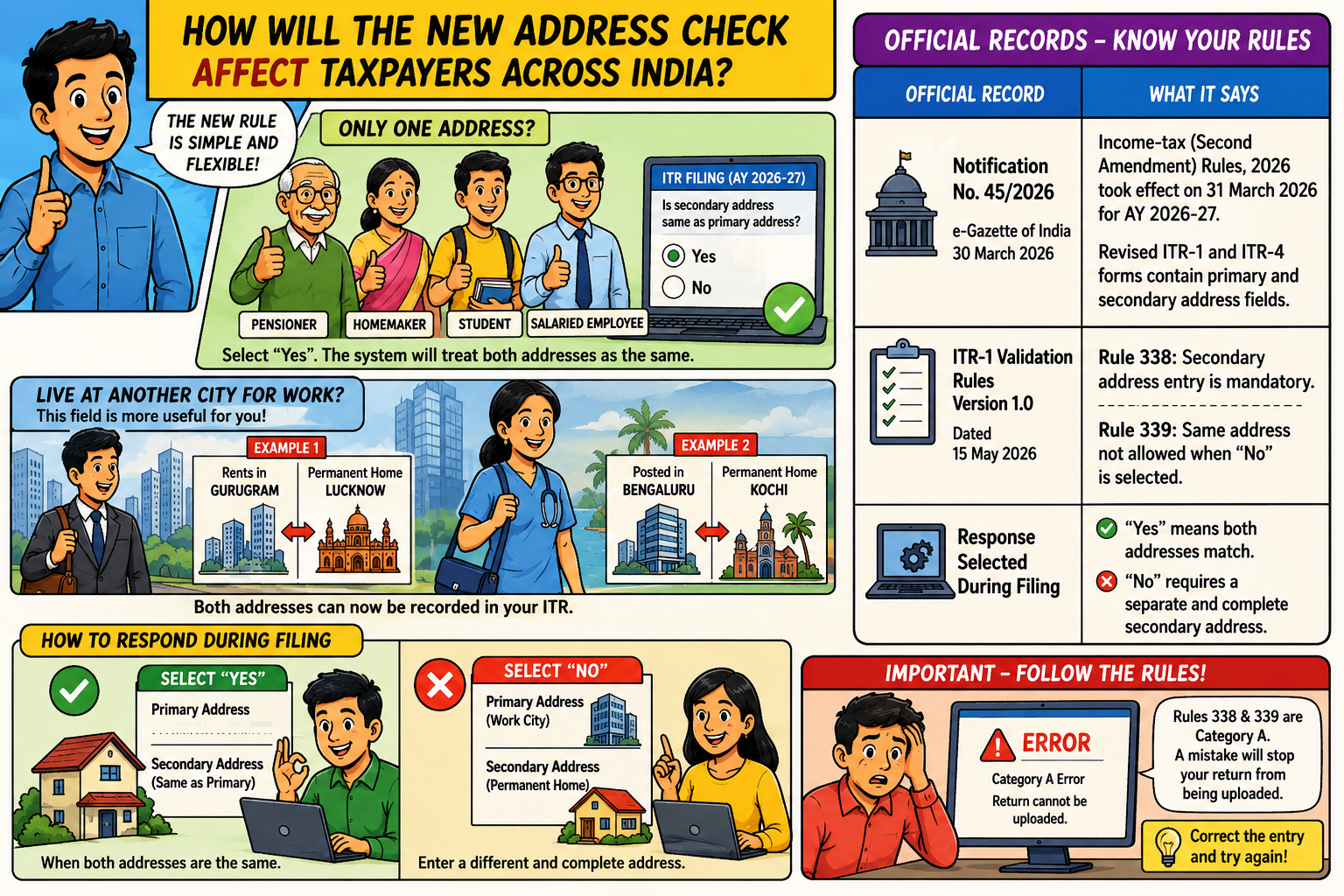
The rule does not require anyone to own, rent or occupy 2 homes. A taxpayer using only 1 address can select "Yes." The filing utility will then treat the secondary location as the same as the primary address. Pensioners, homemakers, students and salaried employees living at their permanent homes do not have to invent another location.
People who move for work may find the new field more useful. An employee renting in Gurugram could retain a permanent family address in Lucknow. A nurse posted in Bengaluru may use Kochi as the alternate location. Both addresses can now appear in the return instead of forcing the filer to choose only 1.
The official records show when the change began and what the portal expects from taxpayers. The key entries are listed below.
Rules 338 and 339 fall under Category A of the ITR-1 validation document. The Income Tax Department states that a Category A error prevents the return from being uploaded and displays an error message. The filer must correct the entry before trying again.
CBDT has not issued a separate statement linking the field to 1 deduction, 1 income category or a specific enforcement drive. The revised return itself places both locations under the details supplied for communication purposes. That remains the official explanation available through the Ministry of Finance notification.
The wording reflects a common filing situation in India. Many people keep a permanent address in their hometown but live near an office, hospital, university or business in another state. Others change rented homes without immediately updating every official record. A second address gives the department another communication location within the filed return.
It may also reduce problems caused by older portal data. Taxpayers sometimes proceed with pre-filled information without reading every line. The new question forces them to look at their residential details before completing Part A.
Earlier versions of ITR-1 generally displayed a single physical address. Mobile numbers and email IDs had expanded over time, but the residential section still focused on 1 location. The AY 2026-27 form now separates contact details into primary and secondary entries.
CBDT introduced the revised ITR-1 and ITR-4 through Notification No. 45/2026, issued as G.S.R. 226(E) in New Delhi on 30 March 2026. The rules became effective on 31 March 2026. Later, the Directorate of Income Tax Systems released the ITR-1 validation rules on 15 May 2026, explaining how wrong address responses would be handled.
The sequence is useful for taxpayers. The notification created the new form. The later validation document showed that the secondary-address question would not operate as an optional blank box.
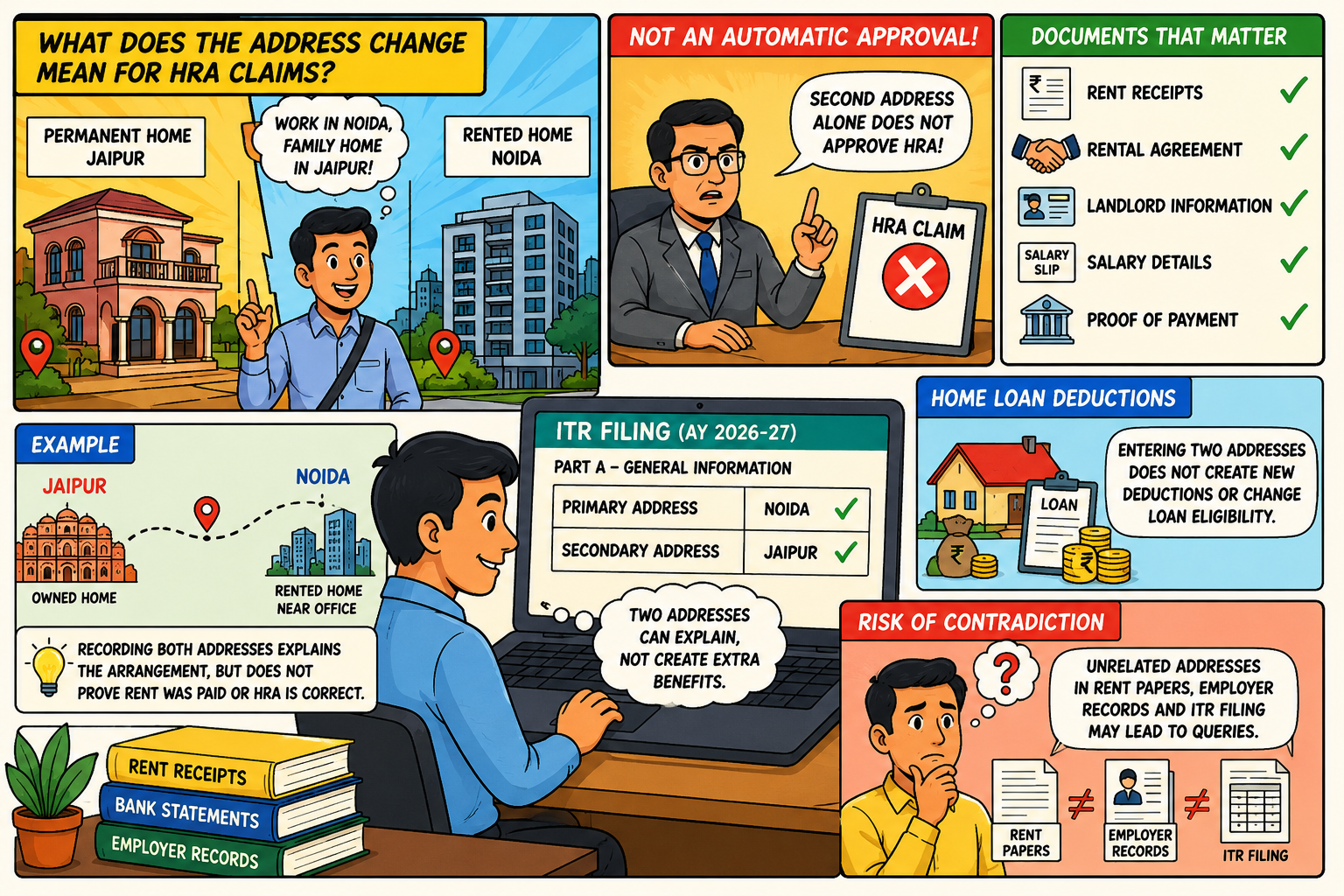
The second address could help explain why an employee pays rent in 1 city while retaining a permanent or owned home elsewhere. That does not make the field an HRA approval mechanism. Rent receipts, salary details, the rental agreement, landlord information and proof of payment remain relevant when supporting an exemption.
For example, an employee may own a house in Jaipur but rent accommodation near an office in Noida. Recording both locations can explain the arrangement. Yet the address declaration alone does not prove that rent was paid or that an exemption was correctly calculated.
The same applies to home loan deductions. Entering 2 addresses does not create a new deduction, increase an existing benefit or alter loan eligibility. A contradiction may lead to a query when rent papers, employer records and the filed return show unrelated locations without an explanation.
The Income Tax Department’s position is procedural. The taxpayer must answer the secondary-address question. A separate entry becomes necessary after “No” is selected, and that location cannot be identical to the primary address. The Ministry of Finance notification refers to communication purposes and does not describe the field as an automatic scrutiny trigger.
From a LoansJagat filing perspective, the larger effect is likely to involve consistency of personal data rather than the amount of tax payable. The new address gives the filing system another detail that can be compared with the taxpayer’s profile, rent papers and employer records. The LoansJagat ITR filing guide advises taxpayers to review personal information before moving to income, deductions, submission and verification. The address check now belongs in that review.
A simple order can prevent most errors. The taxpayer should first identify the current communication address, check the pre-filled details and then answer whether another location exists. A filer using 2 genuine addresses should enter both. Someone using only 1 should select “Yes” instead of choosing “No” and typing the same details again.
Documents are generally not attached to an annexure-less ITR. They should still be retained. Rent receipts, lease papers, employer records and address proof may help when the department later asks why 2 locations were reported.
The house or flat number should match the location currently used for communication. The filer must also review the street, locality, town, state, country and PIN code. A correct PIN code with an outdated house address is still inaccurate.
Anyone who shifted during FY 2025-26 should avoid copying an older address without checking it. The present residence may be entered as primary, while a permanent family home can be shown as secondary. The reverse may also be used where the permanent home remains the main communication location.
Taxpayers using return-preparation software should run the final validation before uploading. The official rules apply at the portal level, even when somebody prepares the return through another utility.
The primary and secondary address check is a small addition backed by a firm validation requirement. Most filers will complete it quickly. People who shifted during FY 2025-26 or maintain a permanent home elsewhere may need a few extra minutes.
CBDT has framed both fields as communication details. The official records do not require every taxpayer to maintain 2 residences, nor do they convert the address declaration into an HRA test on its own.
A correct “Yes” or "No," followed by a final review of the house number, locality and PIN code, should prevent an avoidable filing interruption.
Is a second home mandatory for filing ITR in AY 2026-27?
No. A taxpayer with only 1 address can confirm that the secondary address is identical.
What happens when both addresses are the same?
The filer should select "Yes." The utility will use the primary details for the secondary entry.
Can the same address be entered after selecting “No”?
No. Validation Rule 339 treats the repeated address as an error and prevents upload.
Does a secondary address affect HRA eligibility?
No. HRA depends on the selected tax regime, actual rent payment, salary and supporting records.
Which address should be entered as primary?
The taxpayer should use the preferred current communication address and provide a genuine alternate location where applicable.









.png&w=3840&q=75)


