
By continuing, you agree to LoansJagat's Credit Report Terms of Use, Terms and Conditions, Privacy Policy, and authorize contact via Call, SMS, Email, or WhatsApp
Disclaimer: The information published on LoansJagat is intended for general informational and educational purposes only and should not be considered financial, legal, or investment advice. Interest rates, loan terms, statistics, and other data may change over time and may vary by lender or source. Please verify the latest information and consult a qualified financial advisor or the respective Bank/NBFC before making any financial decisions.
Subscribe Now
About the author

Arshathul Afia
Arshathul Afia is a journalism graduate and fintech content writer with 4+ years of experience in digital publishing and research-led writing. She has written 200+ articles covering personal finance, lending, banking, digital payments, credit, insurance, and major financial developments in India. At LoansJagat, she focuses on simplifying complex fintech news, RBI updates, loan-related changes, policy developments, and industry trends for everyday readers. Her journalism background helps her approach stories with research, context, and clarity, while her SEO experience ensures content remains discoverable and relevant. She aims to make financial news easier to understand, practical, and useful for readers across India.
Related News
Simplify All Your Loans Into One Affordable EMI

Customers Served

Debt Consolidated

1200+ Reviews

Locations in India
Club all Loans & Credit Card Bills into Single EMI

Quick Apply Loan
Consolidate your debts into one easy EMI.

Takes less than 2 minutes. No paperwork.

10 Lakhs+
Trusted Customers

2000 Cr+
Loans Disbursed

4.7/5
Google Reviews

50+
Banks & NBFCs Offers
Instead of fighting avoidable tax cases for years, the government plans to fix problems earlier and focus officers on disputes that genuinely deserve closer investigation.
Finance Minister Nirmala Sitharaman has said the Union government is moving from managing tax litigation after it begins to preventing disputes at their source. Speaking at the 8th International Tax Research and Analysis Foundation conference in Bengaluru on 16 September 2026, she linked this approach to India’s economic growth and asked researchers, companies and tax professionals to offer quantified policy alternatives. For taxpayers, the approach could result in fewer avoidable notices and appeals if the reforms work as intended. The longer-term goal is a tax system whose wording, digital processes and administrative decisions produce more predictable results.
There is a possible downside during the transition. Simpler statutes will not end disputes if assessment units and appellate authorities interpret the same provision differently. Digital checks may also create mismatches for honest filers. The government will therefore be judged by the experience after filing, not only by shorter laws or later settlement schemes.
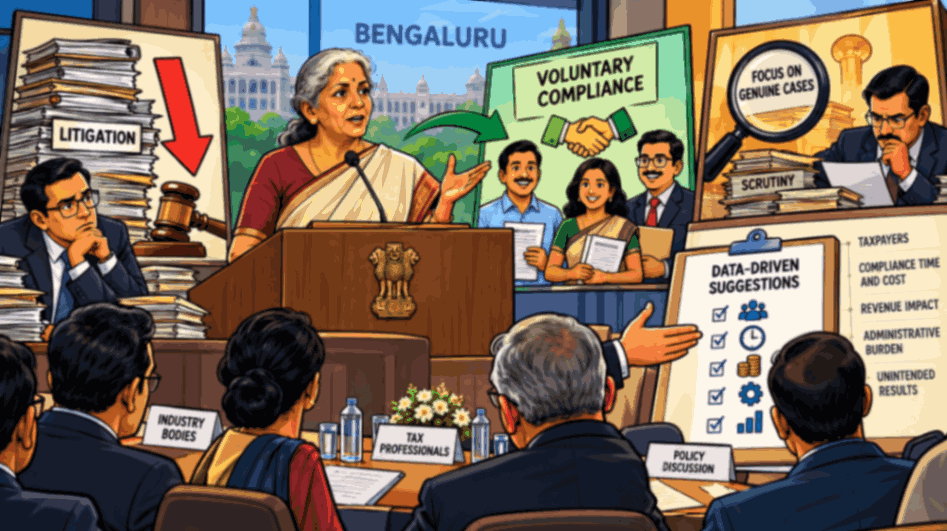
Sitharaman told the conference that the aim was to reduce litigation rather than become better at handling an ever-growing stock of cases. Her stated approach gives voluntary compliance the easier route and reserves enforcement capacity for cases that genuinely need scrutiny. That changes the policy test. A successful reform should stop an ambiguous demand from arising, while a case-disposal drive only tackles the dispute after the taxpayer has spent time and money on it.
The minister also asked industry bodies and tax professionals to move beyond requests for lower rates or fresh exemptions. She sought proposals identifying the taxpayers affected, compliance time and cost, revenue impact, administrative burden and unintended results. She urged the foundation to develop as an independent institution capable of testing proposals before they become rules.
Most people do not land in a tax dispute because of an elaborate financial arrangement. The trouble may begin with a missing TDS credit, an income figure that does not match Form 26AS, or an online reply that nobody acts upon. A pensioner or shopkeeper can then spend months chasing what began as a routine error.
An early correction window could stop that chain. Taxpayers would spend less on professional help, refunds may arrive sooner, and families would not need to search through years of payslips, bank statements and old notices.
The gains could extend beyond income tax. Smaller businesses plan cash flow around GST credits, refunds and routine transactions. When the rule and its digital treatment agree, firms can price goods, pay suppliers and borrow with fewer surprises. Lower compliance expenses can free working capital for hiring, inventory and repayment. The benefit still depends on quick correction windows and reasoned orders taxpayers can act upon.
Rohinton Sidhwa, a partner at Deloitte India, said on 12 February 2025 that replacing complex income-tax provisions with simpler drafting was intended to reduce disputes and encourage voluntary compliance. That view supports Sitharaman’s prevention-first direction, though legislation is only the opening step. Rules, forms, portal checks and officer training must apply the rewritten provisions in the same way. Otherwise, old disputes can reappear under new section numbers.
A workable solution has 3 parts. The department can publish short examples for recurring issues, provide a usable pre-demand correction window and disclose where appellate decisions repeatedly reject the same departmental position. LoansJagat views early certainty as more useful for households than a later settlement window because a dispute avoided also avoids blocked refunds, professional fees and repeated portal follow-ups. A later settlement can close an old file, while an accurate first-stage decision keeps that file from being created.
Sitharaman’s Bengaluru remarks followed several changes introduced since 2024. The government first raised the monetary limits for appeals filed by the tax department. Each limit is based on the amount of tax involved in the dispute. It then moved towards simpler drafting and agreements that could prevent certain cases from starting at all.
Those steps were quite different from one another. A settlement scheme helped people close an existing dispute, while an advance pricing agreement gave a company greater certainty before the tax department examined its transactions.
The sequence tells its own story. Higher appeal limits removed smaller departmental cases from the courts, and Vivad Se Vishwas offered an exit for eligible disputes that were already pending. Neither measure could stop a poorly drafted rule or an inconsistent assessment from producing another case.
The later changes moved closer to the starting point. Simpler provisions can reduce competing interpretations. Advance agreements can settle a transfer-pricing method before an officer raises a demand. That is closer to the prevention-first approach outlined by Sitharaman.
Tax officials are also handling a larger revenue pool. Figures available on 31 March 2026 placed net direct-tax collections for FY 2025-26 at ₹23.40 lakh crore, which was 5.12% higher than the previous year. As receipts and filings grow, even a recurring assessment error can create thousands of replies, rectification requests and appeals. Preventing that error early would save work on both sides.
Sitharaman’s request for quantified proposals places a new responsibility on trade groups, professional bodies and researchers. A submission seeking a deduction or procedural change should show the affected group, filing hours saved, revenue cost and risks of misuse. Evidence can expose drafting problems before authorities build them into forms and software.
Tax administrators have a related duty. They should turn repeated court losses into amended instructions, track how often automated adjustments are reversed and publish response times for rectification. Chartered accountants and advocates can identify patterns from live cases, while businesses can report the operational cost of ambiguous rules. These stakeholder roles differ, but each supplies evidence that a prevention policy needs.
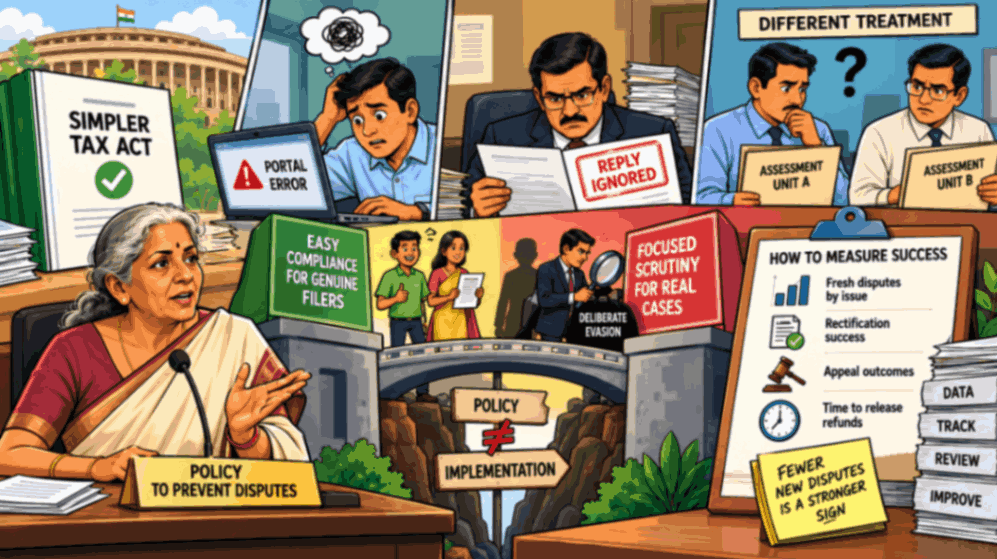
The largest risk is a gap between policy and daily administration. A simpler Act helps little if a portal blocks a valid claim, an order ignores the reply or assessment units treat the same transaction differently. Prevention cannot mean softer enforcement for deliberate evasion. Sitharaman’s formula requires easy compliance for genuine filers and focused scrutiny where facts warrant it.
Measurement will decide whether the shift is working. The government should report fresh disputes by issue, rectification success, appeal outcomes and the time taken to release refunds after a favourable order. A fall in pending cases can result from settlements or higher appeal limits. A fall in newly created disputes would offer stronger proof that policy design and administration have improved.
Sitharaman’s point in Bengaluru was direct. The government wants to stop avoidable tax disputes early, instead of letting cases pile up and trying to settle them years later. She referred to Vivad Se Vishwas, higher tax-effect limits for departmental appeals and the growing use of advance pricing agreements.
The Income-tax Bill, 2025 began as a proposal. Parliament later passed it as the Income-tax Act, 2025, and the new law replaced the 1961 Act from 1 April 2026. Sitharaman also said tax policy must keep pace with India’s economic growth. Voluntary compliance should become easier, while enforcement should remain focused on cases that require closer examination.
On 16 September 2026, she said the government wanted to reduce disputes at their source, make voluntary compliance easier and use enforcement resources for cases needing closer scrutiny. She also asked policy contributors to support proposals with measurable costs, reach and revenue effects.
Consistent rules, better portal checks and an early correction option can stop routine mismatches from becoming formal demands. That can reduce legal expense, prevent refunds from remaining blocked and shorten the time for which households must retain documents and pursue replies.
The limits announced in 2024 are ₹60 lakh for appeals before the Income Tax Appellate Tribunal, ₹2 crore before High Courts and ₹5 crore before the Supreme Court. These are thresholds for departmental appeals, not a waiver of a taxpayer’s assessed liability.
Yes. The prevention-first policy does not remove appeal rights. A taxpayer can challenge an assessment through the available statutory route, subject to the applicable procedure and deadline. The higher monetary limits described above govern many appeals filed by the department.
No. Notices may still arise where information differs, a return needs scrutiny or suspected evasion requires investigation. Simpler drafting should reduce notices caused by ambiguity, but results will depend on software, instructions, officer decisions and accessible correction mechanisms.









.png&w=3840&q=75)


