.png&w=3840&q=65)
By continuing, you agree to LoansJagat's Credit Report Terms of Use, Terms and Conditions, Privacy Policy, and authorize contact via Call, SMS, Email, or WhatsApp
Disclaimer: The information published on LoansJagat is intended for general informational and educational purposes only and should not be considered financial, legal, or investment advice. Interest rates, loan terms, statistics, and other data may change over time and may vary by lender or source. Please verify the latest information and consult a qualified financial advisor or the respective Bank/NBFC before making any financial decisions.
Subscribe Now
About the author
Arshathul Afia
Arshathul Afia is a journalism graduate and fintech content writer with 4+ years of experience in digital publishing and research-led writing. She has written 200+ articles covering personal finance, lending, banking, digital payments, credit, insurance, and major financial developments in India. At LoansJagat, she focuses on simplifying complex fintech news, RBI updates, loan-related changes, policy developments, and industry trends for everyday readers. Her journalism background helps her approach stories with research, context, and clarity, while her SEO experience ensures content remains discoverable and relevant. She aims to make financial news easier to understand, practical, and useful for readers across India.
Related Blog Post
Simplify All Your Loans Into One Affordable EMI

Customers Served

Debt Consolidated

1200+ Reviews

Locations in India
Club all Loans & Credit Card Bills into Single EMI

Quick Apply Loan
Consolidate your debts into one easy EMI.

Takes less than 2 minutes. No paperwork.

10 Lakhs+
Trusted Customers

2000 Cr+
Loans Disbursed

4.7/5
Google Reviews

50+
Banks & NBFCs Offers
Other services mentioned in this article
Despite being free from debt, a professional working in Bengaluru, who makes ₹2 lakh monthly, still feels like purchasing from time to time is risky, as he considers poverty a reality at a young age and the family's future needs to be considered.
A 26-year-old professional working in Bengaluru has drawn attention online after saying that a monthly salary of ₹2 lakh has not removed his fear of spending. In a Reddit post shared in July 2026, he described having no EMIs, no family loans and more than ₹14 lakh in disclosed savings. He still feels uneasy while considering a shirt priced above ₹750.
The post involves a young salaried employee in Bengaluru, his parents in his hometown and a list of planned expenses that could reach ₹31 lakh. It has gained attention because the salary looks comfortable, but the man’s financial position changes once marriage, land, family support and asset purchases enter the picture. The immediate risk is unnecessary guilt around ordinary spending. A bigger risk would be chasing quick returns and losing money reserved for his family.
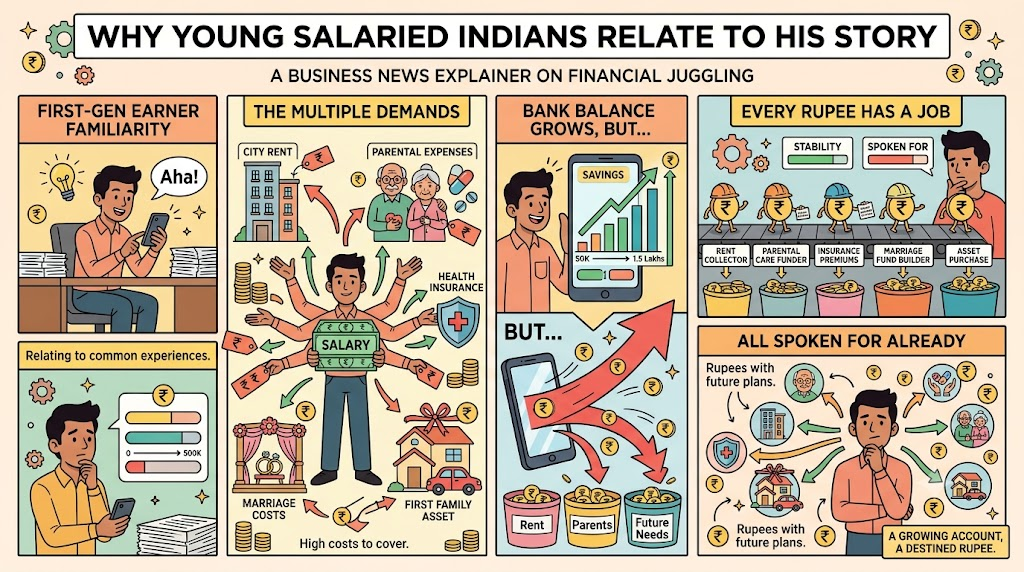
The experience described in the post will appear familiar to many first-generation earners. A monthly salary may need to cover city rent, parental expenses, health insurance, marriage costs, and the first major asset owned by the family. The bank balance grows, but every rupee already has a future job.
The Bengaluru professional has one useful advantage. He has no reported EMI burden. He also invests regularly and has already improved his parents’ living conditions. That leaves him with more options than a borrower paying several instalments each month. However, a high monthly income does not make large goals affordable.
According to the Ministry of Statistics and Programme Implementation, the average monthly per capita consumption expenditure (MPCE) of urban India 2023-24 is ₹6,996. The price of Karnataka urban was ₹8,076.
These numbers do not represent a full Bengaluru household budget. They do show the distance between routine monthly spending and expenses such as land, a wedding or a car.
Until he got his first job at 21, the man said that his family was living on ₹6,000 to ₹7,000 per month. The family was of 3 persons, and their living room was 10m x 10m. He started his job in 2021 and asked his parents to leave their work and come live in his hometown in his 2BHK house.
He has to reside in Bangalore for his work. He rents a 2BHK there and sends ₹15,000 to ₹20,000 home each month. The post doesn't specify if his parents have a pension or personal pension funds.
His disclosed figures present a better picture than his fear suggests, though the planned purchases create a sizeable gap.
The figures in the table are self-reported. The ₹2 lakh salary may be gross pay or take-home income because the poster did not specify this. That detail would change the monthly cash-flow calculation.
Even so, the broad problem is visible. His stated goals exceed his present savings by roughly ₹10.5 lakh to ₹17 lakh. He can buy some of the items, not all of them together. Protecting the existing reserve therefore becomes a priority in his mind.
His spending fear appears linked to the years before his salary improved. The family previously lived with very little income and limited housing space. The money in his salary account now represents protection from that earlier period.
He said he eats outside, meets friends, attends occasional parties and travels. He has also bought useful items. These include a ₹60,000 scooter, a ₹70,000 MacBook M2 and a ₹25,000 OnePlus phone. Complete refusal to spend is not the problem.
The reaction changes when a purchase feels optional. A shirt costing more than ₹750 can appear unnecessary when the same money could remain in the bank. Repeating this calculation for every purchase creates pressure, even when the expense fits comfortably within the monthly income.
LoansJagat’s review of the figures disclosed in the post places his stated monthly investments and regular expenses at around ₹90,000 to ₹95,000. That leaves a substantial portion of his ₹2 lakh salary unaccounted for, assuming the figure represents take-home pay.
The remaining money may be going into the salary account, irregular family expenses, travel, or other purchases not listed in the post. The missing detail limits any exact assessment. Still, the numbers suggest that he is not facing an immediate cash shortage.
The larger issue is goal timing. A ₹10 lakh wedding, ₹15 lakh land purchase, ₹4 lakh used car, and ₹2 lakh motorcycle cannot all be treated as current needs. They require an order.
A LoansJagat guide on guilt-free spending, published on January 27, 2026, explains that planned personal spending can work alongside savings. In this case, a fixed monthly allowance for clothes, meals and travel could stop each purchase from being compared with the entire family’s future.
The usual advice starts with separating funds by purpose. Emergency money should remain liquid. A wedding planned within a year needs a different approach from land that may be purchased after 4 or 5 years.
The SEBI Investor portal advises investors to consider the goal, investment period, and personal risk capacity before selecting a product. Short-term money should not be exposed to heavy market swings. Longer goals can allow more time for investments to recover from temporary falls.
Applied to this case, the man could divide his savings into 5 parts:
Emergency and parental medical expenses
Wedding expenses
Land purchase
Car or motorcycle
Personal spending
He does not need to fund all 5 equally. The emergency reserve comes first. A wedding with a fixed date may follow. Land can take longer. The car and motorcycle should be judged by use, not social pressure.
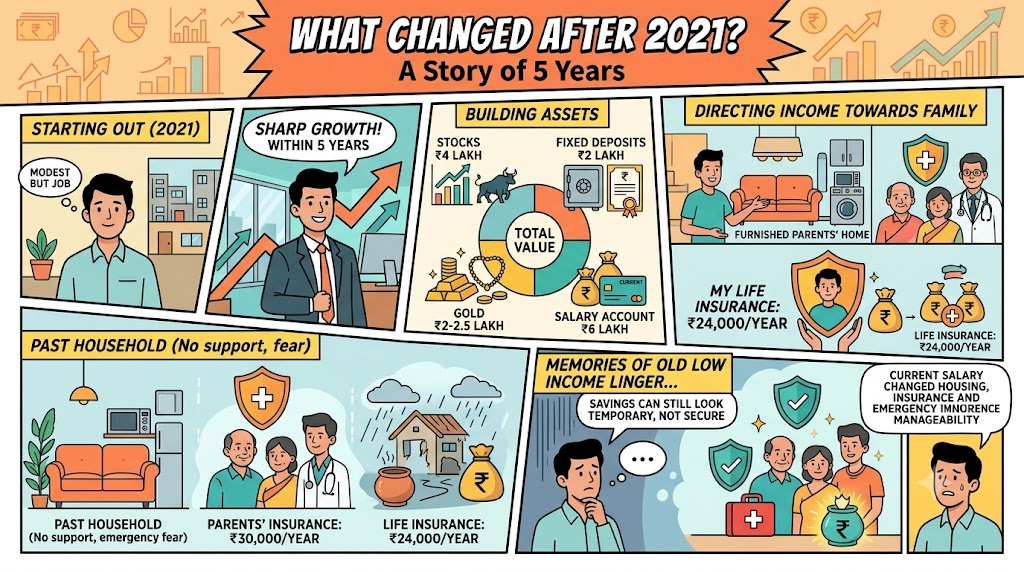
The man’s position has changed sharply within about 5 years. He said his accumulated assets include ₹4 lakh in stocks, ₹2 lakh in fixed deposits, ₹2 lakh to ₹2.5 lakh in gold, and ₹6 lakh in his salary account.
He also furnished his parents’ home and pays ₹30,000 each year for their health insurance. His own life insurance costs ₹24,000 annually. Those payments show that he has already directed his income towards family protection.
The earlier household did not have this support. His current salary has changed housing, insurance access, and the family’s ability to manage an emergency. Yet the memory of the older income remains close. That can make the current savings look temporary rather than secure.
Responses to the post were divided. Several users praised his progress and advised him to avoid risky investments. They suggested planning one goal at a time rather than trying to purchase land, a car, and a motorcycle before marriage.
One commenter described him as part of the “sandwich generation”. The phrase referred to an earner who supports parents while also trying to create assets for his own future. He may have a high salary but no inherited property, retirement cushion or family capital behind him.
Other users were less sympathetic. Some said a person earning ₹2 lakh and carrying no debt was already in a strong position. A few felt that the post was seeking validation. The man later acknowledged that reassurance may have been one reason for sharing his experience.
The Bengaluru professional compared himself with hometown friends working as auto drivers and manual labourers. He said they appeared happier, even though some had bought motorcycles through loans.
That comparison leaves out several details. Their housing costs may be lower. Some may live in family-owned homes. Others may receive support from parents or share expenses with siblings. Their outstanding loans, medical costs and savings are unknown.
Visible spending rarely shows the full household position. A new motorcycle shows up immediately. A medical emergency fund does not.
Comparing his bank balance with another person’s purchase can therefore push him towards decisions that do not suit his own responsibilities.
The Bengaluru professional’s post does not prove that ₹2 lakh is an inadequate monthly salary. His disclosed income, lack of debt and regular investments place him in a stronger financial position than many people of the same age.
His anxiety comes from a different calculation. Savings of ₹14 lakh to ₹14.5 lakh look limited when placed beside goals worth up to ₹31 lakh, retired parents and memories of a household earning only ₹6,000 to ₹7,000 a month.
The safest response is not a rushed investment. A better route is slower and less dramatic. Protect emergency money, place each goal on a date, and keep a small amount for personal use. That allows caution to remain useful without letting it control every ₹750 purchase.
Why does the Bengaluru man feel financially insecure despite earning ₹2 lakh?
His family’s earlier poverty, parental responsibility and goals worth up to ₹31 lakh continue to influence his spending decisions.
How much has he reportedly saved?
He disclosed savings and investments of around ₹14 lakh to ₹14.5 lakh across stocks, deposits, gold and cash.
Does he have any loans or EMIs?
According to the anonymous post, neither he nor his parents currently have loans.
How much does he invest each month?
He invests ₹50,000 in mutual funds, deposits, and gold chits.
Why does he still feel poor despite earning ₹2 lakh a month?
Family duties, big expenses, and past financial struggles still make him think twice before spending.
What is the first thing he should do?
Ideal usage of emergency funds and near-term wedding expenses should be before optional purchases, like a second car.









.png&w=3840&q=75)


