
By continuing, you agree to LoansJagat's Credit Report Terms of Use, Terms and Conditions, Privacy Policy, and authorize contact via Call, SMS, Email, or WhatsApp
Disclaimer: The information published on LoansJagat is intended for general informational and educational purposes only and should not be considered financial, legal, or investment advice. Interest rates, loan terms, statistics, and other data may change over time and may vary by lender or source. Please verify the latest information and consult a qualified financial advisor or the respective Bank/NBFC before making any financial decisions.
Subscribe Now
About the author

Arshathul Afia
Arshathul Afia is a journalism graduate and fintech content writer with 4+ years of experience in digital publishing and research-led writing. She has written 200+ articles covering personal finance, lending, banking, digital payments, credit, insurance, and major financial developments in India. At LoansJagat, she focuses on simplifying complex fintech news, RBI updates, loan-related changes, policy developments, and industry trends for everyday readers. Her journalism background helps her approach stories with research, context, and clarity, while her SEO experience ensures content remains discoverable and relevant. She aims to make financial news easier to understand, practical, and useful for readers across India.
Related News
Simplify All Your Loans Into One Affordable EMI

Customers Served

Debt Consolidated

1200+ Reviews

Locations in India
Club all Loans & Credit Card Bills into Single EMI

Quick Apply Loan
Consolidate your debts into one easy EMI.

Takes less than 2 minutes. No paperwork.

10 Lakhs+
Trusted Customers

2000 Cr+
Loans Disbursed

4.7/5
Google Reviews

50+
Banks & NBFCs Offers
Other services mentioned in this article
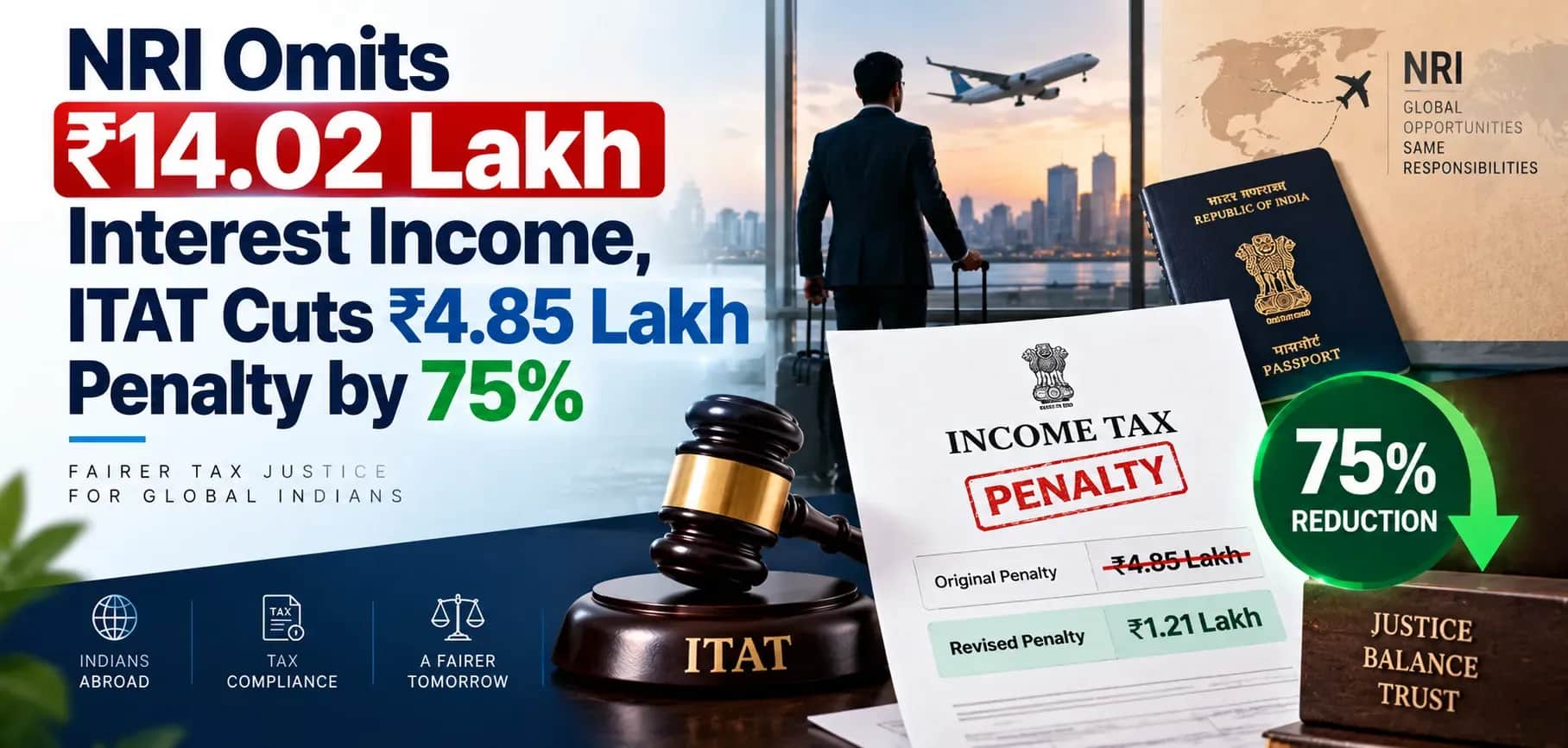
Mumbai ITAT cut an NRI’s tax penalty by 75% after finding that omitted interest showed under-reporting but did not prove deliberate misreporting of taxable income.
Key Highlights
In Tasneem Feroz Nalwalla v. ITO, the tribunal did not cancel the penalty. It changed the way the omission was classified. That brought the amount down from ₹4.85 lakh to ₹1.21 lakh, a reduction of 75%, through the order dated August 20, 2026.
The relief lowers her immediate penalty bill, but it does not erase the filing failure. She had already paid ₹5.49 lakh as additional tax and statutory interest. In the longer run, this order may influence cases where tax officers use the 200% misreporting rate merely because income was discovered through departmental records. For taxpayers, missed bank interest can still bring reassessment, extra tax, interest and years of litigation.
For Assessment Year 2020-21, the woman reported total income of only ₹43,796 in her return filed under Section 139(1). The figure did not match the financial information available on the Income Tax Department’s Insight Portal. Its records showed interest receipts of ₹14,46,321.
That mismatch prompted a closer check. The Assessing Officer contacted ICICI Bank, ICICI Securities and Kotak Mahindra Bank under Section 133(6). Their responses showed that ₹14,02,525 of interest had been left out of the return. The officer then included this amount under income from other sources.
There are 2 figures in reports about this case, and they refer to different parts of the assessment. ₹14.02 lakh was the interest left out of the return. ₹14.46 lakh was the total income assessed after the addition.
The taxpayer paid the tax and interest, totalling ₹5,49,410, on January 23, 2025. That payment was separate from the penalty. After the tribunal’s order, she must still pay ₹1,21,295 unless a later legal proceeding changes the result.

The official text of Section 270A provides 2 different penalty rates. Ordinary under-reporting attracts a penalty equal to 50% of the tax payable on the unreported income. Under-reporting caused by misreporting attracts a much steeper penalty of 200%.
This difference is important for salaried employees, pensioners, investors and NRIs earning interest from Indian accounts. An omitted entry can still lead to a 50% penalty. However, the tax department must support the more serious misreporting charge with facts that fit Section 270A(9). Detection through bank records does not automatically settle that question.
The positive part is limited but useful. A taxpayer can explain how an omission occurred and produce records showing that it was not a planned attempt to hide income. Later conduct can also be considered. Paying the tax quickly, replying to notices and sharing bank documents may support the explanation, though none of these steps guarantees relief.
There is a warning here too. An accountant’s error does not transfer legal responsibility away from the taxpayer. Living outside India also gives no exemption from reporting taxable Indian income. The return still belongs to the person whose PAN appears on it.
Before the tribunal, the woman accepted that the interest income had not been reported. Her dispute concerned the penalty rate. She argued that the omission amounted to ordinary under-reporting, which attracts 50%, rather than misreporting carrying a 200% penalty.
Her counsel said she was living outside India and remained a non-resident until April 1, 2025. She had handed her income tax work to an accountant and had limited familiarity with electronic notices. According to her submission, the accountant’s mistake caused the omission, while her lack of access to the filing process left her unaware of the notices.
Once she learnt about the reassessment, she paid ₹2,42,589 as tax and ₹3,06,821 as interest. The payment was completed on January 23, 2025. She used this later conduct to support her claim that there had been no plan to conceal the income.
The tribunal did not accept every part of her case. It rejected her claim that she had been denied an opportunity to be heard. Records showed that the Assessing Officer had issued several notices. Failure to respond to those notices could not be treated as failure by the department to offer a hearing.
The Section 270A provision lists specific forms of misreporting. They include suppression or misrepresentation of facts, unsupported expenditure claims, false accounting entries and failure to record receipts affecting total income.
Mumbai ITAT said the higher rate should not follow automatically whenever assessed income exceeds returned income. The officer must establish the factual basis for placing the case within the misreporting category. That step carries greater weight because the penalty rises from 50% to 200%.
Here, the bench considered her NRI status, residence abroad, dependence on an accountant and limited familiarity with online compliance. It also took note of the full payment made after she learnt about the liability. Together, these facts were insufficient to sustain the harsher classification.
The tribunal still held her responsible for under-reporting. It directed the Assessing Officer to recalculate the penalty at 50% under Section 270A(7). The appeal was therefore partly allowed, not fully accepted.
Anuj Dave, Practice Head for Ahmedabad and Mumbai at Clavius Legal, said the taxpayer received relief because several circumstances supported her explanation. Her location outside India, reliance on an accountant, limited technological familiarity and later payment were considered together. No single factor would have been enough.
Shashi Mathews, Partner at CMS INDUSLAW, said the department had not established a specific form of misreporting under Section 270A(9). He also pointed out that the ₹5,49,410 payment did not cancel the separate penalty. The order reduced the rate. It did not grant immunity.
The safest response comes before filing. Taxpayers should compare bank statements and interest certificates with Form 26AS, the Annual Information Statement and the Taxpayer Information Summary. The official AIS guidance says the statement displays information available with the department, but it may not include every transaction. The taxpayer remains responsible for complete reporting.
A July 29, 2026 filing review by LoansJagat flagged missing income, mismatched AIS entries and incomplete bank records as common filing risks. Its view fits this case closely. Form 16 alone cannot reveal fixed-deposit interest, rent, investment income or receipts from an older bank account.
For borrowers, accurate returns have another use. Banks and NBFCs often examine ITRs when assessing self-employed applicants or people with income from several sources. A return under reassessment may invite more questions, slow document checks and create a difference between declared income and bank records.
The Assessing Officer issued a notice under Section 148 on March 28, 2024. Notices under Section 142(1) followed on September 30 and October 17, 2024. Further communications were sent on December 10, December 23 and January 2. The taxpayer did not respond during reassessment.
After receiving information from the financial institutions, the officer assessed her total income at ₹14,46,321. The omission was classified as under-reporting caused by misreporting. A penalty of ₹4,85,178 was imposed at 200% of the tax payable on the omitted income.
The Commissioner of Income Tax (Appeals) later upheld that decision. The appellate authority referred to the complete omission of the interest, its discovery through third-party information and the unanswered notices. It also noted that she had not voluntarily disclosed the income before detection.
At the ITAT stage, her counsel relied on Nateshan Sampath v. DCIT, decided by the Bengaluru Bench on January 22, 2025. That order said tax additions should not mechanically produce penalties. The Revenue must identify and establish the statutory ground used against the taxpayer.
Her appeal did bring the penalty down sharply. Even then, the bill was hardly small. The NRI had already paid ₹5.49 lakh towards tax and interest, while the revised penalty added another ₹1.21 lakh. Against the original demand, she saved roughly ₹3.63 lakh.
The filing lesson is simple. Bank interest should be checked account by account before an ITR is submitted. AIS and Form 26AS can help, but personal records remain necessary. A missed deposit entry may look small during filing. Years later, it can become a reassessment and penalty case.
Under-reporting generally arises when assessed income exceeds the income shown in the return. Section 270A sets the penalty at 50% of the related tax. Misreporting covers specified conduct listed in Section 270A(9) and carries a 200% penalty.
No. Tax, statutory interest and penalty are separate liabilities. Payment after detection may help show later cooperation, but it does not remove the original omission or guarantee that the penalty will be cancelled.
Yes. Banks and other reporting institutions submit interest information to the department. Entries may appear in AIS, TIS or Form 26AS. Taxpayers should also check their own statements because pre-filled records may be incomplete or duplicated.
An NRI generally has to report Indian income that is taxable under the applicable law. The treatment can vary according to the account type, residential status and any available exemption. NRO interest is generally taxable, while specified exempt interest requires separate checking.
An accountant’s mistake can support an explanation, but it does not automatically cancel the taxpayer’s liability. The taxpayer must show the surrounding facts, respond to notices and provide supporting records. Each penalty dispute is decided on its own evidence.









.png&w=3840&q=75)


