
By continuing, you agree to LoansJagat's Credit Report Terms of Use, Terms and Conditions, Privacy Policy, and authorize contact via Call, SMS, Email, or WhatsApp
Disclaimer: The information published on LoansJagat is intended for general informational and educational purposes only and should not be considered financial, legal, or investment advice. Interest rates, loan terms, statistics, and other data may change over time and may vary by lender or source. Please verify the latest information and consult a qualified financial advisor or the respective Bank/NBFC before making any financial decisions.
Subscribe Now
About the author

Arshathul Afia
Arshathul Afia is a journalism graduate and fintech content writer with 4+ years of experience in digital publishing and research-led writing. She has written 200+ articles covering personal finance, lending, banking, digital payments, credit, insurance, and major financial developments in India. At LoansJagat, she focuses on simplifying complex fintech news, RBI updates, loan-related changes, policy developments, and industry trends for everyday readers. Her journalism background helps her approach stories with research, context, and clarity, while her SEO experience ensures content remains discoverable and relevant. She aims to make financial news easier to understand, practical, and useful for readers across India.
Related News
Simplify All Your Loans Into One Affordable EMI

Customers Served

Debt Consolidated

1200+ Reviews

Locations in India
Club all Loans & Credit Card Bills into Single EMI

Quick Apply Loan
Consolidate your debts into one easy EMI.

Takes less than 2 minutes. No paperwork.

10 Lakhs+
Trusted Customers

2000 Cr+
Loans Disbursed

4.7/5
Google Reviews

50+
Banks & NBFCs Offers
Other services mentioned in this article
Key Highlights
A personal loan can combine several debts into one EMI, but fees and a longer tenure may leave Indian borrowers paying more overall than expected.
Indian borrowers with credit-card dues, BNPL bills and several EMIs are being advised in July 2026 to check the full repayment cost before replacing those debts with 1 personal loan. Banks, NBFCs, loan platforms and consumer advisers are involved. The option is available across India, mainly for unsecured debts carrying different interest rates and payment dates.
The immediate benefit is easier repayment. A borrower tracks 1 lender and 1 monthly date instead of checking 3 or 4 accounts. That can reduce accidental delays. Over the longer term, however, processing fees, GST, old-loan closure costs and extra repayment months may remove much of the saving. Reusing a credit card after its balance has been paid creates another problem. The borrower may then carry the consolidation EMI and a fresh card bill at the same time.
Credit-Card Dues + BNPL Bills + Personal Loan EMIs
↓
Borrower Collects The Current Closure Amount For Each Debt
↓
A New Personal Loan Is Compared With Existing Repayments
↓
Selected Debts Are Repaid In Full
↓
Old Accounts Are Formally Closed
↓
Borrower Pays 1 EMI On 1 Date
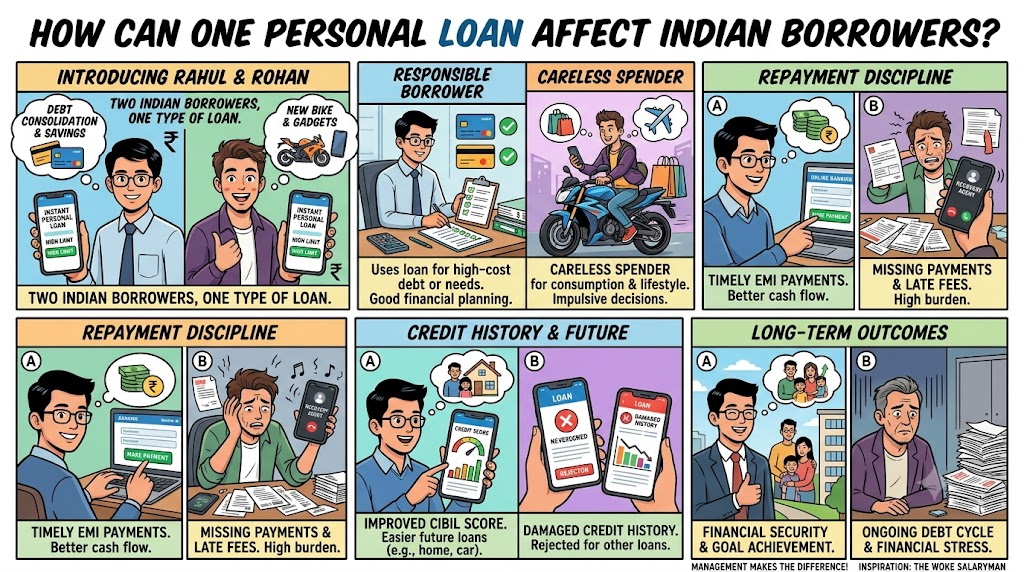
For a salaried household, several due dates can cause trouble even when the total monthly repayment remains affordable. A card bill may fall on the 5th, a consumer loan on the 12th, and a personal loan on the 25th. One missed date can bring a late charge and may appear in the borrower’s repayment record.
Debt consolidation can reduce that administrative load. The stronger case usually involves high-cost unsecured debts, such as revolving credit-card balances, short-term digital loans or delayed BNPL payments. A borrower who receives a personal loan at a lower rate may reduce both the monthly outflow and the total interest paid.
Not every account should be moved. An education loan or secured vehicle loan may already carry a lower rate than the proposed personal loan. Shifting that balance could raise the cost. Loans with only 3 or 4 instalments left may also be better completed separately rather than moved into a new 3-year facility.
The loan amount requires restraint too. A borrower may need ₹4,50,000 to close old balances but accept ₹6,00,000 because the lender offers a top-up. The extra ₹1,50,000 can quickly go towards shopping, travel or household purchases. Debt has then increased, even though the repayment screen shows only 1 EMI.
BankBazaar CEO Adhil Shetty wrote in a Moneycontrol article published on April 20, 2026, that borrowers should first identify the actual source of pressure. When different payment dates are causing missed repayments, auto-debits or adjusted billing dates may solve the problem without another loan. Where high interest is the main issue, the borrower can target the costliest debt first.
His advice also placed limits around consolidation. The new loan should carry a lower rate, and the tenure should not be stretched heavily. Otherwise, the borrower receives a smaller monthly instalment but remains in debt for longer. That trade-off often gets missed during a quick online application.
The practical solution starts with a handwritten list or spreadsheet. Every loan should show its current balance, monthly EMI, remaining months, interest rate and foreclosure amount. Credit-card balances need separate treatment because the amount shown on a monthly statement may differ from the figure required for full closure.
LoansJagat takes a similar borrower-side view. Its personal loan debt consolidation page, accessed on July 22, 2026, describes consolidation as combining loan EMIs and credit-card dues into 1 monthly payment. The page advertises loans of up to ₹99 lakh, although the approved amount, rate and tenure depend on the applicant’s income, repayment record and lender policy. Promotional numbers should never replace the final loan document.
A borrower should compare the full rupee outflow before signing. The interest rate shown in an advertisement covers only part of the deal. Processing fees, GST, insurance, stamp duty and old-loan closure charges can change the result.
The following table shows what needs checking and where official help is available.
The table exposes a common mistake. A borrower may compare 3 current EMIs with 1 proposed EMI and stop there. That does not show the cost of the loan.
Take a ₹5,00,000 personal loan at 14% as an example. Over 24 months, the EMI would be about ₹24,006 and total repayment would reach roughly ₹5,76,155. Stretch the same loan to 36 months, and the EMI falls to about ₹17,089. That looks easier each month. Total repayment, however, rises to around ₹6,15,197 before processing fees and GST.
The extra year adds about ₹39,042. A lower EMI has been achieved, but the loan has not necessarily become cheaper.
Online loan screens often place the EMI in large numbers. The total repayment appears further down the page or inside the repayment schedule. Borrowers facing several due dates may focus on the first number because monthly relief feels urgent.
Suppose 2 existing loans would finish within 14 months, while a credit-card balance needs quicker action. Combining all 3 into a 48-month personal loan may reduce the immediate outflow. The borrower then continues paying for nearly 3 additional years after the smaller loans would have ended.
Foreclosure costs can create another leak. Some existing loans may charge an amount for early closure, depending on the contract and loan type. That charge must be added to the new processing fee. Even a lower interest rate can lose its advantage after both costs enter the calculation.
There is also a behavioural risk. Once a card balance is repaid, the available credit limit returns. A borrower who starts using that limit for groceries, fuel and online purchases may build another balance within a few months. The consolidation loan remains active. Now there are 2 debts again.
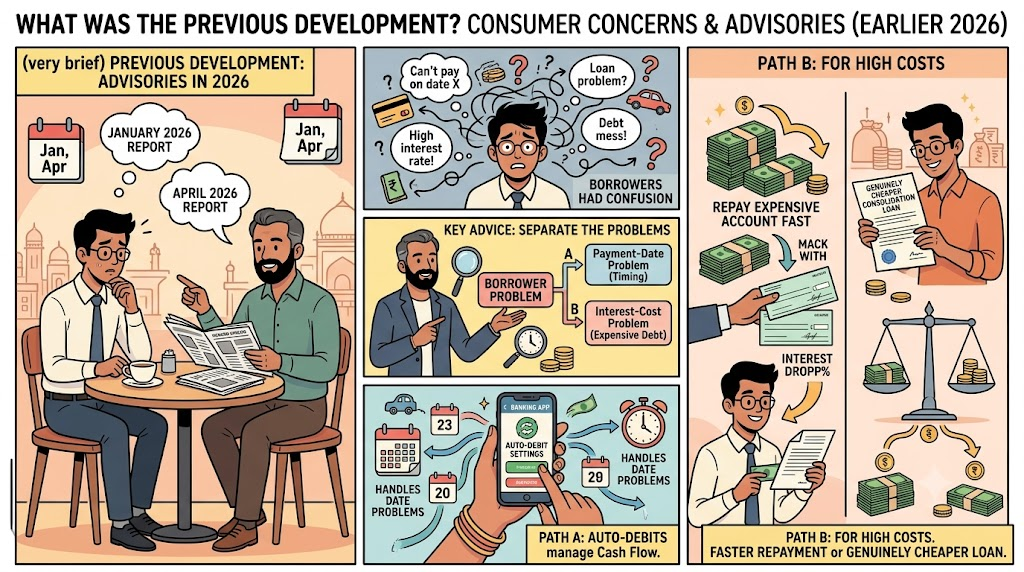
Consumer advisers had raised similar concerns earlier in 2026. Reports published in January and April advised borrowers to separate a payment-date problem from an interest-cost problem. Auto-debits could handle the first. The second required faster repayment of the most expensive account or a genuinely cheaper consolidation loan.
A government update followed on March 17, 2026. The Press Information Bureau said a public directory of digital lending apps had already been operating since July 1, 2025. The directory was introduced to help users check whether a lending app was associated with a regulated bank or NBFC.
That update became relevant as more borrowers searched online for fast personal loans. An unknown app may promise immediate debt consolidation, ask for contacts and phone permissions, then demand an advance payment. Borrowers should not transfer fees to a personal bank account or share an OTP with an agent.
The earlier advice and the latest borrower guidance point in the same direction. Consolidation can work, but only after a cost comparison. The convenience of 1 repayment date cannot repair an unaffordable loan or repeated credit use.
The loan proceeds should be used for the debts listed in the application. Delaying repayment after the money reaches the bank account may create another interest cycle on the old balances.
Each lender should issue a receipt and no-dues certificate. Credit-card users should ask whether the card account will remain active or close completely. A fully paid balance does not automatically cancel a card. Annual fees may continue if the account remains open.
Borrowers who wish to retain 1 card for travel or emergencies can request a lower limit. Removing saved card details from shopping apps may also reduce unplanned spending. These are small steps, but they protect the purpose of the consolidation loan.
The new EMI should be placed on auto-debit. Enough money needs to remain in the account before the due date. A failed debit can bring bank charges as well as a lender penalty.
One personal loan can help an Indian borrower replace several repayment dates with 1 fixed EMI. It may also cut interest when expensive card balances and short-term loans move to a cheaper facility.
The final decision should rest on total repayment. Processing fees, GST, foreclosure charges and extra months must enter the calculation. A borrower should also check whether the current debts are close to completion before moving them.
Debt consolidation works best when it closes expensive accounts and stops fresh borrowing. Used only to lower the next month’s outflow, it may postpone the problem and add another year or two of repayment.
What is a personal loan for debt consolidation?
It is a personal loan used to repay several existing debts. The borrower then makes 1 monthly payment to the new lender.
Which debts can be consolidated?
Credit-card balances, BNPL dues, consumer loans and other unsecured debts may qualify. Lender approval depends on the applicant’s financial profile.
Does debt consolidation always reduce interest?
No. Savings depend on the new rate, tenure, processing fee, GST and charges for closing the existing loans.
Can a longer tenure reduce the EMI?
Yes, but it usually raises the total interest paid. The borrower remains in debt for additional months or years.
What should happen to the old loan accounts?
Every selected account should be repaid fully. The borrower should collect a no-dues certificate and written closure confirmation.
Can paid-off credit cards be used again?
They can, unless cancelled or blocked. Fresh spending may create another card balance alongside the consolidation loan.










.png&w=3840&q=75)


