By continuing, you agree to LoansJagat's Credit Report Terms of Use, Terms and Conditions, Privacy Policy, and authorize contact via Call, SMS, Email, or WhatsApp
Disclaimer: The information published on LoansJagat is intended for general informational and educational purposes only and should not be considered financial, legal, or investment advice. Interest rates, loan terms, statistics, and other data may change over time and may vary by lender or source. Please verify the latest information and consult a qualified financial advisor or the respective Bank/NBFC before making any financial decisions.
Subscribe Now
About the author

Arshathul Afia is a journalism graduate and fintech content writer with 4+ years of experience in digital publishing and research-led writing. She has written 200+ articles covering personal finance, lending, banking, digital payments, credit, insurance, and major financial developments in India. At LoansJagat, she focuses on simplifying complex fintech news, RBI updates, loan-related changes, policy developments, and industry trends for everyday readers. Her journalism background helps her approach stories with research, context, and clarity, while her SEO experience ensures content remains discoverable and relevant. She aims to make financial news easier to understand, practical, and useful for readers across India.
Related News
Simplify All Your Loans Into One Affordable EMI

Customers Served

Debt Consolidated

1200+ Reviews

Locations in India
Club all Loans & Credit Card Bills into Single EMI

Quick Apply Loan
Consolidate your debts into one easy EMI.

Takes less than 2 minutes. No paperwork.

10 Lakhs+
Trusted Customers

2000 Cr+
Loans Disbursed

4.7/5
Google Reviews

50+
Banks & NBFCs Offers
Other services mentioned in this article
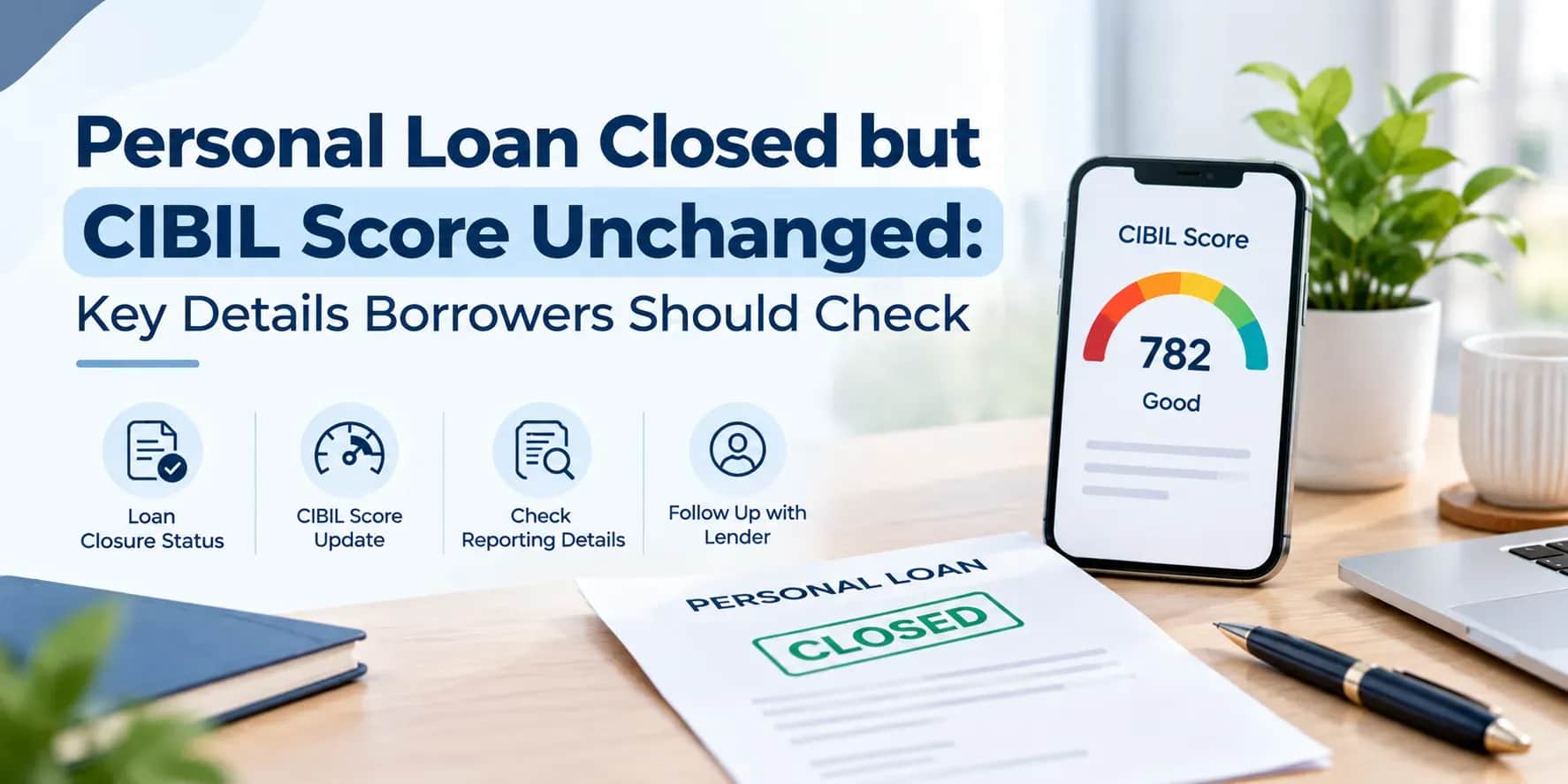
After personal loan repayment, the CIBIL score may stay unchanged. Borrowers should check how the lender has recorded closure before making another application for credit.
Key Highlights
Borrowers in India who have finished repaying a personal loan may still see an unchanged CIBIL score. In its published consumer guidance, CIBIL says payment updates may take 15–30 days to appear in the report. That waiting period concerns account information. The score may stay the same even after the account information changes.
The EMI ends after full repayment. Yet an incorrect outstanding balance may still reach the lender reviewing the borrower’s next application. The report needs to show that the loan has ended. Repayment history remains relevant, and transactions on other credit accounts continue to affect the score.
CIBIL calculates the score from the wider credit profile. Closing the personal loan leaves other borrowing activity in the calculation. Credit-card utilisation still counts, along with repayments on other loans and recent applications for credit. A completed repayment therefore cannot determine the entire result.
The closed account itself can remain visible. CIBIL keeps it as a record of past borrowing, rather than proof that payment is pending. A closed entry with no outstanding dues records repayment. If the balance still shows money owed despite full payment, the lender needs to verify it.
Lenders supply the account data from which credit information companies calculate scores using their own models. Minister of State for Finance Pankaj Chaudhary described this process in his 11 August 2025 Lok Sabha reply to Question No. 3616. The reply also confirmed that borrowers can request corrections to their credit information. A score and the account records behind it serve different purposes.
CIBIL states that it cannot change account information independently. The reporting lender must confirm the correction. Borrowers can raise a dispute as soon as they find incorrect information in their CIBIL report. The 30-day period applies to complaint resolution, not to filing a dispute. The final payment receipt establishes the payment made; the closure letter and no-objection certificate support verification that the loan has ended.
A “settled” entry deserves particular attention. Under CIBIL’s reporting terminology, paying the full amount results in a different status from paying a reduced amount accepted by the lender. A settlement records the latter arrangement and may affect a subsequent loan decision.
The score alone cannot show whether the lender missed the closure or entered the wrong status. The account record provides those details.
CIBIL’s account-status guidance explains why “settled” and “closed” are not interchangeable. A genuine settlement cannot be treated as full repayment merely because the borrower wants a different entry.
Our view is that the response should follow the account record. A missing closure needs follow-up with the lender. An accurate closure with an unchanged score calls for reviewing the remaining credit profile. Treating both situations as a reason to borrow again adds another repayment obligation without addressing the actual issue.
The correction right predates the current discussion. Borrowers have a right to request updates or corrections under the Credit Information Companies (Regulation) Act, 2005. The Ministry of Finance confirmed that provision in its statement of 23 August 2013.
A request starts the 30-day period for taking appropriate steps to update the information, as reiterated in the 11 August 2025 parliamentary reply. The complaint acknowledgement records when the borrower raised a missing closure. That date helps track the correction request; it does not set a date by which the score must increase.
The lender confirms repayment through the closure letter and sends account information for the credit report. Borrowers need both records to agree. Once the closure is accurate, continued payments on remaining accounts are more useful than taking fresh credit solely to move the score.
CIBIL retains closed accounts as credit history. A repaid loan remaining listed is different from that loan incorrectly showing an outstanding balance.
The score reflects the whole credit profile. A fall after closure does not, by itself, establish the cause. Other account updates, utilisation and recent enquiries need review.
CIBIL’s consumer guidance gives a 15–30-day period for recent updates. That estimate does not guarantee a score increase.
An NOC can support a correction request after full repayment. CIBIL still needs the lender to verify the information.
Fresh borrowing creates another payment obligation and may involve a lender enquiry. CIBIL recommends borrowing for an actual need and maintaining timely repayments.