
By continuing, you agree to LoansJagat's Credit Report Terms of Use, Terms and Conditions, Privacy Policy, and authorize contact via Call, SMS, Email, or WhatsApp
Disclaimer: The information published on LoansJagat is intended for general informational and educational purposes only and should not be considered financial, legal, or investment advice. Interest rates, loan terms, statistics, and other data may change over time and may vary by lender or source. Please verify the latest information and consult a qualified financial advisor or the respective Bank/NBFC before making any financial decisions.
Subscribe Now
About the author

Arshathul Afia
Arshathul Afia is a journalism graduate and fintech content writer with 4+ years of experience in digital publishing and research-led writing. She has written 200+ articles covering personal finance, lending, banking, digital payments, credit, insurance, and major financial developments in India. At LoansJagat, she focuses on simplifying complex fintech news, RBI updates, loan-related changes, policy developments, and industry trends for everyday readers. Her journalism background helps her approach stories with research, context, and clarity, while her SEO experience ensures content remains discoverable and relevant. She aims to make financial news easier to understand, practical, and useful for readers across India.
Related News
Simplify All Your Loans Into One Affordable EMI

Customers Served

Debt Consolidated

1200+ Reviews

Locations in India
Club all Loans & Credit Card Bills into Single EMI

Quick Apply Loan
Consolidate your debts into one easy EMI.

Takes less than 2 minutes. No paperwork.

10 Lakhs+
Trusted Customers

2000 Cr+
Loans Disbursed

4.7/5
Google Reviews

50+
Banks & NBFCs Offers
The 8.90% figure looks attractive, yet a borrower’s actual bill can rise after the bank checks salary, old repayments, current loans and charges more closely.
Key Highlights
According to Paisabazaar data used in the 15 September 2026 comparison, 8 private banks in India listed personal loan rates starting at 8.90% as of 9 September. Axis Bank carried the lowest entry rate in that snapshot, followed by HSBC at 9.70%. HDFC Bank, ICICI Bank and IDFC FIRST Bank each started at 9.99%. The update affects salaried and self-employed applicants seeking unsecured credit for medical bills, repairs, education, weddings or debt repayment.
The immediate benefit is a lower possible EMI for an applicant who qualifies near the bottom of the rate band. The negative side appears later. A bank may sanction a higher rate after checking repayment history, employment stability and current obligations. Processing fees can also reduce the amount credited. Across 60 months, a small-looking EMI gap can turn into a large addition to total repayment.
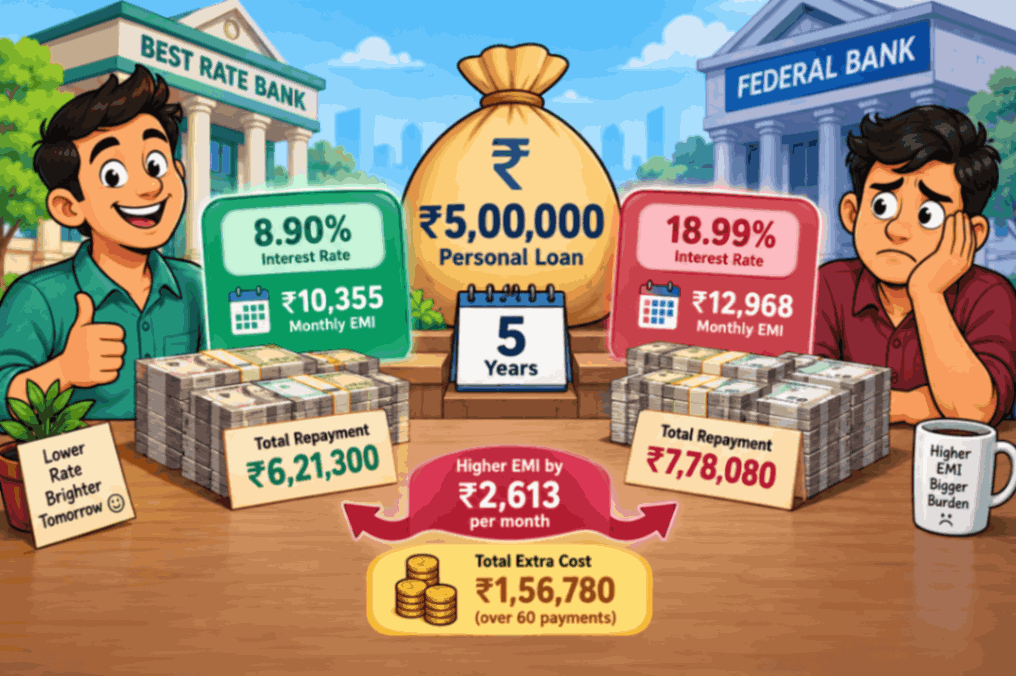
Prices for a ₹5 lakh personal loan over 5 years were analyzed by this comparison. If you take the loan at the lowest listed rate of 8.90%, then your monthly EMI will be around ₹10,355. At the upper end of Federal Bank’s rates of 18.99%, the EMI would be ₹12,968. A difference of ₹2,613 in monthly EMI works out to an approximate difference of around ₹1,56,780 over the 60 payments, pre-tax, fees, and missed payment penalties.
That calculation explains why the news extends beyond a low starting number. An applicant approved at 8.90% would repay about ₹6,21,300 through the listed EMIs. At the upper end, repayment would reach roughly ₹7,78,080. Eligibility decides which figure becomes real.
Each entry uses the same ₹5 lakh amount and 5-year tenure. Lenders may revise rates and apply tax to fees after reviewing an application.
Until the applicant agrees to all the terms, the fee column needs to be checked. At ₹5 lakhs, a fee of 1% is ₹5,000, and 5% is ₹25,000, before taxes are applied. The lender docks this amount from the disbursement. The borrower, therefore, receives the cash amount less than what was originally sanctioned. The borrower is still liable to pay the originally sanctioned amount. A low fee in combination with a high interest defeats the entire purpose when the loan is closed early.
Lower starting bands can help applicants with stable earnings and a strong repayment record. A family facing a hospital bill may access funds without pledging gold or property. Competition among banks also creates room to compare written offers and seek better pricing.
Access does not make every loan affordable. A ₹10,355 EMI consumes over 20% of a ₹50,000 monthly income, even before rent, food, school expenses and other repayments. A job interruption can then create missed instalments and late charges. Borrowers need a repayment buffer, not merely approval. The safest loan amount is often lower than the amount a bank agrees to sanction.
Digital loan safety received government attention well before this comparison. A Ministry of Finance release dated 17 March 2026 stated that the Digital Lending Apps directory had operated from 1 July 2025. The directory allows citizens to verify whether an app claims a connection with a regulated lender. The same release directed victims of illegal loan apps and related cyber incidents to the national reporting portal or helpline 1930.
Another government update dated 20 July 2026 said helpline 1930 covers incidents involving illegal loan applications. It referred citizens to the SACHET mechanism for complaints against unauthorised entities collecting money. Minister of State for Finance Pankaj Chaudhary told Parliament that authorities were reviewing digital lending and consumer protection.
Banks view personal loan pricing as a risk decision. A high credit score helps, but lenders also examine salary continuity, employer category, current EMI burden, recent credit enquiries and repayment delays. Someone with a good score may still receive a higher rate if several loans are already active. The advertised minimum therefore belongs to a narrow eligible group rather than every visitor who opens the application page.
The borrower-side view from LoansJagat is equally practical: an EMI calculator provides a useful estimate, but it does not show the whole cost when processing fees, GST, bounce charges and pre-closure expenses apply. Its 21 July 2026 analysis advised borrowers to use the calculator first and then inspect the lender’s charges sheet.
The fresh analysis from the September figures points in the same direction. A borrower choosing between 9.70% with a 1% fee and 9.99% with another fee structure should compare rupee outgo, not rate labels alone. The sanction letter, Key Facts Statement and repayment schedule should agree on the rate, tenure, EMI and deductions. A verbal promise from a sales representative carries little value if the signed documents show different terms.
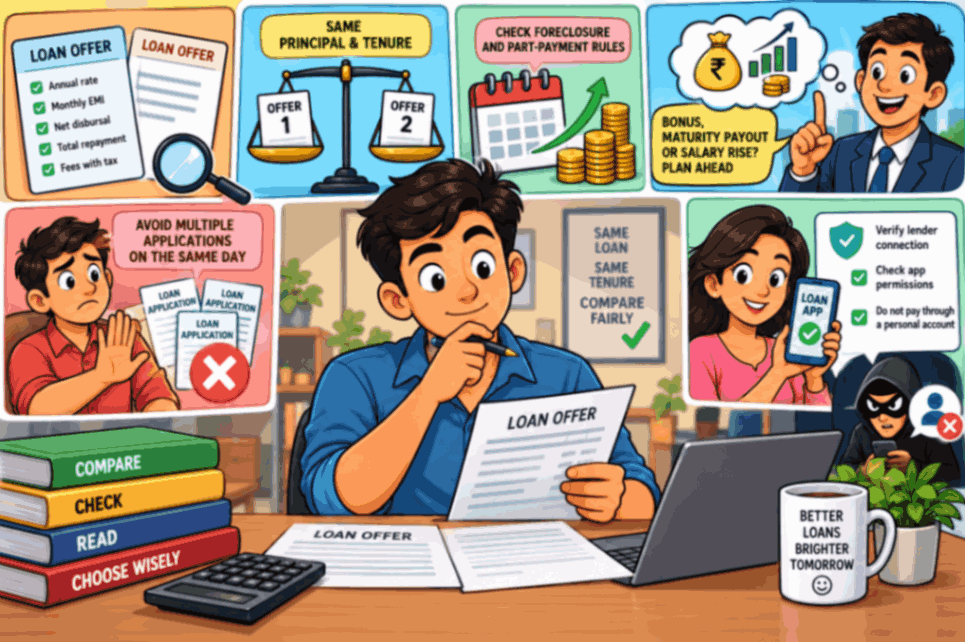
Applicants should request at least 2 written offers for the same principal and tenure. Comparing different loan amounts or repayment periods can hide the real gap. The final annual rate, EMI, net disbursal, total repayment and fees with tax should appear together. Foreclosure and part-payment rules also need attention if a bonus, maturity payout or future salary rise may support early closure.
Borrowers should avoid several formal applications on the same day because multiple hard enquiries may appear risky. Eligibility checks can narrow the list. Anyone using a loan app should verify the lender connection, inspect its permissions and refuse payment demands made through a personal account.
The September 2026 comparison gives Indian borrowers a useful price marker: 8 private banks list personal loan rates from 8.90%, with EMIs on ₹5 lakh ranging from ₹10,355 to ₹12,968. Yet those figures describe a market snapshot, not the offer every applicant will receive.
The stronger decision comes from comparing written terms in rupees. Rate, fee, net disbursal, total repayment and closure cost belong in the same calculation. Borrowers who verify the lender, keep an emergency buffer and reject hurried app-based offers are less likely to turn a short-term cash need into an expensive 5-year repayment problem.
The word “onwards” means 8.90% is the lowest listed entry rate, not a promise. A bank can quote more after checking income, credit history, existing EMIs and tenure. The sanction letter and Key Facts Statement carry the applicable terms.
There is no one monthly installment for all ₹5 lakh borrowers. Around ₹10,355 would be the monthly payment for a 5-year loan at 8.90%. A borrower charged 18.99% may have to pay ₹12,968. Although the loans have the same duration of 60 months, there is a sizable difference in payments. It is also possible for a bank to waive its processing charge, and the amount may be credited directly to the borrower's account.
For September 2026, Axis Bank charges 8.90%, HSBC 9.70%, HDFC Bank and ICICI Bank charge 9.99% and IDFC FIRST Bank charges 9.99%. These are the charges published. However, for borrowers with outstanding loans, irregular repayment history, or multiple credit enquiries in the recent past, the published charges may not be applicable, and higher charges may be levied. The sanction letter provides the applicable rate.
Although wedding guests are gone in a few days, wedding loans are with the couple for many years after. If the main concern is costs for better decoration, a more expensive venue or a larger guest list, scaling down the wedding can take away all the unnecessary costs and the interest that goes with them. A personal loan may be a viable option if deposits are paid and the remaining cost is low. However, the EMI payments should not be a financial strain if the borrowing spouse loses his/her job for a period of time.
Considering 2 different loan offers, charging a 1% fee on a ₹5 lakh loan would mean a charge of ₹5,000, whereas charging a 5% fee would mean a charge of ₹25,000 (excluding taxes). Assuming the charges are taken by the banks at the time of processing the loans, the first case leaves the borrower with ₹4,75,000 while the second case leaves the borrower with ₹4,95,000. The ₹20,000 is available to the borrower before the first instalment even has to be paid. Even if the processing fee is relatively low, it may not change this.









.png&w=3840&q=75)


