

By continuing, you agree to LoansJagat's Credit Report Terms of Use, Terms and Conditions, Privacy Policy, and authorize contact via Call, SMS, Email, or WhatsApp
Disclaimer: The information published on LoansJagat is intended for general informational and educational purposes only and should not be considered financial, legal, or investment advice. Interest rates, loan terms, statistics, and other data may change over time and may vary by lender or source. Please verify the latest information and consult a qualified financial advisor or the respective Bank/NBFC before making any financial decisions.
Subscribe Now
About the author

Arshathul Afia
Arshathul Afia is a journalism graduate and fintech content writer with 4+ years of experience in digital publishing and research-led writing. She has written 200+ articles covering personal finance, lending, banking, digital payments, credit, insurance, and major financial developments in India. At LoansJagat, she focuses on simplifying complex fintech news, RBI updates, loan-related changes, policy developments, and industry trends for everyday readers. Her journalism background helps her approach stories with research, context, and clarity, while her SEO experience ensures content remains discoverable and relevant. She aims to make financial news easier to understand, practical, and useful for readers across India.
Related News
Simplify All Your Loans Into One Affordable EMI

Customers Served

Debt Consolidated

1200+ Reviews

Locations in India
Club all Loans & Credit Card Bills into Single EMI

Quick Apply Loan
Consolidate your debts into one easy EMI.

Takes less than 2 minutes. No paperwork.

10 Lakhs+
Trusted Customers

2000 Cr+
Loans Disbursed

4.7/5
Google Reviews

50+
Banks & NBFCs Offers
In 12 months, 21.86 lakh loans worth ₹6,294 crore were disbursed to street vendors under the PM SVANidhi, bringing formal working-capital credit further into the hands of the informal sector in the country.
On 27 August 2026, the Ministry of Housing and Urban Affairs announced that PM SVANidhi has already completed 1 year of its restructured phase, wherein 21.86 lakh loans valued at ₹6,294 crore have been disbursed to 10.56 lakh fresh beneficiaries. The update released by the Press Information Bureau refers to the period since the restructuring was approved by the Union Cabinet on 27th August 2025. Street vendors benefit from short-term access to working capital without collateral to purchase inventory, repairs, and daily operating costs. Regular repayments can develop a formal credit record, which can assist in future bank borrowing.
There's a more difficult side, as well. Street-vending revenue may fluctuate dramatically from day to day depending on the weather and the number of people on the street or demand for festival food or city ordinances and regulations, but the money is always paid on time. This means it's significant to consider the volume and when each loan occurs. The new scheme attempts to reduce this risk by providing a progressive increase in credit rather than the maximum credit up front. Banks and Urban Local Bodies also need to ensure the verification and grievance redressal processes are still functional for those who may not have much paperwork to run their businesses.
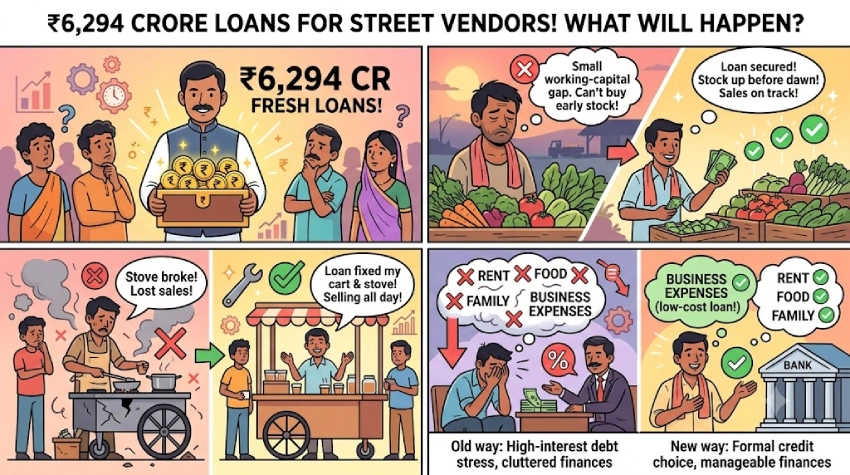
Many vendors can be convinced or dissuaded from selling for a whole day by a small working-capital gap. The vegetable seller might require cash prior to dawn to purchase vegetables from a wholesale market. If a stove or cart wheel breaks at a tea stall, the sales will be lost. Those who borrow in order to cover business cash needs and then use it for rent, food, or family expenses have another choice with formal credit.
The total gains are greater after the first loan. A successful on-time borrower can make their way to the next tranche, with a payment history in tow. This may be beneficial for employees who have not taken a loan from a bank previously. A smaller initial loan is also a way for the vendor to assess how the repayments will fit in with the daily turnover before going for a bigger loan. That's a better approach than assuming that the maximum credit available is the best credit for all businesses.
The Indian School of Business (ISB) surveys in 2023 and 2025 were provided as evidence in the Ministry's reply to Parliament on 27 July 2026. In the 2023 study, 95% of the beneficiaries surveyed were the first to avail a bank loan under PM SVANidhi.According to the 2023 study, 95% of the beneficiaries studied availed bank loans for the first time under PM SVANidhi. The average annualised business income of borrowers had increased by approximately 20% between 2023 and 2025, according to the 2025 follow-up. Not all borrowers were 20% more successful. The results differ between cities, different products, different seasons, and different types of expenditures of money.
The same government reply said around 30% of surveyed borrowers across loan cycles reported holding loans outside PM SVANidhi too, suggesting that some had moved into wider formal credit. The next job is practical. Banks need to explain repayment schedules properly, Urban Local Bodies need to reduce verification delays, and borrowers should move to the next tranche only when sales can support it. Better local assistance may do more for take-up than another layer of paperwork.
The Cabinet decision of 27 August 2025 changed the loan structure and the duration of the scheme. The first tranche rose from ₹10,000 to ₹15,000 and the second from ₹20,000 to ₹25,000. The third tranche remained at ₹50,000. A UPI-linked RuPay Credit Card was also introduced for eligible vendors who have repaid the second loan.
The structure is easier to compare in one place:
The staged system keeps first-time borrowing relatively small and gives lenders some repayment history before a larger amount is approved. That can reduce the chance of a vendor taking on more debt than the business can carry. The official PM SVANidhi portal also lists the revised tranches and provides online access to scheme-related services.
The ₹6,294 crore figure shows scale, but what happens after disbursement is more revealing. A vendor who moves from an informal lender to a bank can gain a recorded repayment history and access to later loan cycles. That record can become useful when the same borrower needs another working-capital loan, and the lender has previous repayment behaviour to examine.
LoansJagat’s earlier PM SVANidhi coverage made a similar borrower-focused point: the programme can reduce dependence on high-cost informal borrowing while helping small vendors build a verifiable financial record. For a street seller, that may be more useful than the headline amount alone. A ₹25,000 second loan approved after an earlier repayment gives the lender actual borrower history. Still, formal debt has to be repaid, so the next tranche should fit business cash flow rather than simply the amount available.
That distinction is important. A busy food seller near a railway station may turn over stock several times in a week, while a seasonal garment vendor can face long periods of weaker sales. Giving both the same borrowing advice would be poor lending practice. The useful part of the staged PM SVANidhi model is that vendors can begin with a smaller amount and build upwards after proving repayment ability.
Housing and Urban Affairs Minister Manohar Lal has presented PM SVANidhi as a route into affordable credit and wider social security. At the scheme’s 6-year event in Agartala on 31 May 2026, the ministry highlighted findings that beneficiary incomes had improved and that many vendors had entered institutional lending for the first time. The emphasis has gradually moved from pandemic recovery towards longer-term financial inclusion.
In Parliament, Minister of State Tokhan Sahu gave a more data-led assessment on 27 July 2026. He referred to the studies on PM SVANidhi released by ISB in 2023 and 2025, which revealed that 95% of the beneficiaries surveyed had availed their first bank loan under the PM SVANidhi scheme. The Ministry of Housing and Urban Affairs and the Department of Financial Services are implementing the restructured programme, with the banks and Urban Local Bodies carrying out much of the work at the ground level.
For borrowers, this division of responsibility has a direct effect. A policy can approve larger loans nationally, yet an applicant still depends on local identification, bank processing and usable documentation. Faster movement at those points could decide whether a vendor receives money while the business opportunity still exists or several weeks later.
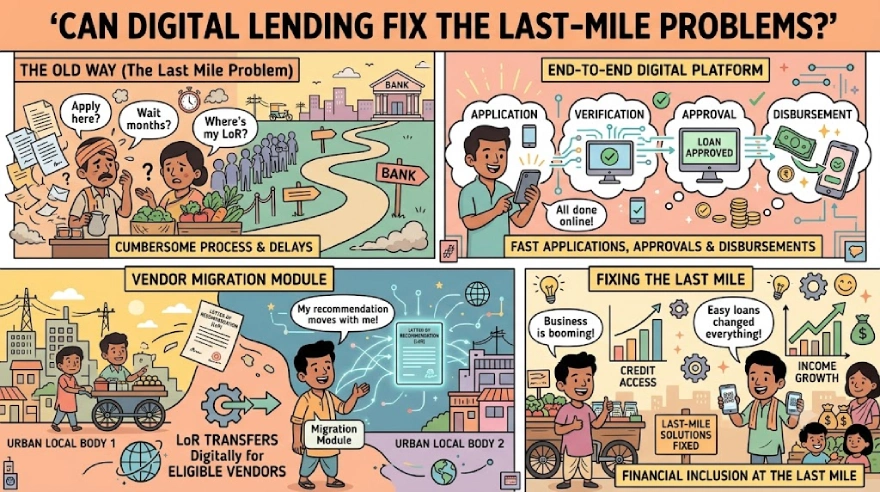
The restructured programme includes an end-to-end Digital Lending Platform covering application, verification, approval and disbursement. A Vendor Migration Module has also been introduced so a Letter of Recommendation can move when an eligible vendor shifts between participating Urban Local Bodies and census towns.
Technology alone will not fix every delay. A vendor who does not know the revised rules, lacks help with documents or cannot complete local verification may still remain outside the scheme. Local camps, bank staff and municipal teams remain important. For a borrower running a cart or roadside stall every day, an application process has to be simple enough to complete without repeatedly leaving the place of business.
The programme will also have to avoid treating higher credit limits as an automatic sign of progress. A smaller loan repaid comfortably can be healthier for a micro-business than a larger one that strains weekly cash flow. That is where borrower guidance, not just digital processing, becomes important.
PM SVANidhi’s ₹6,294 crore disbursement in 1 year shows that the restructured scheme is moving sizable amounts of small-ticket credit through formal channels. The immediate beneficiaries are vendors who need working capital without collateral, but the stronger outcome would be successful repayment followed by access to the next loan stage or other institutional credit.
That is where the scheme will be judged over the next few years. Faster applications, accurate vendor identification, sensible borrowing and fewer local processing delays can turn a small working-capital loan into a usable credit history. If those pieces work, the 2025 restructuring could bring many more vendors into regular banking before the lending window closes in 2030.
Successful repayment of the previous loans of ₹15,000 and ₹25,000 will enable the eligible vendor to move to a next loan amount of ₹50,000.
Street vendors in covered urban areas are eligible to apply, and it will be gradually expanded to census towns and peri-urban areas.
No. PM SVANidhi provides collateral-free working-capital loans, subject to eligibility, vendor verification, and the applicable lending process.
The applicant should check the status, contact the lending bank or Urban Local Body, and use available grievance channels when required.
Yes. Successful repayment allows eligible borrowers to move from the first tranche to the second and then the third loan.









.png&w=3840&q=75)


