
By continuing, you agree to LoansJagat's Credit Report Terms of Use, Terms and Conditions, Privacy Policy, and authorize contact via Call, SMS, Email, or WhatsApp
Disclaimer: The information published on LoansJagat is intended for general informational and educational purposes only and should not be considered financial, legal, or investment advice. Interest rates, loan terms, statistics, and other data may change over time and may vary by lender or source. Please verify the latest information and consult a qualified financial advisor or the respective Bank/NBFC before making any financial decisions.
Subscribe Now
About the author

Arshathul Afia
Arshathul Afia is a journalism graduate and fintech content writer with 4+ years of experience in digital publishing and research-led writing. She has written 200+ articles covering personal finance, lending, banking, digital payments, credit, insurance, and major financial developments in India. At LoansJagat, she focuses on simplifying complex fintech news, RBI updates, loan-related changes, policy developments, and industry trends for everyday readers. Her journalism background helps her approach stories with research, context, and clarity, while her SEO experience ensures content remains discoverable and relevant. She aims to make financial news easier to understand, practical, and useful for readers across India.
Related Blog Post
Simplify All Your Loans Into One Affordable EMI

Customers Served

Debt Consolidated

1200+ Reviews

Locations in India
Club all Loans & Credit Card Bills into Single EMI

Quick Apply Loan
Consolidate your debts into one easy EMI.

Takes less than 2 minutes. No paperwork.

10 Lakhs+
Trusted Customers

2000 Cr+
Loans Disbursed

4.7/5
Google Reviews

50+
Banks & NBFCs Offers
Other services mentioned in this article
PNB’s 444-day fixed deposit now pays up to 7.40%, offering eligible savers a higher rate without committing their money for a multi-year period in 2026.
Key Highlights
Punjab National Bank has revised its domestic term deposit rates below ₹3 crore, and the 444-day period now carries one of the strongest returns on its retail card. According to Punjab National Bank, the rates effective from 1 June 2026 are 6.60% for regular customers, 7.10% for senior citizens aged 60 to 80, and 7.40% for super senior citizens aged 80 and above.
The rates apply to eligible domestic deposits booked with PNB in India. For households, the tenure creates a route between a standard 1-year FD and a longer 2-year or 3-year commitment. It may suit money reserved for fees, a home repair, a family function or another payment due next year. Plans can change, though. PNB generally applies a 1% penalty when a callable domestic term deposit is closed early, and the final interest rate may fall below the rate offered at booking.
The offer gives depositors a way to lock a fixed rate for a little over 1 year without moving into a long tenure. It can work for a household that already knows when a large payment is due. Money reserved for the 2027 academic year, a planned house repair or a family event may reach maturity within about 15 months. Emergency savings need a different place because early closure changes the return.
Senior citizens gain more from the special slab. PNB adds 0.50 percentage points to the regular 444-day rate for customers aged 60 to below 80, while super senior citizens receive 0.80 percentage point above the regular rate. For a retired household using FD interest for planned spending, that difference can protect income from being locked for 3 years or longer. The higher rate still works only when the money remains deposited until maturity.
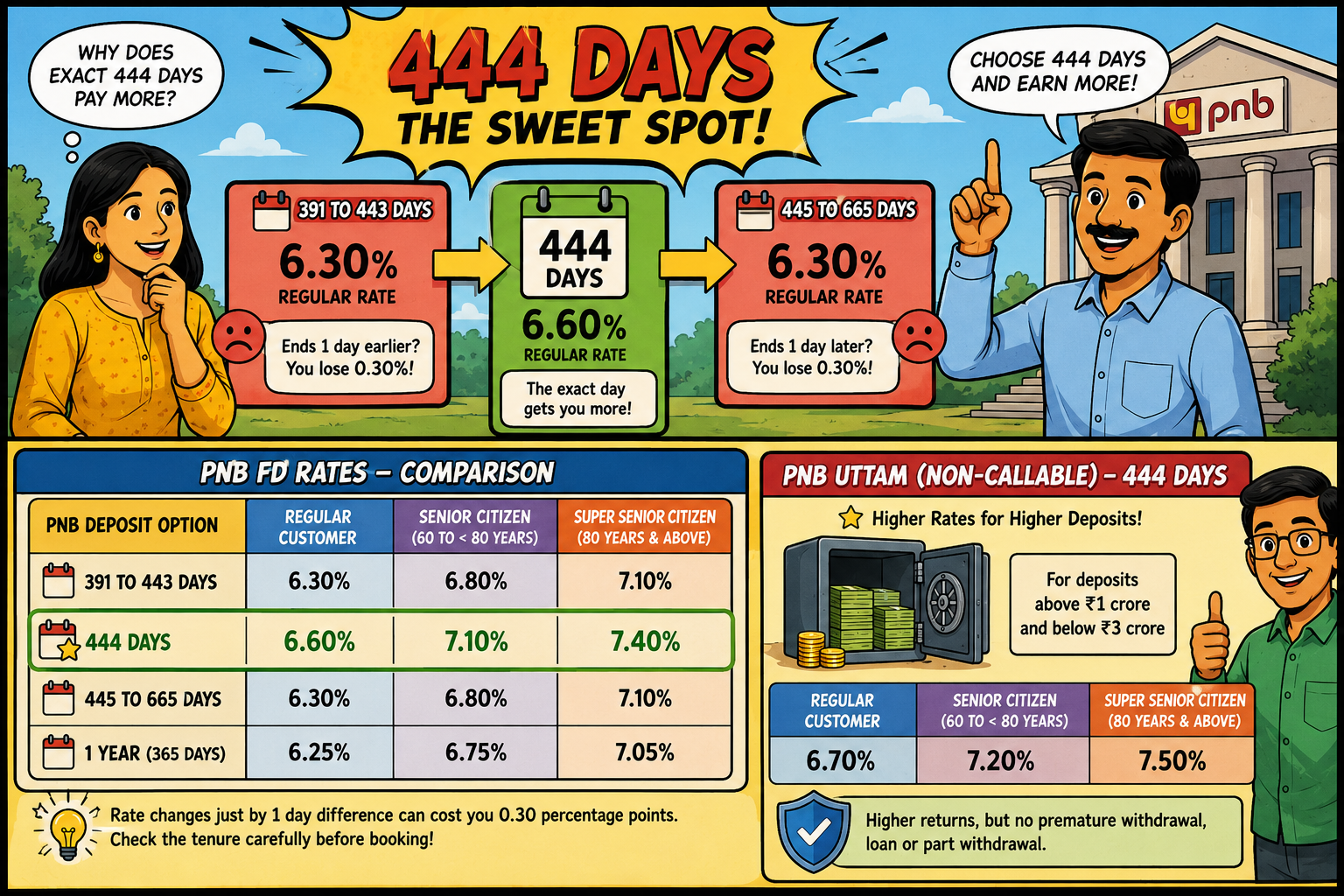
PNB’s rate card creates a narrow premium at exactly 444 days. The regular rate is 6.30% for 391 to 443 days, rises to 6.60% on day 444, and returns to 6.30% for 445 to 665 days. A customer who enters the wrong maturity period may therefore lose 0.30 percentage points even though the deposit ends only 1 day earlier or later.
The table below separates the main callable slabs from the higher non-callable PNB Uttam option.
The 7.50% figure requires care. It applies to an eligible super senior citizen under PNB Uttam, a non-callable scheme for deposits above ₹1 crore and below ₹3 crore. The standard callable FD available below ₹3 crore pays a maximum of 7.40%. Most retail savers should compare their return with the callable rate, since early access may be more useful than an extra 0.10 percentage point.
A LoansJagat comparison published on 24 April 2026 showed that several public sector banks were using 444-day deposits to attract funds for a selected period. The comparison listed rates of up to 6.70% for regular customers, 7.20% for senior citizens and 7.45% for super senior citizens across the PSU bank group. It also recorded SBI’s 15 December 2025 revision of its 444-day Amrit Vrishti rate to 6.45% for regular depositors and 6.95% for senior citizens.
That earlier comparison gives useful context to PNB’s 1 June 2026 card. Banks do not always raise every FD rate together. They may pay more for one maturity bucket while leaving the periods around it lower. LoansJagat’s view that 444-day products were becoming a deposit-acquisition tool is supported by PNB’s present pricing, where the regular rate rises by 0.30 percentage point for 1 exact day and drops again after it.
The comparison also points to a wider change in how banks price special deposits. Instead of raising returns for every tenure, a bank can offer a sharper rate for one carefully chosen period. Depositors get a higher return, while the bank receives funds for the duration it currently prefers.
That is a useful analysis for a retail saver. A special tenure does not automatically mean the bank’s entire FD range has improved. The benefit may disappear when the customer changes the maturity date, chooses a different scheme or renews the deposit after the special rate has been withdrawn.

PNB is the first stakeholder in this decision because its live card fixes the rate available on the booking date. The Income Tax Department states that bank TDS generally does not apply where annual eligible interest stays within ₹50,000 for other resident depositors or ₹1 lakh for resident senior citizens under Section 194A. These are TDS thresholds, not tax-free allowances. FD interest may still form part of taxable income.
The Deposit Insurance and Credit Guarantee Corporation, or DICGC, covers eligible bank deposits up to ₹5 lakh per depositor per bank, including principal and accrued interest in the same capacity and right. Deposits held at different PNB branches are added together for this ceiling. A saver holding more than ₹5 lakh can review how money is divided across banks, while also checking rates, access needs and tax treatment.
The strongest approach is to avoid placing every rupee under 1 receipt. A customer with ₹10 lakh could keep an emergency portion outside the FD and divide the rest into 2 or 3 deposits. If an unexpected bill arrives, only the required receipt may need to be closed. That can reduce the loss caused by a 1% premature closure penalty on the full amount.
Customers should also check the maturity instruction before confirming the deposit. Automatic renewal may place the principal and interest into a new FD at the rate available on the renewal date, not the original 6.60%, 7.10% or 7.40%. Someone saving for a known payment may prefer maturity proceeds to move into a linked account instead.
The nominee's details deserve attention, too. A correct nomination can reduce paperwork for family members if the depositor dies before maturity. Senior and super senior customers should also confirm that their date of birth and customer category are correctly recorded before the FD is booked.
PNB’s 444-day FD offers a focused rate advantage for savers who can leave their money untouched for about 14.6 months. The standard callable rates are 6.60%, 7.10% and 7.40%, depending on age, while the 7.50% PNB Uttam rate applies only under stricter deposit and withdrawal conditions.
The strongest use case is a planned expense with a known date. Customers should confirm the live rate, choose exactly 444 days, review the 1% early-closure rule and account for tax before booking. Smaller receipts can also protect part of the return if an emergency forces an early withdrawal.
When did the revised PNB rates take effect?
The domestic term deposit rates discussed in this article took effect on 1 June 2026.
Can the 444-day FD be closed before maturity?
The standard callable deposit can generally be closed early, but PNB applies its premature withdrawal formula and ordinarily charges 1% penal interest.
Is the 7.50% PNB rate available to every depositor?
No. The 7.50% rate applies to eligible super senior citizens under the non-callable PNB Uttam scheme for deposits above ₹1 crore and below ₹3 crore.
Is interest from the PNB FD tax-free?
No. The TDS threshold does not make the FD interest tax-free. Tax treatment depends on the depositor’s total taxable income and applicable provisions.
Does opening FDs at several PNB branches increase deposit insurance?
No. DICGC combines eligible deposits held in the same capacity across branches of the same bank for the ₹5 lakh ceiling.
Who should consider the 444-day tenure?
It may suit customers with a planned payment after about 15 months who are unlikely to need the deposited money earlier.









.png&w=3840&q=75)


