
Disclaimer: The information published on LoansJagat is intended for general informational and educational purposes only and should not be considered financial, legal, or investment advice. Interest rates, loan terms, statistics, and other data may change over time and may vary by lender or source. Please verify the latest information and consult a qualified financial advisor or the respective Bank/NBFC before making any financial decisions.
Subscribe Now
About the author

Arshathul Afia is a journalism graduate and fintech content writer with 4+ years of experience in digital publishing and research-led writing. She has written 200+ articles covering personal finance, lending, banking, digital payments, credit, insurance, and major financial developments in India. At LoansJagat, she focuses on simplifying complex fintech news, RBI updates, loan-related changes, policy developments, and industry trends for everyday readers. Her journalism background helps her approach stories with research, context, and clarity, while her SEO experience ensures content remains discoverable and relevant. She aims to make financial news easier to understand, practical, and useful for readers across India.
Related News
Simplify All Your Loans Into One Affordable EMI

Customers Served

Debt Consolidated

1200+ Reviews

Locations in India
Club all Loans & Credit Card Bills into Single EMI

Quick Apply Loan
Consolidate your debts into one easy EMI.

Takes less than 2 minutes. No paperwork.

10 Lakhs+
Trusted Customers

2000 Cr+
Loans Disbursed

4.7/5
Google Reviews

50+
Banks & NBFCs Offers
India’s private banks are expected to outpace public sector banks through FY28 as repayment stress eases on unsecured loans and lenders put surplus deposits to work.
Key Highlights
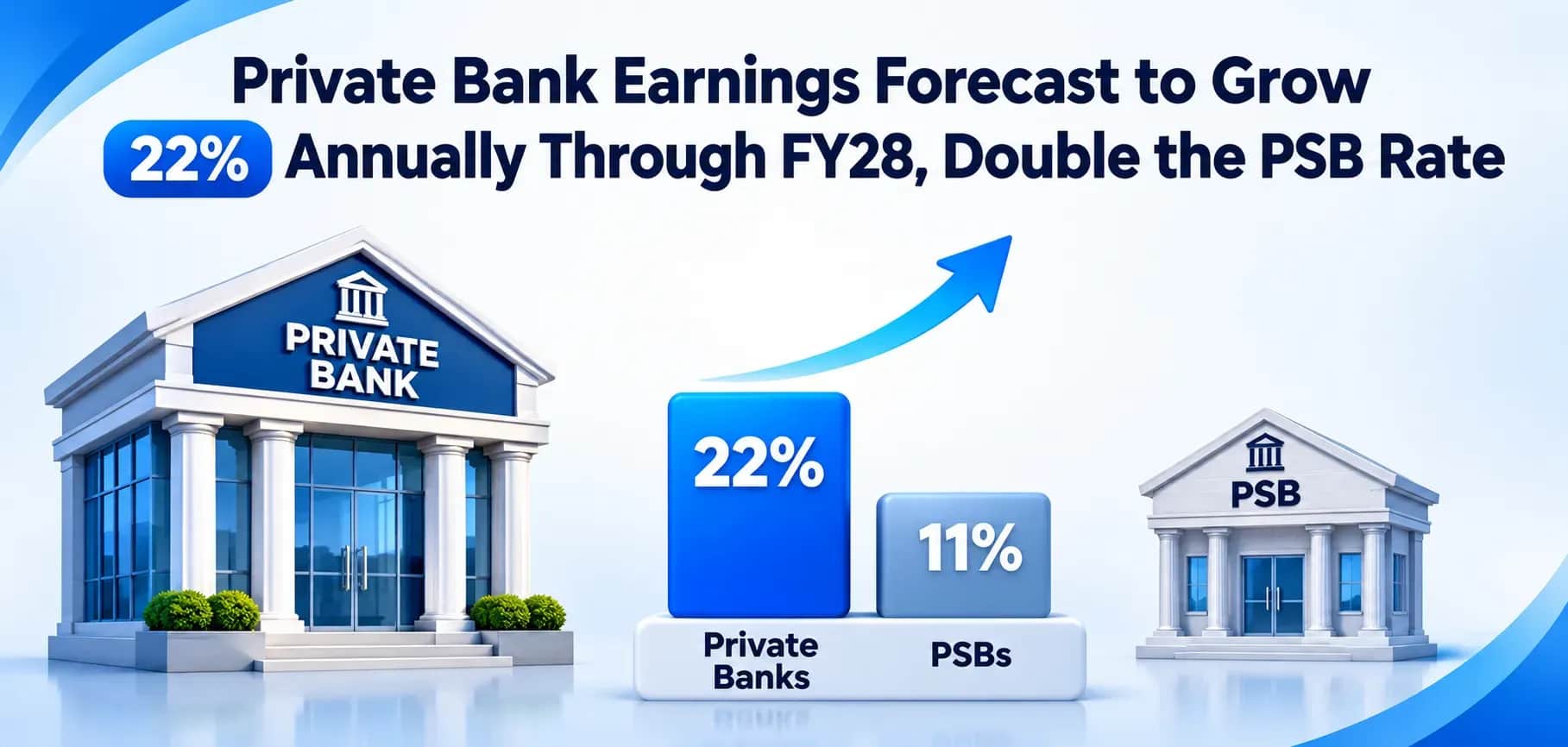
Banking sector earnings grew 6.5% in FY26. A brokerage report dated 18 November 2026 puts compound annual earnings growth through FY28 at 22% for private lenders and 11% for public sector banks (PSBs). For FY27 alone, consensus estimates point to about 15% earnings growth, taking combined profits to ₹4.6 lakh crore.
The forecast counts on continued loan growth, stable asset quality and improving net interest margins. It also assumes banks can deploy more of the money they raised through foreign currency deposits. In the September quarter, some of that liquidity was still weighing on private bank margins.
Banks raised $133 billion through Foreign Currency Non-Resident (Bank), or FCNR(B), deposits between 8 June and 31 August 2026. They provided leverage of around 60% against those deposits, supporting deposit mobilisation and lending. The scale of the inflows and thin margins on overseas business squeezed private banks’ net interest margins in the September quarter. Putting surplus funds to work could lift revenue in the coming quarters.
Private lenders also have a relatively large share of repo-linked loans. When the policy rate rises, those loans can reprice upwards and bring in more interest income. Meanwhile, repayment stress has eased across microfinance, credit cards and personal loans. The brokerage expects mid-sized private lenders to benefit from better margins and relatively stable credit costs, with higher revenue helping them spread operating expenses over a larger income base.
Several public sector banks already have credit-to-deposit ratios that leave limited room to expand lending without attracting more deposits. A smaller share of floating-rate loans limits the benefit of higher rates, especially if funding costs stay high. Recoveries from written-off accounts are also declining, and wage revisions could add to expenses in FY28.
Expected credit loss (ECL) rules take effect on 1 April 2027. The shift could raise ongoing credit costs more at PSBs than at larger private lenders. Fewer loans have recently turned bad, keeping credit costs relatively low even as some public sector banks built up provisions ahead of the change. Consensus puts PSB earnings growth at around 10% a year through FY28.
Over the past two years, consensus profit estimates for private banks fell by about 12% for FY27 and 11% for FY28 as unsecured retail and microfinance loans came under pressure. Estimates have edged up 1% in the past three months, with several mid-sized lenders seeing larger revisions.
Public sector lenders have had a steadier run of upgrades. Their consensus estimates rose 9% for FY27 and 6% for FY28 over two years, including increases of 5% and 3% in the past three months. Stronger net interest income helped. A better mix of assets lifted margins, and some lenders used FCNR(B) deposits to pay off more expensive funding.
The brokerage projects 21% year-on-year earnings growth in the fourth quarter of FY27 across the banks it tracks. It expects private bank earnings to rise 24% and PSB earnings to grow 17%. Its preferred stocks are ICICI Bank, HDFC Bank, Kotak Mahindra Bank, AU Small Finance Bank and State Bank of India.
Private banks are forecast to lead the earnings recovery through FY28. The pace will depend partly on how quickly they turn surplus deposits into interest income and how far repayment stress eases in unsecured retail loans. Public sector banks face higher provisioning costs and possible wage revisions. Fee income remains another variable. If the proposed insurance rules take effect, private banks could lose 50% to 60% of their bancassurance income. Watch margins and provisions in the next set of results.
Private banks’ earnings are forecast to grow at a 22% compound annual rate from FY26 to FY28. Earnings at public sector banks could grow 11%.
Consensus estimates put aggregate banking sector profits at ₹4.6 lakh crore in FY27, about 15% above FY26. The figure reflects projected earnings across both groups.
The framework requires banks to set aside money for expected losses on loans. The transition could increase credit costs at PSBs and weigh on profits.
The role can include sales targets. Customer service officers may offer insurance and other products while helping customers with account opening, deposits and everyday enquiries.
An FCNR(B) deposit is a fixed deposit in foreign currency at an Indian bank. Eligible non-resident Indians and persons of Indian origin can open one.
Start your journey today
Apply Now*T&C apply











