

By continuing, you agree to LoansJagat's Credit Report Terms of Use, Terms and Conditions, Privacy Policy, and authorize contact via Call, SMS, Email, or WhatsApp
Disclaimer: The information published on LoansJagat is intended for general informational and educational purposes only and should not be considered financial, legal, or investment advice. Interest rates, loan terms, statistics, and other data may change over time and may vary by lender or source. Please verify the latest information and consult a qualified financial advisor or the respective Bank/NBFC before making any financial decisions.
Subscribe Now
About the author

Arshathul Afia
Arshathul Afia is a journalism graduate and fintech content writer with 4+ years of experience in digital publishing and research-led writing. She has written 200+ articles covering personal finance, lending, banking, digital payments, credit, insurance, and major financial developments in India. At LoansJagat, she focuses on simplifying complex fintech news, RBI updates, loan-related changes, policy developments, and industry trends for everyday readers. Her journalism background helps her approach stories with research, context, and clarity, while her SEO experience ensures content remains discoverable and relevant. She aims to make financial news easier to understand, practical, and useful for readers across India.
Related News
Simplify All Your Loans Into One Affordable EMI

Customers Served

Debt Consolidated

1200+ Reviews

Locations in India
Club all Loans & Credit Card Bills into Single EMI

Quick Apply Loan
Consolidate your debts into one easy EMI.

Takes less than 2 minutes. No paperwork.

10 Lakhs+
Trusted Customers

2000 Cr+
Loans Disbursed

4.7/5
Google Reviews

50+
Banks & NBFCs Offers
Old bank accounts can become inoperative after 2 years without customer activity, restricting withdrawals until the holder completes the bank’s required identity and KYC checks.
The immediate effect is blocked debit access. A withdrawal, transfer or cheque may fail until the bank verifies the holder. Outdated contact details and missing nominations can later make recovery harder for families. Banks use the tag to reduce fraud in long-unused accounts.
Old salary accounts form an obvious risk group. An employee may open an account in Pune, switch jobs in Bengaluru and receive the next salary elsewhere. The earlier account is forgotten, though it may still hold money or remain linked to an income-tax refund. Students, retired workers and small traders can face the same problem.
There is a protective side. A bank cannot allow debit transactions before verifying the holder, which makes an abandoned account harder to misuse. Savings interest continues, and minimum-balance penalties cannot be imposed after the inoperative tag. Government-benefit and scholarship accounts also receive separate treatment so inactivity alone does not block an eligible payment.
Atish Jain, CEO of Choice Wealth, told Mint on August 14, 2026, that dormant accounts had become a blind spot and could attract money-mule activity. He favoured wider video KYC and app-based activation. A customer may live hundreds of kilometres from the original branch while the bank already has digital identity tools.
LoansJagat’s assessment is that the first consumer loss will often appear as a failed payment rather than missing money. An income-tax refund may reach an old account, or a family may find a forgotten balance after the holder dies. Customers should update mobile and nomination details, then close unwanted accounts. The LoansJagat review of the accelerated payout scheme shows why banks now have a stronger reason to trace claimants.
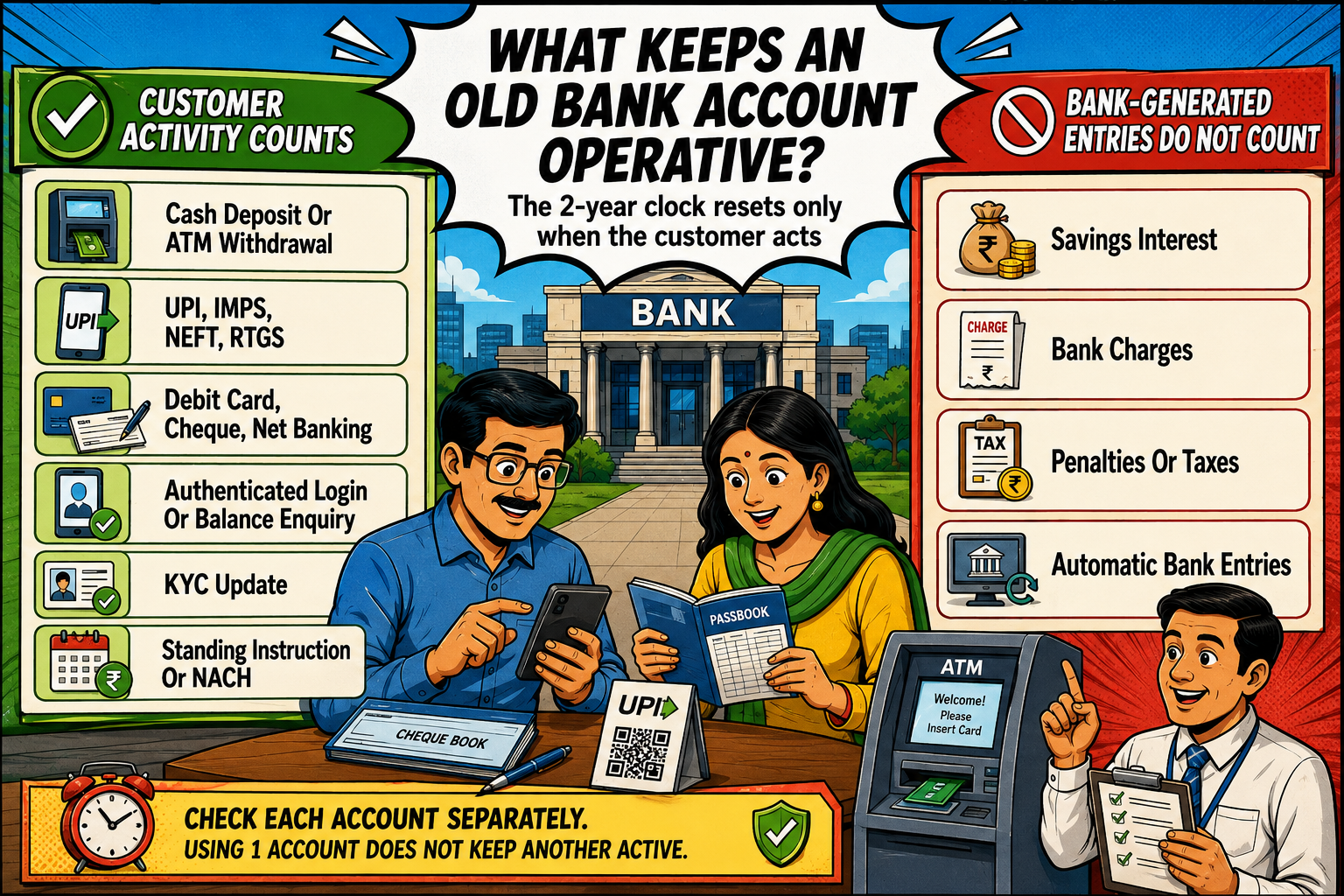
The 2-year clock does not depend only on cash deposits and withdrawals. Authenticated digital activity, service requests and KYC updates can also count. Automatic entries created by the bank usually do not.
The table separates customer activity from bank-generated entries and helps identify the date that reset the inactivity period.
Each account is assessed separately. Regular use of 1 account does not keep another account with the same bank operative. Someone holding 2 old savings accounts should check both, even when the customer profile and PAN are common.
The bank’s official app or internet-banking page is the quickest starting point. If login access works, the holder can review the status, balance and last transaction. A successful authenticated login may itself count as a non-financial customer-induced transaction when the system records it.
Where digital access has stopped, the customer should call the bank or visit a nearby branch. Ask 4 questions: What is the status, when was the last qualifying activity, which KYC documents are needed, and whether video verification is available? Old statements should be checked for transfers, card payments, cheques or authenticated requests. Ignore savings interest and bank charges.
For accounts unused for 10 years, UDGAM can locate an eligible deposit. It does not pay the claimant. The owner, nominee or legal heir must apply to the bank concerned.
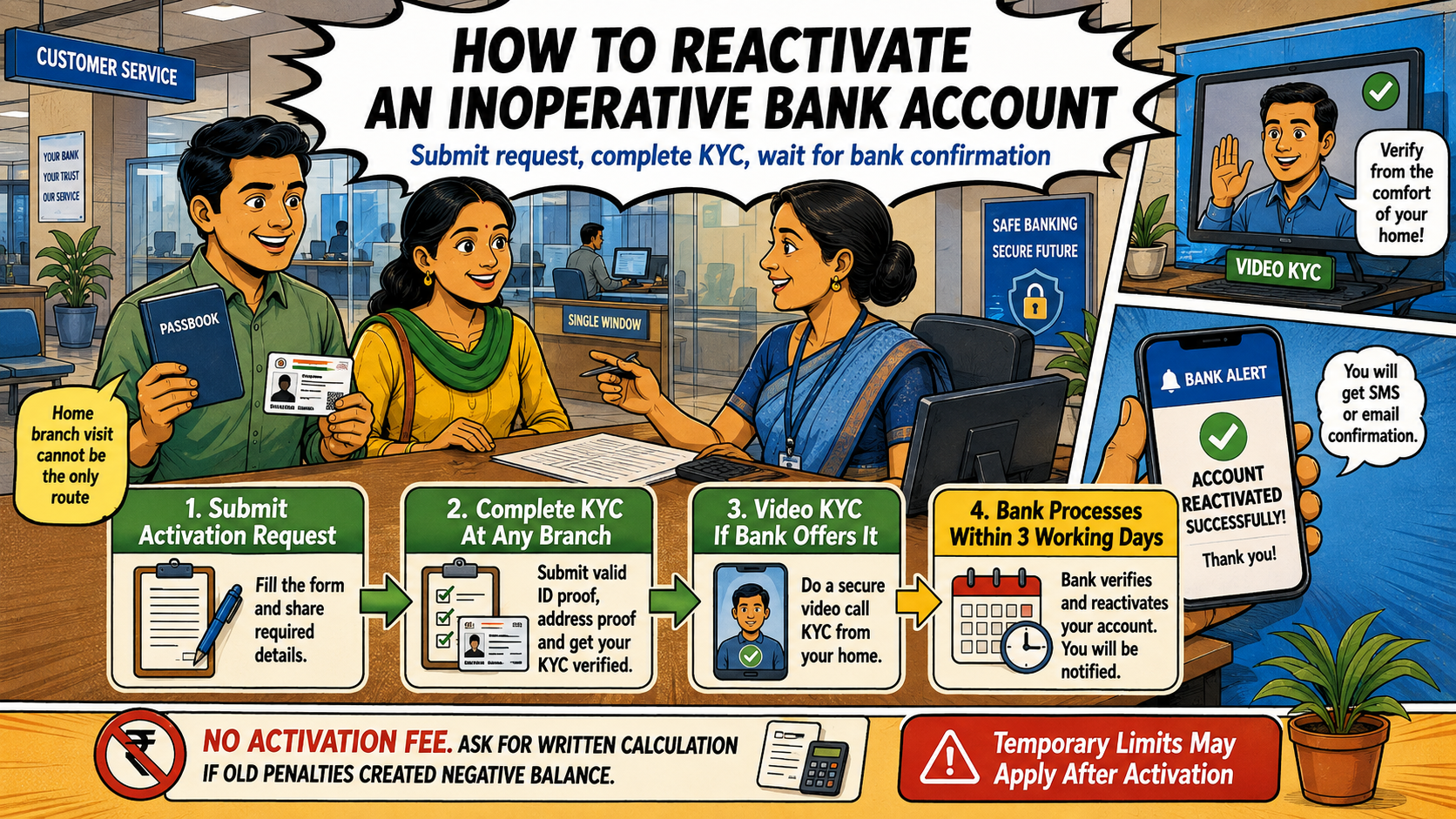
The account holder must submit the bank’s activation request and complete KYC. A home-branch visit cannot be the only route. Banks must make KYC updating available at all branches, including non-home branches. Video Customer Identification Process may also be used when the bank offers it.
The bank should process a complete application within 3 working days and notify the holder after removing the restriction. It may apply temporary transaction limits after activation to check unusual transfers following a long silence.
No activation fee is allowed. If minimum-balance penalties created a negative balance after the inoperative date, the customer should request a written calculation and complain to the bank. Earlier charges may need separate review.
UDGAM was launched on August 17, 2023, giving people a single search route for eligible unclaimed deposits across participating banks. Revised directions were issued on January 1, 2024, and effective from April 1, 2024, and then set out how banks must review, classify, contact and reactivate these accounts. Banks have to review accounts without customer-induced transactions for more than 1 year and warn customers that another year without activity may lead to an inoperative tag.
The next push came through “Aapki Poonji, Aapka Adhikar” from October to December 2025. District camps helped people search for forgotten deposits and start claims. From October 1, 2025, an incentive offered banks 5% to 7.5% of eligible settled amounts, subject to a cap.
Minister of State for Finance Pankaj Chaudhary gave the official position in Lok Sabha Unstarred Question No. 3695, answered on March 16, 2026. He reported about ₹83,063 crore in the DEA Fund as of February 28, 2026. That amount represents deposits that reached the 10-year unclaimed stage. It is not the value of every account marked inoperative after 2 years.
The Press Information Bureau update of March 24, 2026, said the national campaign had returned ₹5,777 crore through 22.95 lakh claims by February 28, 2026. Those recoveries covered several classes of unclaimed financial assets, not only bank deposits. Special camps had reached 748 districts.
Department of Financial Services Secretary M. Nagaraju earlier asked public sector banks to strengthen campaign outreach. Chaudhary later said banks were tracing depositors and heirs, publishing searchable records and simplifying claims. The Banking Laws (Amendment) Act, 2025 also allowed up to 4 nominees, which can reduce disputes after a depositor’s death.
An inoperative account does not erase the holder’s ownership. It restricts access until the bank completes verification. That distinction is important for anyone who still has an old salary account, a forgotten savings balance or a deposit opened by a family member years ago.
Customers should review each account separately, update KYC and nomination records, and formally close unwanted accounts. If a deposit has crossed 10 years, UDGAM can identify the bank, but the claim must still be filed there. Waiting adds paperwork and leaves families searching through old records.
A savings or current account becomes inoperative after more than 2 years without customer-induced activity.
Yes. Savings interest continues, although the bank may restrict debit transactions until activation.
No. The owner or eligible legal heir can claim the balance after completing verification.
The process varies by bank, but KYC or authorised documentation will usually be required first.
No. UDGAM helps locate the deposit; the concerned bank verifies and settles the claim.









.png&w=3840&q=75)


