
By continuing, you agree to LoansJagat's Credit Report Terms of Use, Terms and Conditions, Privacy Policy, and authorize contact via Call, SMS, Email, or WhatsApp
Disclaimer: The information published on LoansJagat is intended for general informational and educational purposes only and should not be considered financial, legal, or investment advice. Interest rates, loan terms, statistics, and other data may change over time and may vary by lender or source. Please verify the latest information and consult a qualified financial advisor or the respective Bank/NBFC before making any financial decisions.
Subscribe Now
About the author

Arshathul Afia
Arshathul Afia is a journalism graduate and fintech content writer with 4+ years of experience in digital publishing and research-led writing. She has written 200+ articles covering personal finance, lending, banking, digital payments, credit, insurance, and major financial developments in India. At LoansJagat, she focuses on simplifying complex fintech news, RBI updates, loan-related changes, policy developments, and industry trends for everyday readers. Her journalism background helps her approach stories with research, context, and clarity, while her SEO experience ensures content remains discoverable and relevant. She aims to make financial news easier to understand, practical, and useful for readers across India.
Related News
Simplify All Your Loans Into One Affordable EMI

Customers Served

Debt Consolidated

1200+ Reviews

Locations in India
Club all Loans & Credit Card Bills into Single EMI

Quick Apply Loan
Consolidate your debts into one easy EMI.

Takes less than 2 minutes. No paperwork.

10 Lakhs+
Trusted Customers

2000 Cr+
Loans Disbursed

4.7/5
Google Reviews

50+
Banks & NBFCs Offers
Other services mentioned in this article
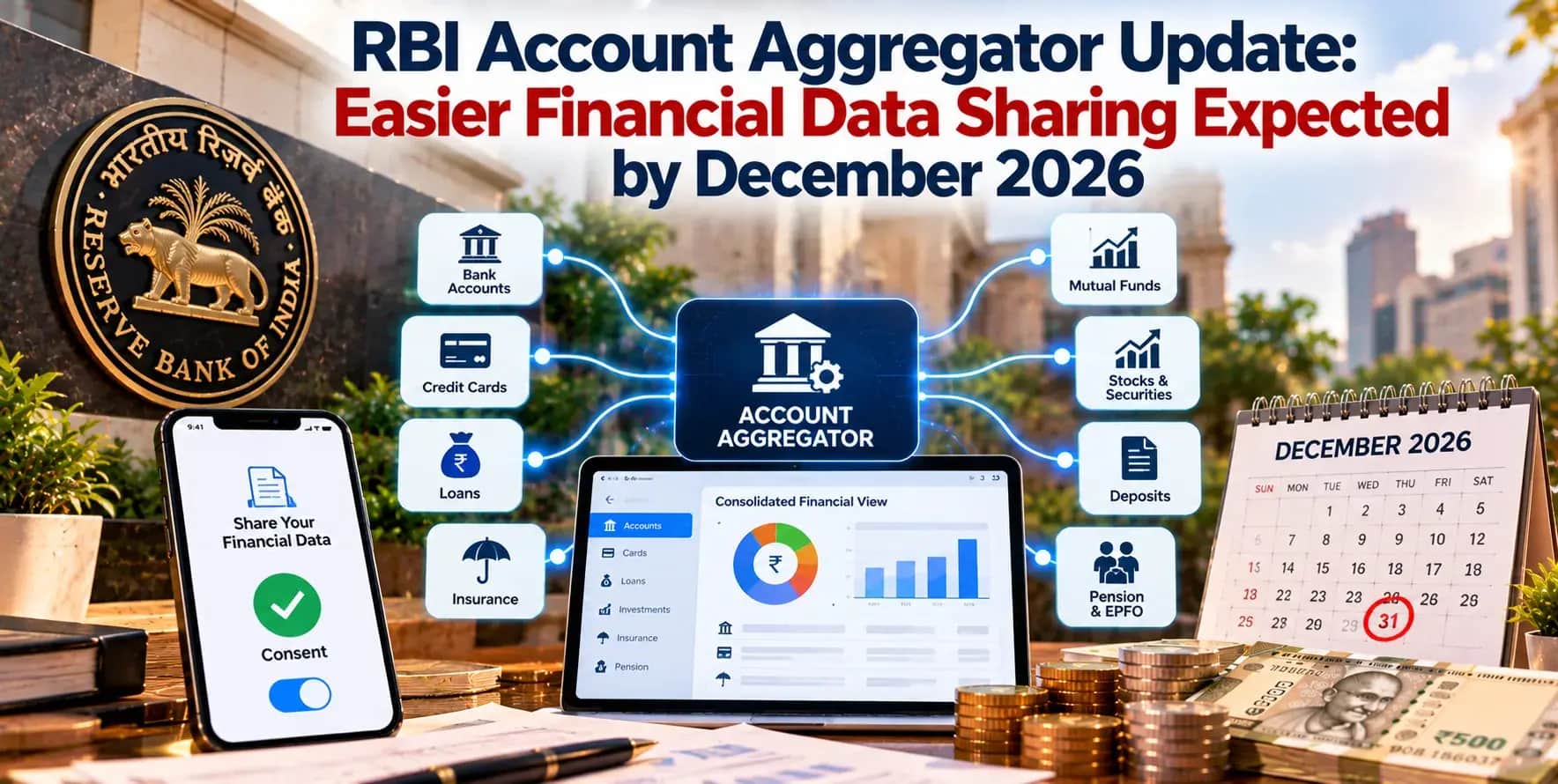
Consumers will get more choice in sharing their financial records as Account Aggregator platforms become interoperable, with implementation expected by the end of December 2026.
Key Highlights
The government news announcement dated 7 October 2026 confirms that NBFC Account Aggregators will become interoperable. Customers will be able to access and share records held by different Financial Information Providers through their chosen aggregator. For borrowers, the change addresses platform-related obstacles when submitting financial information to lenders.
The expected benefit is less effort in getting authorised records to a financial institution. Once the platforms are connected, customers should be able to share records through their chosen aggregator, even when the receiving institution uses another. Industry representatives have also called for tighter controls over customer information and how it is handled. Customer permission will still govern sharing.
An Account Aggregator carries financial information between institutions with the customer’s permission. The October decision changes how separate aggregator platforms connect. Customers should face fewer restrictions because their chosen aggregator and a financial institution use different connections. The purpose is to make existing records easier to access and share, including information used during loan assessment.
Our view is that the practical gain lies in the paperwork stage of borrowing. Getting authorised records to a lender with fewer platform hurdles could reduce repeated effort for applicants. The lender still makes the approval decision, however. Easier access to bank statements does not change the income or repayment obligations shown in them.
State Bank of India chairman C S Setty welcomed the Account Aggregator measures in comments reported on 7 October 2026. He saw them as progress towards connecting financial services through customer consent. For Paisabazaar chief executive Santosh Agarwal, processing customer information could take less time and effort, with lower operational costs. The lower operating costs Agarwal discussed remain a possible outcome of implementation. No savings had been reported at that stage.
BankBazaar chief executive Adhil Shetty said there should be clear guidelines on customer data during the rollout. Security arrangements and the process by which customers can lodge complaints should also be clear, he added. He also recommended informing customers which bank would receive their records and why the information was being requested before seeking their permission to share it. A simple way to withdraw permission remains essential when sharing continues over a period.
The Account Aggregator framework formally launched on 2 September 2021, as recorded in the Ministry of Finance’s release dated 2 September 2025, Release ID 2162953. It already supported financial data transfers based on customer consent. Interoperability extends the connections through which that service operates.
The network had substantial reach before the latest decision. Government data as of 31 March 2026 separately reports the number of accounts enabled for data sharing and those already linked by users.
The Department of Financial Services attributes these figures to Sahamati. They represent accounts, not individual customers. Availability on the network also does not mean the account holder has authorised information to be shared.
Customers retain the choice to register, accept a sharing request or refuse it. The Ministry of Finance’s explanation published on 10 September 2021, Release ID 1753713, states that recurring consent can also be revoked.
That guidance explains that Account Aggregators cannot read the information they transfer. Information leaves the sender in encrypted form, with decryption restricted to the recipient. When customers give consent, they are shown how long that recipient will have access. Connecting more platforms does not replace those permissions.
The Account Aggregator update targets the difficulty of sharing records across separate platforms. Implementation is expected by 31 December 2026. Customers would have more freedom to select an aggregator while retaining the decision over whether their financial information is shared.
Implementation is expected by 31 December 2026, following the announcement on 7 October 2026.
Customers will be able to access and share information across different Financial Information Providers through an NBFC Account Aggregator of their choice.
NBFC Account Aggregators operate under a registration framework. The Department of Financial Services lists companies granted registration to provide Account Aggregator services.
The framework uses encrypted transfers and customer consent. Permission applies to the specified sharing arrangement; it does not give every connected institution access.
Yes. Customers can reject sharing requests and revoke permission for recurring transfers, according to the Ministry of Finance’s guidance.









.png&w=3840&q=75)


