.png&w=3840&q=65)
By continuing, you agree to LoansJagat's Credit Report Terms of Use, Terms and Conditions, Privacy Policy, and authorize contact via Call, SMS, Email, or WhatsApp
Disclaimer: The information published on LoansJagat is intended for general informational and educational purposes only and should not be considered financial, legal, or investment advice. Interest rates, loan terms, statistics, and other data may change over time and may vary by lender or source. Please verify the latest information and consult a qualified financial advisor or the respective Bank/NBFC before making any financial decisions.
Subscribe Now
About the author

Arshathul Afia
Arshathul Afia is a journalism graduate and fintech content writer with 4+ years of experience in digital publishing and research-led writing. She has written 200+ articles covering personal finance, lending, banking, digital payments, credit, insurance, and major financial developments in India. At LoansJagat, she focuses on simplifying complex fintech news, RBI updates, loan-related changes, policy developments, and industry trends for everyday readers. Her journalism background helps her approach stories with research, context, and clarity, while her SEO experience ensures content remains discoverable and relevant. She aims to make financial news easier to understand, practical, and useful for readers across India.
Related Blog Post
Simplify All Your Loans Into One Affordable EMI

Customers Served

Debt Consolidated

1200+ Reviews

Locations in India
Club all Loans & Credit Card Bills into Single EMI

Quick Apply Loan
Consolidate your debts into one easy EMI.

Takes less than 2 minutes. No paperwork.

10 Lakhs+
Trusted Customers

2000 Cr+
Loans Disbursed

4.7/5
Google Reviews

50+
Banks & NBFCs Offers
Other services mentioned in this article
RBI’s October 1 rule lets banks price ₹3 crore bulk FDs by liquidity risk, while retail depositors may see better daily rate disclosure from banks.
The Reserve Bank of India has changed fixed deposit pricing rules for banks, allowing differential interest rates on bulk deposits from October 1, 2026. According to the Reserve Bank of India notification dated July 30, 2026, banks can consider the run-off rate under the Liquidity Coverage Ratio framework while pricing bulk rupee deposits. The rule applies to large deposits, mainly ₹3 crore and above, not ordinary retail FDs.
For retail customers, the short-term effect may be limited. A depositor placing ₹1 lakh, ₹5 lakh or ₹20 lakh in a fixed deposit should not expect an automatic rate jump after October 1. The long-term change is different. Banks will have to publish bulk deposit rates daily, and that can make rate shopping cleaner for large customers. There is a possible downside too. Some big depositors may receive lower quotes if banks see their money as quick-moving during liquidity pressure.
The issue is about how banks quote interest rates on large fixed deposits. Earlier, bulk deposit pricing often depended on tenor, amount, branch-level communication and the bank’s funding need on that day. The new rule adds one more formal test: liquidity behaviour. If a deposit is expected to move out quickly during stress, a bank can price it differently.
The RBI has also added a strict disclosure rule. Banks must publish deposit interest rates, including bulk deposit rates, on their websites in advance. Bulk deposit rates must be displayed by 10:00 am every business day, with a grace period up to 10:10 am. The same rule says banks cannot discriminate between similar deposits accepted on the same date at any branch. So, if 2 deposits look similar in amount, date and category, a bank cannot quietly give one depositor a better quote only because the negotiation happened elsewhere.
For most Indian households, the change will be seen through transparency, not a sudden rise in income. A retired teacher in Nagpur, a salaried family in Pune or a shop owner in Jaipur will still check normal FD rates from the bank’s rate card. Their final return will depend on tenure, senior citizen benefit, premature withdrawal rules and the bank’s current rate cycle.
The positive part is comparison. Once banks publish bulk deposit rates daily, large depositors can check offers before moving funds. Retail savers also get a reminder to avoid blind booking. FD decisions should not be based only on the highest number shown in an advertisement. Safety counts. The DICGC guide says savings, fixed, current and recurring deposits are insured together up to ₹5 lakh per depositor per bank, including principal and interest.
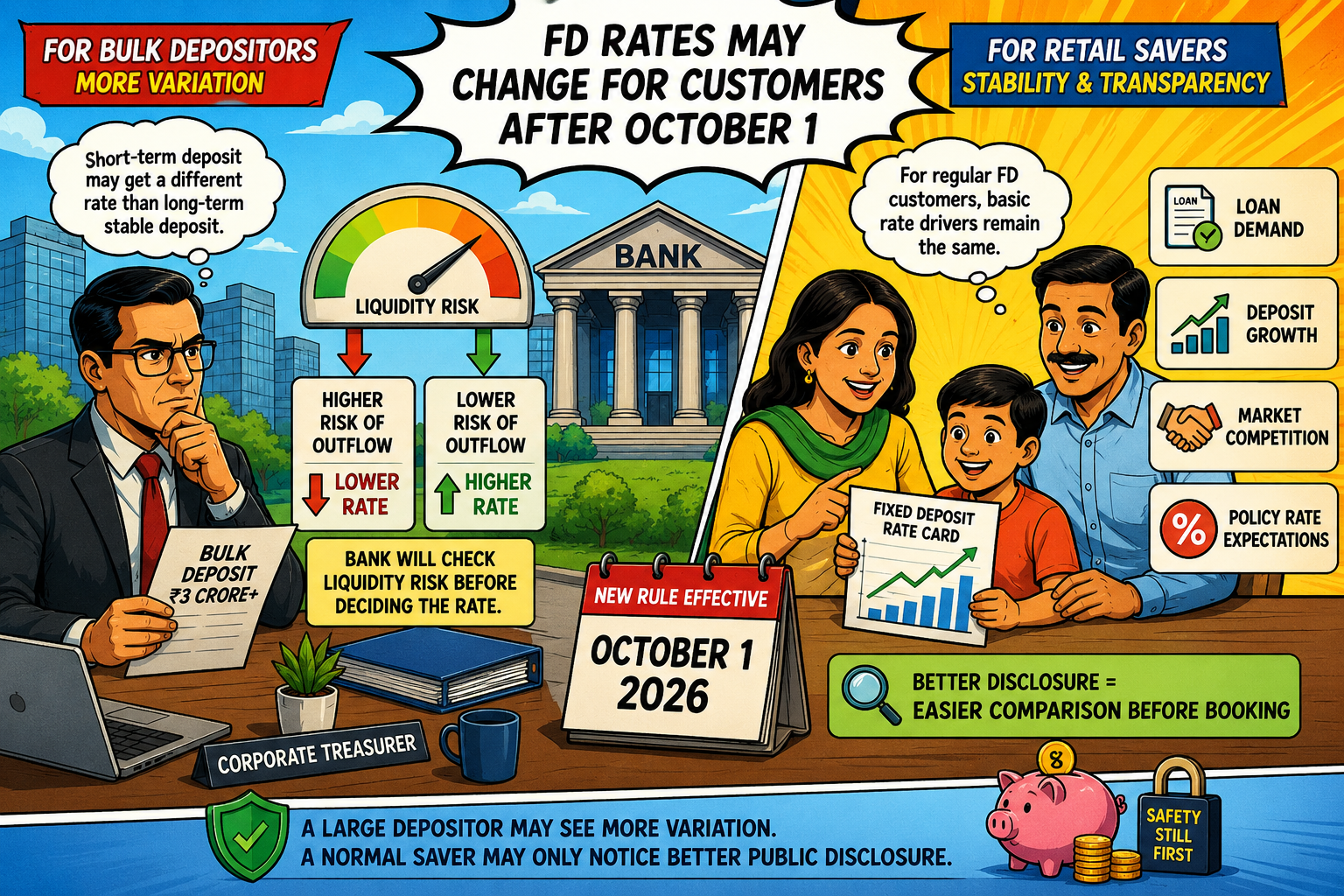
FD rates may change after October 1, but this rule alone does not order banks to increase rates. The impact will be sharper for bulk depositors. A company parking surplus money for 30 days may get a different rate from a trust placing stable funds for a longer period. The bank’s liquidity team will look at how risky that money is from an outflow point of view.
For retail customers, the basic rate drivers remain the same. Banks raise or cut FD rates depending on loan demand, deposit growth, market competition and policy-rate expectations. A large depositor may see more variation after October 1. A normal saver may only notice better public disclosure. That is still useful. It gives customers a cleaner place to check rates before walking into a branch.
The earlier development came when the bulk deposit threshold for scheduled commercial banks and small finance banks was moved from ₹2 crore to ₹3 crore. This meant a deposit of ₹2.5 crore, which earlier came under the bulk deposit category, would no longer fall into the main ₹3 crore threshold used for commercial banks.
That earlier change reduced the number of deposits treated as bulk deposits. The latest rule takes the next step by saying banks can price those large deposits differently through liquidity-risk classification. The shift is small for household savers, but for treasuries, family offices and institutions, it changes the rate negotiation process.
Before reading the table, one point is useful. The customer impact depends on deposit size. A ₹50,000 FD and a ₹5 crore FD will not be treated the same way under this rule.
The table shows why the rule is not a blanket rate announcement. It is a pricing and disclosure update. The final return for customers will still depend on bank competition and the chosen tenure.
The expert reading is fairly direct. Banks now have more freedom in bulk deposit pricing, but that freedom comes with a public rate card. Treasury teams will have to align the website rate, branch quote and internal approval record. If they fail, the issue can become a compliance problem rather than a routine customer complaint.
Depositors should respond with basic checks. Large depositors should ask whether the FD is callable or non-callable, whether premature withdrawal is allowed, and whether the day’s rate matches the bank website. Retail customers should compare at least 2 banks, check tax on interest and avoid locking emergency funds for a long period. Chasing an unusually high FD rate without checking the bank and insurance cover can be risky.

The timing of this FD rule change is important because Indian savers are already watching deposit returns more carefully. Families that earlier left spare money in savings accounts are comparing fixed deposit rates more often, especially when banks offer better returns for selected tenures. This is why even a rule aimed mainly at ₹3 crore and above bulk deposits has caught wider public attention.
LoansJagat’s analysis on deposit behaviour adds useful context here. Its June 3, 2026, report said the share of savings account deposits in total deposits fell from 34.6% in March 2022 to 28.7% in March 2026, while fixed deposits rose from 55.2% to 61.6%. That shift shows why customers now track FD rate changes more actively. The new rule may not raise retail FD rates overnight, but daily disclosure and tighter pricing rules can make depositors ask better questions before locking their money.
For banks, the new rule gives pricing room but removes some old comfort. A branch cannot casually promise a better bulk FD rate if the disclosed rate card says something else. Treasury, branch staff and compliance teams will need the same version of the day’s rate.
For customers, the gain is cleaner information. Large depositors may still negotiate, but the negotiation now has a published reference point. Retail customers may not gain an instant rate hike, yet the rule still helps them ask sharper questions. What is the rate today? Is premature withdrawal allowed? Is the deposit insured? What happens if the money is needed before maturity?
RBI’s new fixed deposit rule is aimed at large deposits, not everyday household FDs. From October 1, 2026, banks can price ₹3 crore and above bulk deposits differently by looking at liquidity risk. They must also display the rates daily, which gives depositors a better reference point before booking.
Small savers should not treat this as a confirmed rate hike. Their best step is still practical: compare rates, read withdrawal terms, check tax impact and keep the ₹5 lakh deposit insurance limit in view. For large depositors, the new rule changes the conversation. The rate can differ, but the bank now needs a rule-backed reason and a published rate card.
For scheduled commercial banks and small finance banks, the key bulk deposit threshold is ₹3 crore and above.
No automatic hike is guaranteed. Retail FD rates will still depend on each bank’s deposit and lending needs.
Banks can consider liquidity risk. A deposit likely to leave quickly may be priced differently from stable money.
No rushed action is needed. Customers should compare the maturity benefit, penalty and new rate before making any change.









.png&w=3840&q=75)


