
Disclaimer: The information published on LoansJagat is intended for general informational and educational purposes only and should not be considered financial, legal, or investment advice. Interest rates, loan terms, statistics, and other data may change over time and may vary by lender or source. Please verify the latest information and consult a qualified financial advisor or the respective Bank/NBFC before making any financial decisions.
Subscribe Now
About the author

Arshathul Afia is a journalism graduate and fintech content writer with 4+ years of experience in digital publishing and research-led writing. She has written 200+ articles covering personal finance, lending, banking, digital payments, credit, insurance, and major financial developments in India. At LoansJagat, she focuses on simplifying complex fintech news, RBI updates, loan-related changes, policy developments, and industry trends for everyday readers. Her journalism background helps her approach stories with research, context, and clarity, while her SEO experience ensures content remains discoverable and relevant. She aims to make financial news easier to understand, practical, and useful for readers across India.
Related News
Simplify All Your Loans Into One Affordable EMI

Customers Served

Debt Consolidated

1200+ Reviews

Locations in India
Club all Loans & Credit Card Bills into Single EMI

Quick Apply Loan
Consolidate your debts into one easy EMI.

Takes less than 2 minutes. No paperwork.

10 Lakhs+
Trusted Customers

2000 Cr+
Loans Disbursed

4.7/5
Google Reviews

50+
Banks & NBFCs Offers
Other services mentioned in this article
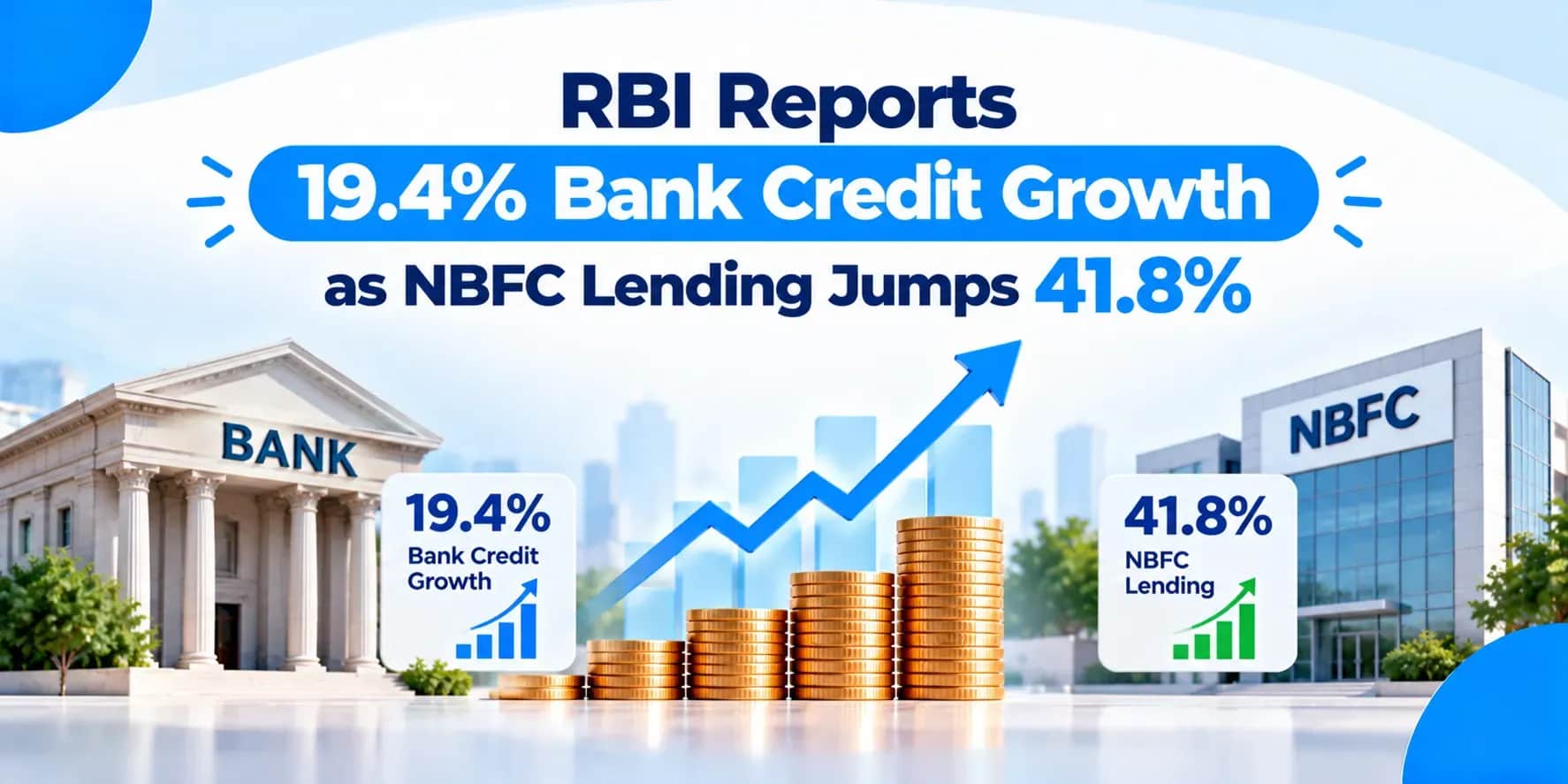
September’s banking data showed 19.4% annual credit growth across India, with services and NBFC lending leading the rise as households and businesses increased their borrowing.
Banks’ outstanding loans to non-banking financial companies, or NBFCs, reached ₹22.53 lakh crore in September 2026. These companies were among the strongest contributors to India’s 19.4% annual bank credit growth. The September sectoral credit release, published on 30 October 2026, also recorded increases in services, industry, agriculture and personal loans.
Customers also borrow through NBFCs, which offer loans and other financial services. Banks also lend to these companies. September’s 41.8% increase measures that bank-to-NBFC relationship, rather than the loans finance companies subsequently extended to individual customers. Lending and investment both fall within NBFC activities, as the Finance Ministry explains.
The funding reaches NBFCs first; their loans to customers are separate transactions. Growth in the former need not produce an equal increase in the latter. For anyone comparing personal and business loan options, the relevant costs remain those in the offer, including interest and fees over the repayment period. September’s figures describe the expansion of lenders’ outstanding credit; an individual loan offer determines the borrower’s cost.
Services outpaced the other major sectors in September. The release identified NBFCs, trade, commercial real estate, transport operators and professional services as contributors, while industrial lending also expanded across businesses of different sizes.
The figures below show annual growth as of 30 September 2026. The 30 October credit update reports these major sectoral rates.
Services credit includes bank lending to NBFCs. Adding NBFC lending separately to the services total would count the same category twice. Personal loans form another category, covering borrowing such as housing and vehicle loans.
Within industry, large and medium businesses recorded faster credit growth, while micro and small industries maintained steady expansion. Engineering, chemicals, food processing, textiles and infrastructure featured among the growing segments in the September release.
The September assessment described housing and vehicle credit as resilient. Loans against fixed deposits grew faster. Gold jewellery and education loans still recorded strong increases, though their annual growth fell below the previous year’s pace.
That distinction helps explain the household picture. Slower growth in a loan category still means outstanding borrowing increased when the growth rate remains positive. It does not mean lenders’ loan balances fell. September’s personal lending figures therefore reflect different speeds of expansion across products, rather than a uniform change in household borrowing.
Funding an NBFC, lending to its customers and setting their interest rates involve separate transactions. Bank credit to an NBFC appears on the bank’s loan book. The NBFC’s subsequent customer lending represents another stage of financing. September’s headline captures the expansion in bank credit, so reading it as a direct measure of household loan demand would combine different transactions.
Borrowing costs require a separate comparison too. Fresh rupee lending rates averaged 8.51% in September, against 8.61% in August, while the average outstanding rate remained 8.96%, according to the 30 October update. These averages describe loans across the banking system. A borrower’s contract, loan category and applicable rate determine the repayment amount.
The August sectoral update, published on 30 September 2026, had already identified NBFCs, trade, professional services and commercial real estate as drivers of services credit. September continued that trend, with services growth moving above August’s pace.
The comparison concerns annual growth rates at successive reporting dates. September’s figure measures outstanding credit against the corresponding previous-year period. It should not be read as an increase in lending during September alone.
September’s bank credit figures show expansion across the major lending categories, with services and NBFC financing leading growth. Household lending also increased, although individual loan products followed different paths.
For borrowers, the distinction remains practical: credit growth shows how lending balances changed, while the loan agreement determines repayment costs. September’s lower average fresh lending rate and unchanged outstanding rate illustrate why those measures need separate attention.
Banks’ total outstanding credit increased 19.4% against the corresponding previous-year period. It does not mean banks disbursed that much additional credit during September alone.
The September release identified NBFCs, trade, commercial real estate, transport operators and professional services as contributors. Services recorded 28.3% annual credit growth.
Banks and NBFCs both lend. Their functions differ, including deposit-taking permissions. NBFCs cannot accept demand deposits, according to the Finance Ministry’s banking information.
September’s figure measures banks lending to NBFCs. Establishing whether customers switched lenders requires borrower-level evidence rather than this bank funding measure.
The average rate on outstanding rupee loans remained 8.96%. The average fresh lending rate fell, but that measures a different group of loans.
Start your journey today
Apply Now*T&C apply











