Disclaimer: The information published on LoansJagat is intended for general informational and educational purposes only and should not be considered financial, legal, or investment advice. Interest rates, loan terms, statistics, and other data may change over time and may vary by lender or source. Please verify the latest information and consult a qualified financial advisor or the respective Bank/NBFC before making any financial decisions.
Subscribe Now
About the author

Arshathul Afia is a journalism graduate and fintech content writer with 4+ years of experience in digital publishing and research-led writing. She has written 200+ articles covering personal finance, lending, banking, digital payments, credit, insurance, and major financial developments in India. At LoansJagat, she focuses on simplifying complex fintech news, RBI updates, loan-related changes, policy developments, and industry trends for everyday readers. Her journalism background helps her approach stories with research, context, and clarity, while her SEO experience ensures content remains discoverable and relevant. She aims to make financial news easier to understand, practical, and useful for readers across India.
Related News
Simplify All Your Loans Into One Affordable EMI

Customers Served

Debt Consolidated

1200+ Reviews

Locations in India
Club all Loans & Credit Card Bills into Single EMI

Quick Apply Loan
Consolidate your debts into one easy EMI.

Takes less than 2 minutes. No paperwork.

10 Lakhs+
Trusted Customers

2000 Cr+
Loans Disbursed

4.7/5
Google Reviews

50+
Banks & NBFCs Offers
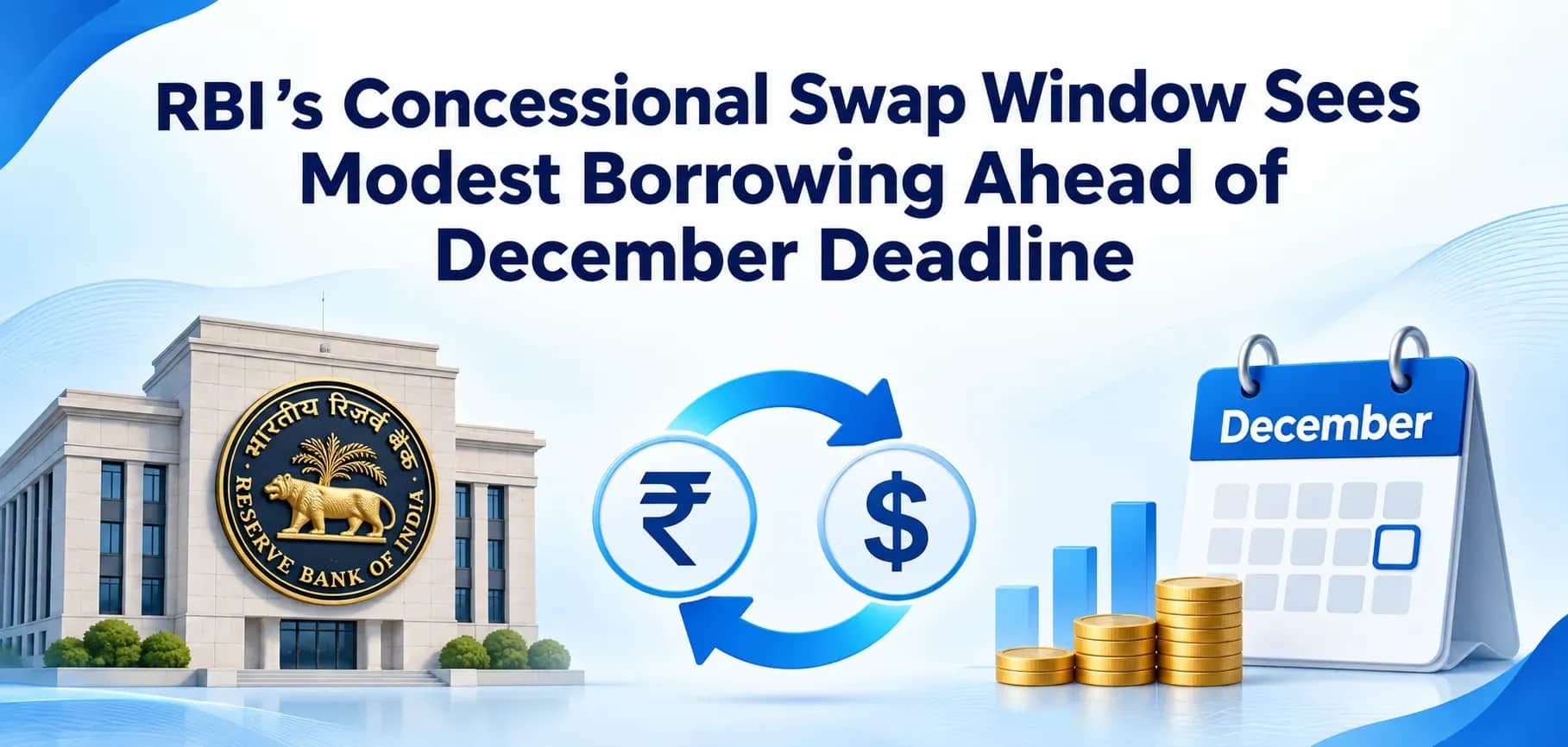
India’s concessional swap window drew $10.616 billion through two overseas borrowing routes by 18 September 2026, as funding costs and issuance paperwork held back borrowers.
Key Highlights
On 19 November 2026, the Reserve Bank of India (RBI) had about six weeks left to attract eligible overseas borrowing through its concessional swap window. Indian banks and public sector undertakings (PSUs) had raised a combined $10.616 billion by 18 September, in the latest published tally. The RBI introduced the dollar-rupee facility on 8 June 2026 to draw foreign currency into India and support the rupee.
Most of the money in that tally had already come in by the end of August. Global borrowing costs had made overseas debt expensive for Indian issuers. Yields have since eased, leaving borrowers to weigh the full cost of an overseas issue against what they would pay to raise funds at home. Those returning to the market also have ratings and paperwork to deal with.
The RBI’s 21 September release showed that the two routes had drawn almost equal amounts by 18 September. Their pace differed, though. Overseas foreign currency borrowings (OFCBs) had led at the end of August, but external commercial borrowings (ECBs) accounted for $1.405 billion of the $1.465 billion added over the next three weeks.
Under this facility, the ECB route is open to eligible majority government-owned or government-controlled PSUs outside the banking sector for debt with an average maturity of at least three years. Authorised Dealer Category I banks may use the OFCB route for overseas foreign currency debt with a minimum maturity of three years.
Borrowers may raise funds in other currencies. The RBI conducts the swap in US dollars. The facility covers eligible undrawn amounts on existing ECBs and excludes debt with embedded options and new ECBs used to refinance or repay existing ones.
Read also: Health Insurers Outpace Broader Market as October Non-Life Premiums Reach ₹32,761 Crore
An eligible bank sells dollars to the RBI at the prevailing Financial Benchmarks India Pvt. Ltd. (FBIL) reference rate. At the end of the swap, it returns the rupees with the premium and gets the dollars back. The premium is fixed at 1.5% a year, compounded every six months. Swaps are in multiples of $1 million, and their term follows the repayment schedule or maturity of the underlying debt, up to five years.
The premium gives issuers a known cost for the swap. They still have to pay interest on the foreign currency debt and cover issuance expenses. A fall in benchmark yields may improve the calculation, but it offers little incentive to borrow overseas if the total cost still exceeds what the issuer would pay in India.
On 17 November 2026, three-year and five-year US Treasury yields stood at 4.84% and 4.90%, respectively. Brent crude futures traded at $93.10 a barrel on 18 November. The recent easing in yields and crude prices gave eligible borrowers a better opening, particularly if they already had credit ratings and issuance documents in place.
UCO Bank established a $1 billion medium-term note programme on 17 November, following a non-deal roadshow in Dubai on 2 and 3 November. The programme gives the bank a framework for future debt issues. The announcement listed the programme size without reporting any bond pricing or proceeds. Banks that postponed fundraising when yields were higher may still need to secure ratings or update existing programmes and documents before approaching investors.
The RBI had originally set 30 September 2026 as the cut-off for eligible Foreign Currency Non-Resident (Bank), or FCNR(B), deposits. It brought that date forward to 31 August after a strong response. Deposits mobilised by the revised cut-off reached $132.98 billion. As of 19 November, the RBI had announced neither an early closure nor an extension for either borrowing route.
The December deadline leaves little room for issuers still preparing an overseas bond deal. Lower US yields give banks and public sector undertakings a better starting point. They still have to price the debt, include the swap premium and fees, and compare domestic rates. Issuers with ratings and documents already in place have more time to act. An eligible ECB drawdown or OFCB inflow must arrive by 31 December 2026. Banks have until 15 January 2027 to use the swap.
Eligible public sector undertakings can use the external commercial borrowing route through authorised banks. Authorised Dealer Category I banks can use the overseas borrowing route.
The RBI charges a fixed annual premium of 1.5%, compounded every six months. Banks can swap amounts in multiples of $1 million under the facility.
Eligible ECB drawdowns and OFCB inflows must arrive by 31 December 2026. Banks then have until 15 January 2027 to complete the swap with RBI.
A weaker rupee raises the rupee cost of repaying unhedged dollar debt. A currency hedge reduces that exposure, and its premium adds to borrowing costs.
An FCNR(B) deposit is a term deposit held in foreign currency at an Indian bank by eligible non-residents. The RBI’s special swap supported eligible deposits.
Start your journey today
Apply Now*T&C apply