
By continuing, you agree to LoansJagat's Credit Report Terms of Use, Terms and Conditions, Privacy Policy, and authorize contact via Call, SMS, Email, or WhatsApp
Disclaimer: The information published on LoansJagat is intended for general informational and educational purposes only and should not be considered financial, legal, or investment advice. Interest rates, loan terms, statistics, and other data may change over time and may vary by lender or source. Please verify the latest information and consult a qualified financial advisor or the respective Bank/NBFC before making any financial decisions.
Subscribe Now
About the author

Arshathul Afia
Arshathul Afia is a journalism graduate and fintech content writer with 4+ years of experience in digital publishing and research-led writing. She has written 200+ articles covering personal finance, lending, banking, digital payments, credit, insurance, and major financial developments in India. At LoansJagat, she focuses on simplifying complex fintech news, RBI updates, loan-related changes, policy developments, and industry trends for everyday readers. Her journalism background helps her approach stories with research, context, and clarity, while her SEO experience ensures content remains discoverable and relevant. She aims to make financial news easier to understand, practical, and useful for readers across India.
Related Blog Post
Simplify All Your Loans Into One Affordable EMI

Customers Served

Debt Consolidated

1200+ Reviews

Locations in India
Club all Loans & Credit Card Bills into Single EMI

Quick Apply Loan
Consolidate your debts into one easy EMI.

Takes less than 2 minutes. No paperwork.

10 Lakhs+
Trusted Customers

2000 Cr+
Loans Disbursed

4.7/5
Google Reviews

50+
Banks & NBFCs Offers
RBI’s planned fraud intelligence platform will help banks spot risky digital payments earlier, share warnings faster and reduce losses linked to mule accounts across India.
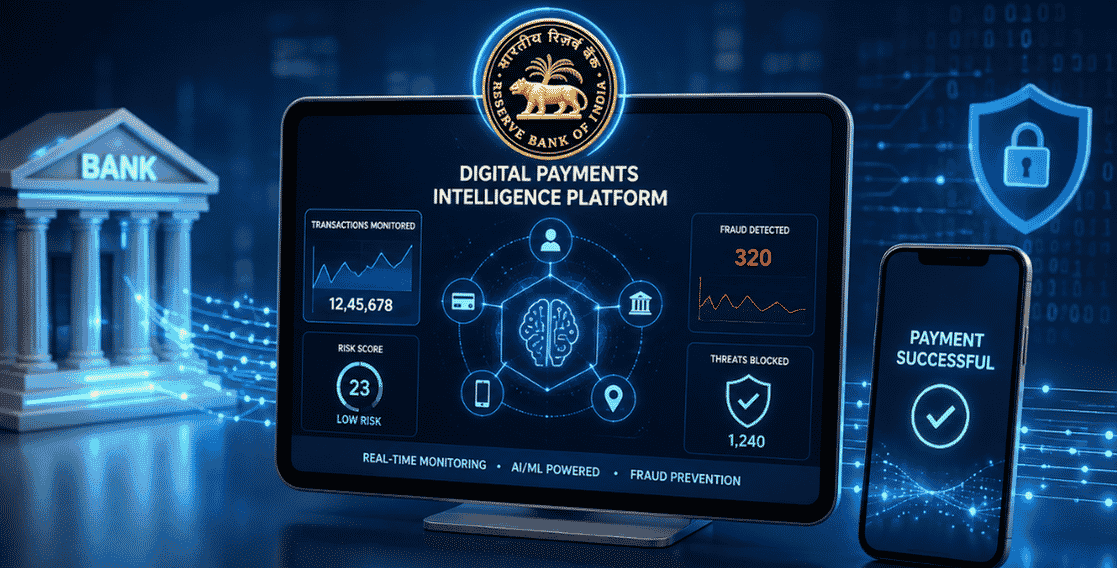
The Reserve Bank Innovation Hub is developing the Digital Payments Intelligence Platform, or DPIP, for Indian banks and payment institutions. It combines a shared registry of suspicious activity with a planned AI-based risk score. The Indian Digital Payment Intelligence Corporation, or IDPIC, will operate the wider system. A Press Information Bureau release dated May 12, 2026, confirmed that I4C would share mule-account intelligence with RBIH.
The short-term aim is to warn banks before a suspicious UPI, card or online banking payment is completed. Over a longer period, information supplied by 1 institution could protect customers of several other banks. There is a possible downside. Genuine transfers may face delays if a model produces a wrong alert, especially for traders, freelancers and small firms receiving money from new customers.
Customers will not open a separate DPIP application. The check will take place within the bank’s payment process. If a pensioner tries to send ₹90,000 after a fake police call, the beneficiary may already appear in shared fraud records. The bank could display a warning, call the sender or request another verification step.
Small businesses could gain protection too, though their payment patterns require careful handling. A shop may receive money from hundreds of unfamiliar UPI IDs, while a freelancer may accept a large first payment from a new client. LoansJagat’s assessment is that DPIP’s real test will be the time between an alert and a trained human review, not the number of warnings generated. Its coverage of MuleHunter.AI and the I4C data-sharing agreement also flags the risk of innocent accounts being restricted through false positives.
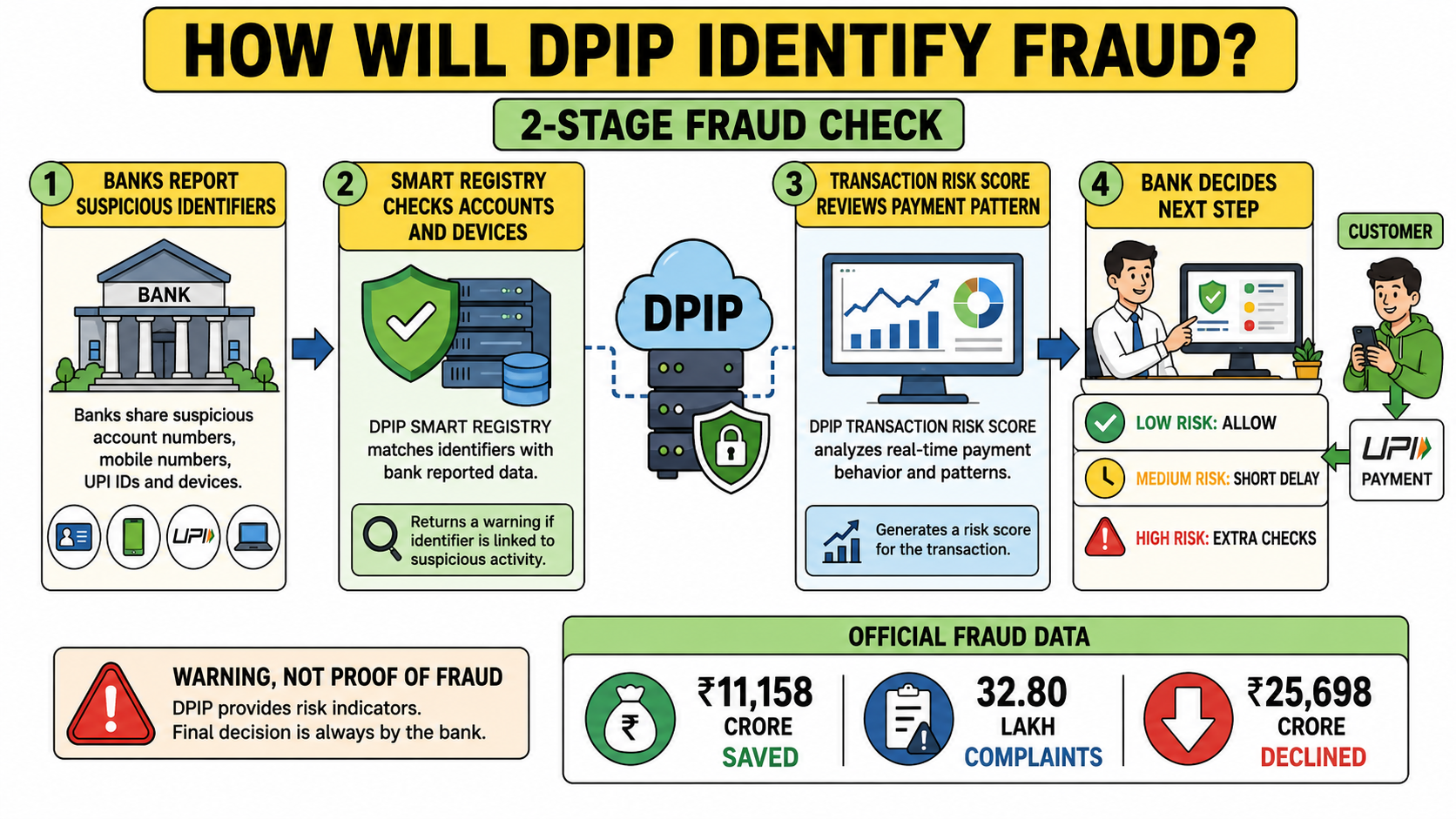
DPIP has 2 separate layers. The Smart Registry will hold identifiers connected with suspicious or fraudulent activity reported by participating banks. The planned second phase will study previous transaction data and return a risk score before a payment is completed. The bank will then choose the next action under its approved fraud policy.
A high score will serve as a warning, not a finding of guilt. The sender’s bank may permit the transfer, introduce a brief cooling period or ask for documents. A beneficiary bank may conduct enhanced checks before releasing suspected fraud proceeds.
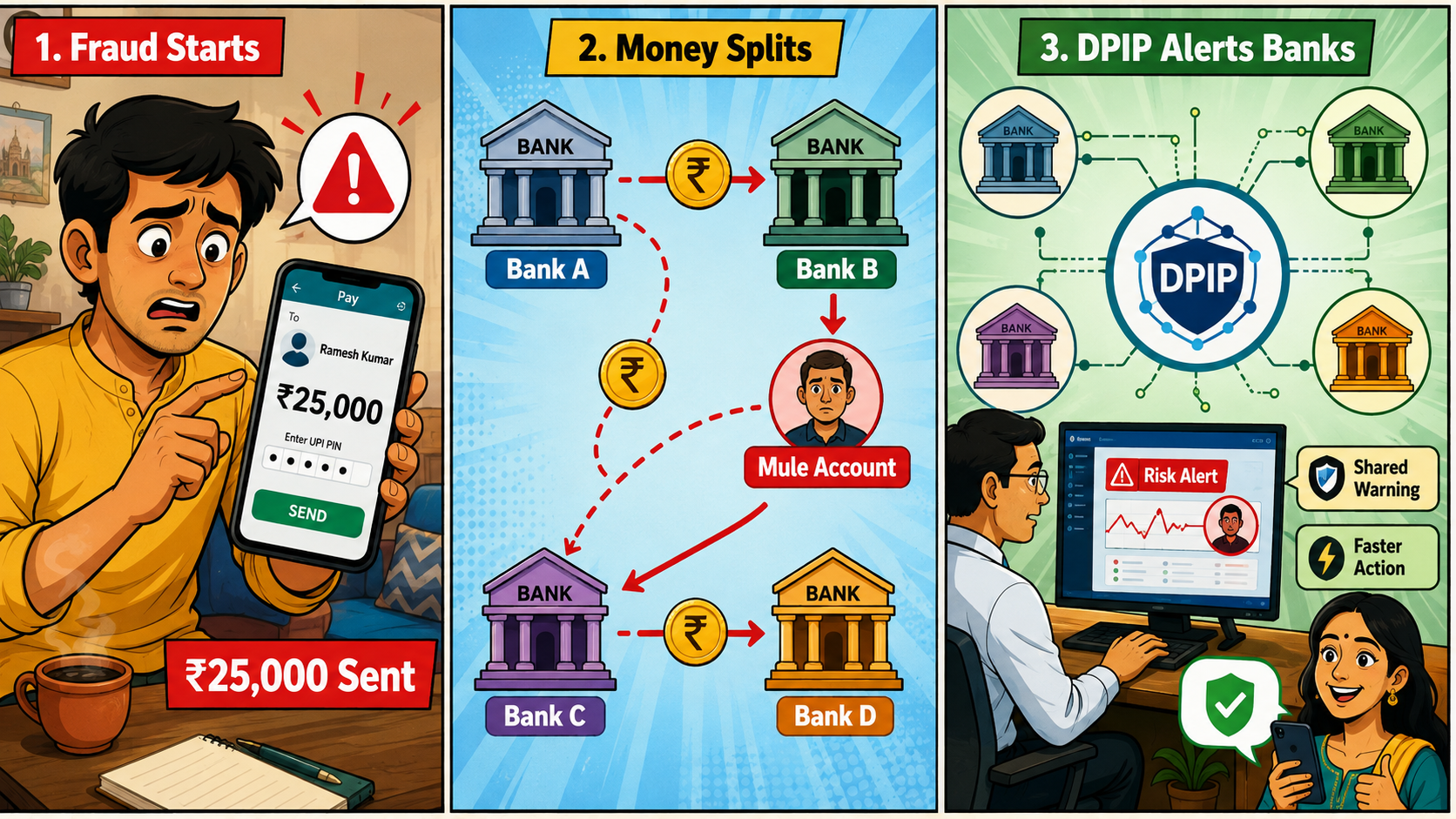
Digital fraud rarely remains inside 1 bank. A victim may send money from Bank A to a mule account in Bank B. The fraudster can split it across Banks C and D before the complaint reaches the first branch. Separate fraud systems see fragments of that route. DPIP is designed to help participating institutions compare warnings much earlier.
The platform also addresses repeat use of suspicious identities. A person blocked by 1 bank may try another institution, mobile number or payment address. Phase I can reveal the earlier report during onboarding. Phase II may find behaviour that a registry lookup misses.
The government data explains the urgency without treating every complaint as a confirmed offence. Between FY 2023-24 and FY 2025-26, the National Cyber Crime Reporting Portal received more than 53.87 lakh cyber-fraud complaints involving a reported amount above ₹56,087 crore. Those figures cover complaints submitted to the cybercrime system. They should not be presented as the same dataset as frauds classified and reported by banks.
RBIH CEO Sahil Kini said on June 22, 2026, that the hub was building the DPIP prototype for transfer to IDPIC. IDPIC MD and CEO K. Satyanarayana Raju explained on May 17, 2026, that banks could apply their own thresholds to low, medium and high-risk indications. The final decision stays with the bank.
Union Home Minister Amit Shah said on May 12, 2026, that “mule accounts are big hurdles in curbing cybercrimes." The practical answer requires more than a model score. Banks need trained review staff, specific alert reasons and a fast grievance route. A customer whose genuine account is restricted should be told what documents are required and where the review stands. Otherwise, an anti-fraud tool could create a second problem for the person it was meant to protect.
RBI proposed DPIP in June 2024 and appointed a committee chaired by former NPCI MD and CEO A.P. Hota. The committee examined how a shared digital public infrastructure could support network-level fraud intelligence. RBIH later began work on the prototype with a group of public and private banks.
IDPIC was incorporated as a Section 8 company on October 16, 2025, led by State Bank of India and Bank of Baroda. By March 31, 2026, 7 banks had joined the Phase I pilot. RBIH’s separate MuleHunter.AI system was identifying likely mule accounts.
On May 12, 2026, I4C and RBIH signed an agreement covering fraud-risk information, analytical support and operational coordination. I4C’s Suspect Registry can supply identifiers linked with mule accounts. RBIH can use those records to train and improve fraud models. DPIP has a wider purpose because it is intended to connect shared intelligence with checks on individual digital payments.
A bank warning should not be dismissed because the recipient sounds convincing. The sender should pause and verify the beneficiary through a separate phone number. Police officers, regulators and courier staff do not ask people to transfer money to a “safe account”.
If money has already been sent, the customer should contact the bank and call 1930 immediately. The complaint can then enter the Citizen Financial Cyber Fraud Reporting and Management System, where banks and police may try to trace and place a lien on the funds. Reporting early improves the chance of stopping onward transfers, but it does not guarantee an immediate refund.
DPIP could shorten the gap between the first fraud warning and action by another bank. Its Smart Registry gives participating institutions a shared reference point. The planned risk score adds a second check before money moves, which may help stop digital arrest scams, fake investments and other payment frauds that depend on speed.
The system still needs careful execution. Banks must protect genuine customers from unexplained blocks while acting quickly on strong warnings. DPIP can improve early detection, yet secure account opening, customer verification and rapid reporting through 1930 will continue to decide how much money can be protected.
DPIP is a shared fraud-intelligence system being developed by RBIH. It will help participating banks check suspicious identifiers and, in its second phase, receive transaction-level risk scores.
No. DPIP can provide intelligence and a risk warning. The bank will decide whether to allow, delay, verify or stop a payment under its own approved policy.
That will depend on the bank’s payment process. A customer may see a warning, receive a verification call or face a temporary delay while the bank reviews the transfer.
DPIP focuses on detection before or during payment screening. Recovery depends on quick reporting, the money trail, available funds and action by banks and law enforcement agencies.
Banks assess each transfer separately. The sender, beneficiary, amount, device and recent activity may produce different risk results. The affected customer should ask the bank which side declined the payment.








.png&w=3840&q=75)


