
By continuing, you agree to LoansJagat's Credit Report Terms of Use, Terms and Conditions, Privacy Policy, and authorize contact via Call, SMS, Email, or WhatsApp
Disclaimer: The information published on LoansJagat is intended for general informational and educational purposes only and should not be considered financial, legal, or investment advice. Interest rates, loan terms, statistics, and other data may change over time and may vary by lender or source. Please verify the latest information and consult a qualified financial advisor or the respective Bank/NBFC before making any financial decisions.
Subscribe Now
About the author

Arshathul Afia
Arshathul Afia is a journalism graduate and fintech content writer with 4+ years of experience in digital publishing and research-led writing. She has written 200+ articles covering personal finance, lending, banking, digital payments, credit, insurance, and major financial developments in India. At LoansJagat, she focuses on simplifying complex fintech news, RBI updates, loan-related changes, policy developments, and industry trends for everyday readers. Her journalism background helps her approach stories with research, context, and clarity, while her SEO experience ensures content remains discoverable and relevant. She aims to make financial news easier to understand, practical, and useful for readers across India.
Related News
Simplify All Your Loans Into One Affordable EMI

Customers Served

Debt Consolidated

1200+ Reviews

Locations in India
Club all Loans & Credit Card Bills into Single EMI

Quick Apply Loan
Consolidate your debts into one easy EMI.

Takes less than 2 minutes. No paperwork.

10 Lakhs+
Trusted Customers

2000 Cr+
Loans Disbursed

4.7/5
Google Reviews

50+
Banks & NBFCs Offers
Other services mentioned in this article
Home loan borrowers may get a longer EMI break as economists move India’s next 25 bps rate hike call beyond the October policy cycle.
India’s home loan borrowers may not face an immediate EMI increase after the latest dovish pause, as economists have pushed fresh 25 bps rate hike calls beyond the October policy cycle. The main players in this story are the central bank, lenders, economists and millions of floating-rate borrowers. The impact will be felt across India, especially in cities where housing loans already take a large part of monthly income.
The short-term relief is direct. A borrower whose EMI is linked to a floating benchmark may not see a sudden rise right away. The long-term risk is still open. If food prices, fuel costs or global oil pressure stay high, banks may prepare for higher lending rates later. That can raise EMIs, stretch loan tenures, or make new home loans harder for borderline applicants.
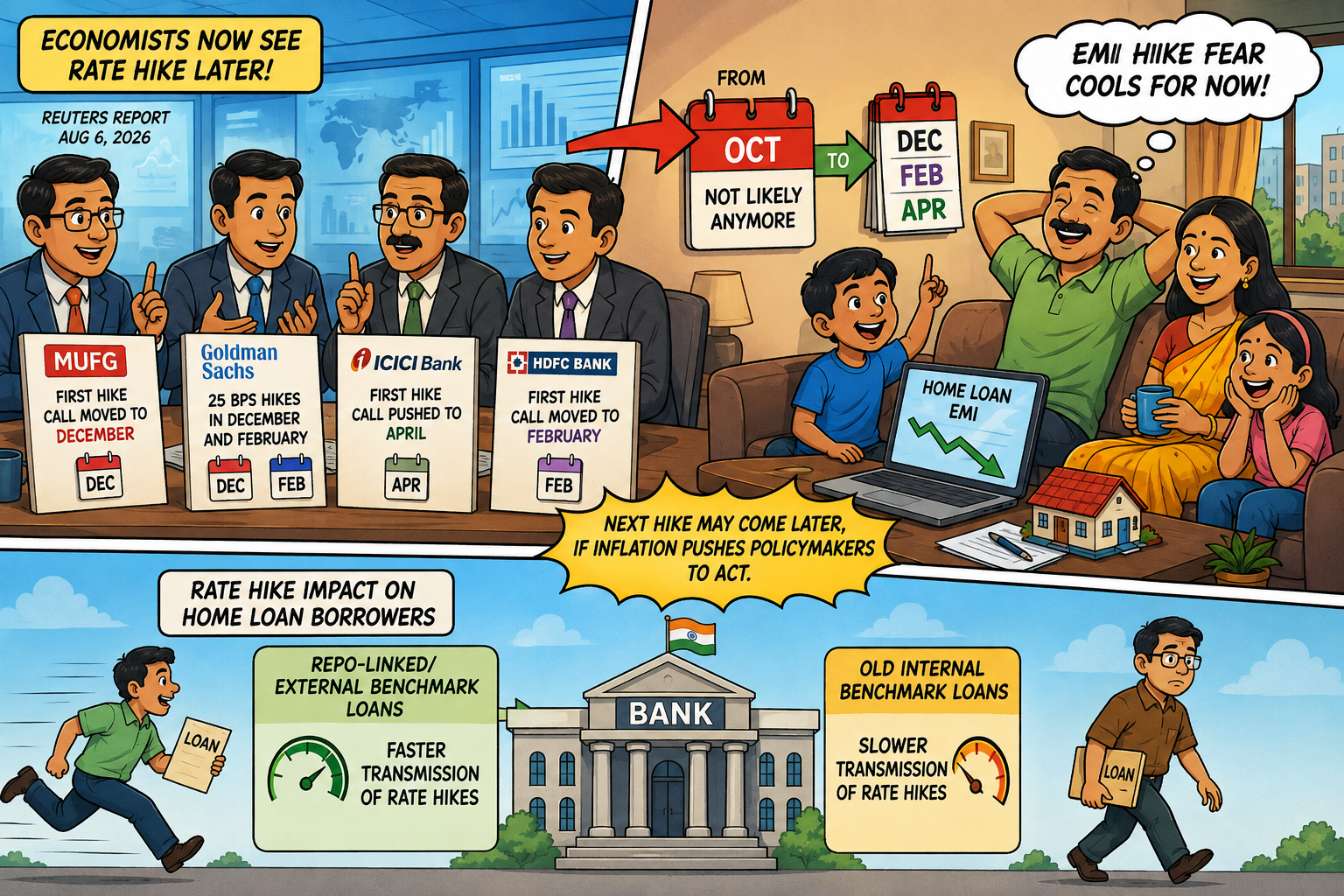
The immediate EMI fear has cooled because economists no longer see October as the most likely point for the next rate hike. Reuters reported on August 6, 2026, that MUFG moved its first hike call from October to December, while Goldman Sachs expected 25 bps hikes in December and February. ICICI Bank pushed its first hike call to April, and HDFC Bank moved its call to February.
For a home loan borrower, the takeaway is simple. October may not bring the rate shock many feared earlier. That does not mean the loan has become cheaper. It only means the next increase may arrive later if inflation gives policymakers enough reason to act. Borrowers with repo-linked or external benchmark-linked loans usually see faster transmission than those on older internal bank benchmarks.
The first effect will be visible in household budgeting. A family paying a home loan EMI, school fees, rent overlap and daily expenses gets more time before another possible rate-linked increase. That helps, even if the relief is temporary. In cities such as Mumbai, Bengaluru, Pune, Hyderabad, Delhi NCR and Chennai, a small EMI increase can disturb monthly planning because loan sizes are often large.
There is a positive side for new buyers too. Someone planning to finalise a flat before Diwali may get more time to compare lenders, check loan terms and negotiate processing charges. Buyers should not treat this as a green signal to borrow at the maximum limit. A 25 bps hike can look small in a headline, but on a large home loan, it can still raise the monthly burden.
A borrower should check the loan reset cycle before assuming the EMI will stay unchanged for long. Banks do not always revise every loan on the same day. Some reset monthly. Some reset once in 3 months. The loan agreement gives that answer, not social media posts.
After this table, the borrower action becomes narrow and useful. Check the benchmark. Ask for the reset date. Ask whether a future rate increase will raise the EMI, extend tenure, or do both. These 3 answers can prevent a surprise when the bank message arrives.
Economists are not saying rate hikes are cancelled. They are saying the likely timing has shifted. Reuters reported that Michael Wan of MUFG now sees the first move in December instead of October. Goldman Sachs expects 2 hikes of 25 bps each, one in December and another in February. HDFC Bank and ICICI Bank economists placed their calls even later.
That spread in forecasts tells borrowers to prepare without panic. A household with surplus cash can make a small part-payment if the loan is floating-rate and foreclosure charges do not apply. Another borrower can ask the bank for a lower spread. This is where many borrowers lose money. They keep paying an older spread while new borrowers get better rates.
LoansJagat’s borrower explainer on floating home loans says EMI or tenure can change when benchmark rates move, even without signing a new agreement. That point is useful because many borrowers assume banks need fresh consent before every EMI change. In floating loans, the reset clause already allows such changes when the benchmark moves. Borrowers can read more.
The solution is not complicated. Borrowers should ask the lender for a one-page loan rate breakup. It should show the benchmark, spread, current rate, reset date and remaining tenure. If the spread is too high, they can ask for a conversion offer or compare a balance transfer. Not every transfer saves money, though. Processing fees, legal charges and valuation charges must be counted.
The most recent major update came from the government's inflation report. The Press Information Bureau released June 2026 CPI data on July 13, 2026, at 4:00 PM. It showed retail inflation at 4.38% and food inflation at 5.32%. This was sufficient to keep the discussion on rate hikes alive, although the latest policy stance gave borrowers short-term relief.
Growth data also shaped the debate. The Ministry of Statistics and Programme Implementation released provisional GDP estimates on June 5, 2026, at 4:00 PM. FY 2025-26 real GDP growth stood at 7.7%, while Q4 growth stood at 7.8%. A strong growth print can support loan demand, but it also keeps inflation watchers alert if demand pushes prices higher.
This is why borrowers should not see the dovish pause as a final answer. It is only one stage in a longer rate cycle. Inflation can cool. Oil can rise. Global conditions can change quickly. A borrower cannot control these factors, but the loan structure is within reach.
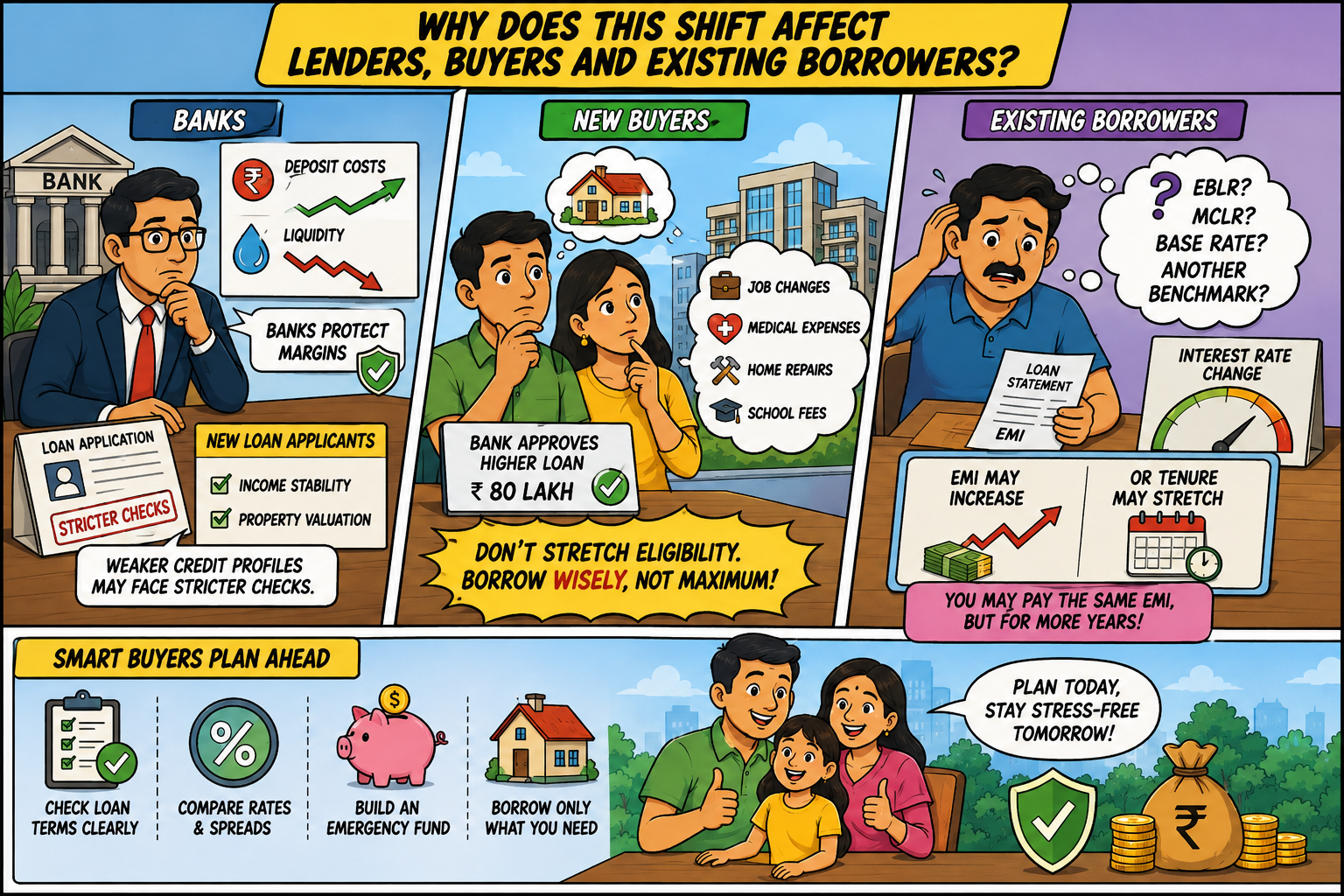
Banks will watch the same data before pricing fresh loans. If deposit costs rise or liquidity tightens, lenders may protect margins even before borrowers feel the full rate cycle. New borrowers with weaker credit profiles may face stricter checks, especially on income stability and property valuation.
Existing borrowers have a different problem. Many of them do not know whether their loan is linked to EBLR, MCLR, base rate or another benchmark. Some only know the EMI amount. That is risky. When the next rate change comes, the EMI may move, or the tenure may stretch quietly. A borrower may continue paying the same EMI but spend more years clearing the loan.
Fresh buyers should also avoid stretching eligibility. A bank may approve a higher loan, but the family has to repay it through job changes, medical expenses, repairs and school years. Taking a little less debt can be smarter than chasing a bigger flat and then hoping rates stay soft.
The title tells the story plainly. RBI dovish pause pushes 25 bps rate hike calls beyond October policy, and that gives home loan borrowers a short break from immediate EMI pressure. It is useful relief, not a permanent shield.
Borrowers should use this gap well. Check the benchmark, reset date, spread and remaining tenure now. If the loan is expensive, ask the bank for a conversion option or compare a balance transfer with all charges included. The next rate hike may come later than October, but when it comes, the loan agreement will decide how fast it reaches the EMI.
Economists pushed fresh 25 bps rate hike calls beyond October, reducing immediate EMI pressure for floating home loan borrowers.
EMIs may rise after a future rate hike, but the actual date depends on each bank’s loan reset cycle.
Food inflation affects household spending quickly and can push wider price pressure if it stays high for several months.
Small prepayments can help if emergency savings are safe and the loan is floating-rate with no major charges.
Banks usually extend tenure first because it keeps the monthly EMI stable for borrowers. The loan runs longer, interest cost rises, and repayment pressure feels smaller at first glance only.









.png&w=3840&q=75)


