
By continuing, you agree to LoansJagat's Credit Report Terms of Use, Terms and Conditions, Privacy Policy, and authorize contact via Call, SMS, Email, or WhatsApp
Disclaimer: The information published on LoansJagat is intended for general informational and educational purposes only and should not be considered financial, legal, or investment advice. Interest rates, loan terms, statistics, and other data may change over time and may vary by lender or source. Please verify the latest information and consult a qualified financial advisor or the respective Bank/NBFC before making any financial decisions.
Subscribe Now
About the author

Arshathul Afia
Arshathul Afia is a journalism graduate and fintech content writer with 4+ years of experience in digital publishing and research-led writing. She has written 200+ articles covering personal finance, lending, banking, digital payments, credit, insurance, and major financial developments in India. At LoansJagat, she focuses on simplifying complex fintech news, RBI updates, loan-related changes, policy developments, and industry trends for everyday readers. Her journalism background helps her approach stories with research, context, and clarity, while her SEO experience ensures content remains discoverable and relevant. She aims to make financial news easier to understand, practical, and useful for readers across India.
Related Blog Post
Simplify All Your Loans Into One Affordable EMI

Customers Served

Debt Consolidated

1200+ Reviews

Locations in India
Club all Loans & Credit Card Bills into Single EMI

Quick Apply Loan
Consolidate your debts into one easy EMI.

Takes less than 2 minutes. No paperwork.

10 Lakhs+
Trusted Customers

2000 Cr+
Loans Disbursed

4.7/5
Google Reviews

50+
Banks & NBFCs Offers
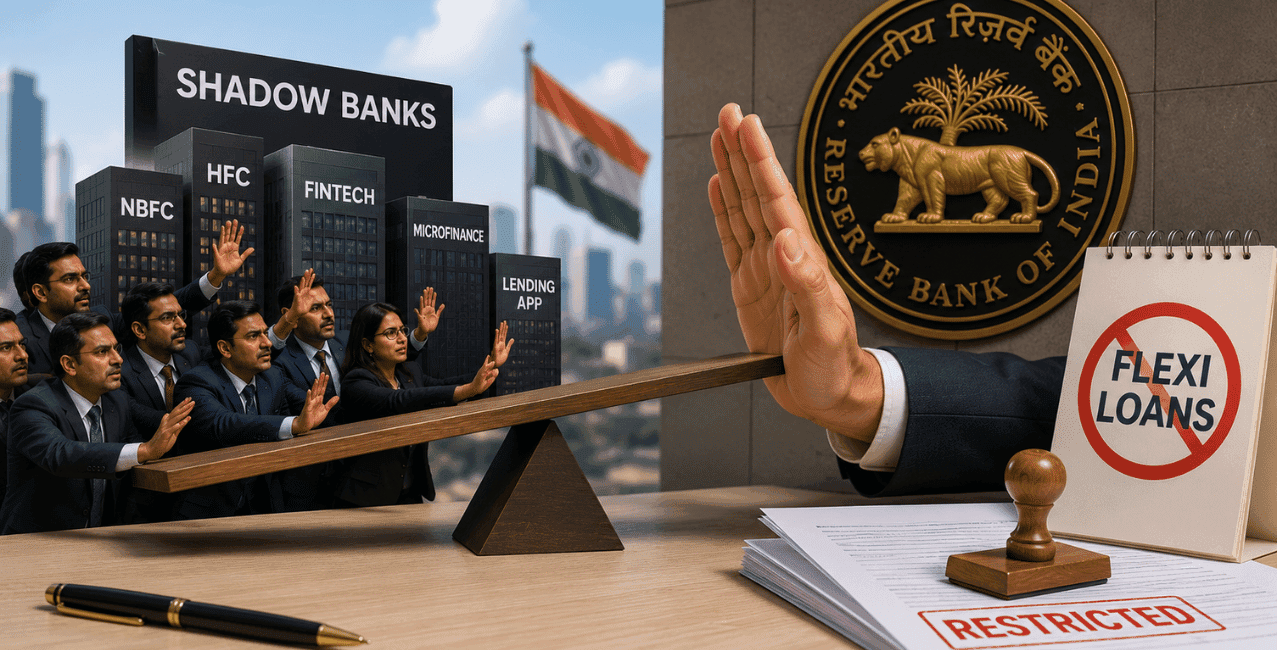
RBI’s draft may end reusable flexi loans at most NBFCs, reducing rollover risk while narrowing short-term credit for self-employed borrowers and small businesses across India.
In the short term, borrowers with irregular income could lose a ready source of cash. The Press Information Bureau reported on 27 March 2026 that 56.2% of workers were self-employed, while 23.6% held regular wage or salaried jobs. A trader waiting for an invoice may need a fresh term loan for every requirement. Over several years, fixed repayment dates may expose financial stress earlier, but fewer choices could push weaker applicants towards expensive informal lenders.
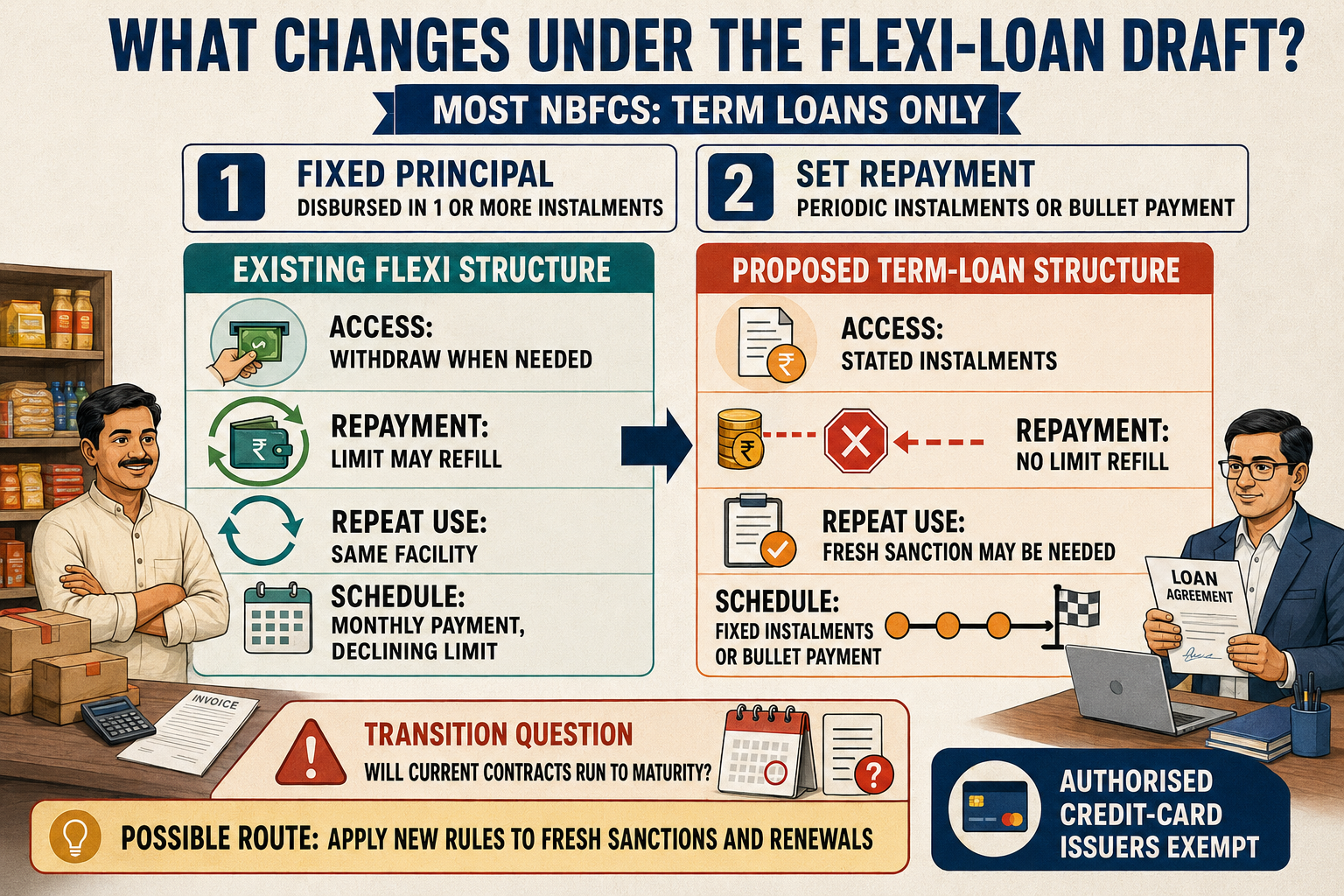
RBI has proposed 2 tests for a term loan. First, the lender must sanction a fixed principal amount and release it in 1 or more instalments. Second, the borrower must repay it through a predetermined schedule, either periodic instalments or a bullet payment on stated dates. Once the principal is repaid, that amount cannot replenish the available limit.
Any fund-based facility that fails this definition would count as revolving credit. The draft would remove existing provisions for demand or call loans and restrict revolving products. Authorised credit-card issuers would be excluded. The proposal is not final, and it does not address current accounts or unused limits.
The table shows why the wording changes more than a product name. A facility may have a final closing date, yet it can still fall within the proposed restriction when repayment restores borrowing power.
The missing transition provisions are important. An immediate change could freeze facilities that businesses expected to use through an entire season. A phased start would let current contracts run until maturity while applying the restriction to fresh sanctions and renewals.
A term loan gives the customer a stated principal, repayment date and closing point. The borrower cannot keep the account alive by drawing again after each repayment. That may help families identify the true cost of a loan, while credit bureaus receive a more direct record of outstanding debt. It also prevents a borrower from paying an instalment with money taken from the unused portion of the same facility.
The benefit becomes stronger when a customer already holds several digital credit lines. A fixed schedule shows how much must be paid and when the obligation ends. Lenders may spot trouble sooner instead of discovering it after repeated withdrawals. The proposal could therefore reduce evergreening, where fresh credit keeps an older obligation appearing current even though the borrower’s own income cannot support repayment.
Vinod Kothari, founder of Vinod Kothari & Consultants, told ETBFSI on 11 August 2026 that supply-chain finance differs from unrestricted consumer credit. Such funding usually follows an approved invoice, purchase or sale. The borrower cannot freely divert it to unrelated expenses. He argued that reserving this business mainly for banks could reduce finance available to smaller suppliers.
Vivek Ramji Iyer, partner at Grant Thornton, viewed the draft through NBFC liquidity. A revolving facility requires a lender to keep funds ready for later withdrawals, even when the timing is uncertain. Experts favour separate tests for secured facilities, invoice finance and open-ended consumer lines. A workable rule could set a fixed maturity, reduce limits each year, block redraws after missed payments and let current contracts run until maturity.
NBFC executives said RBI supervisors had discouraged revolving credit for nearly 2 years before the August draft. Jugal Mantri, Executive Director and CEO of Anand Rathi Global Finance, told ETBFSI that his company stopped issuing such facilities in January 2025. The earlier message, according to Mantri, was that banks should provide most working-capital facilities.
RBI consolidated its NBFC credit rules in November 2025. Those directions still included provisions for demand or call loans, though lenders said references supporting wider revolving products had reduced. The 2026 proposal removes the remaining demand-loan provisions and places a direct restriction in the rulebook. That would turn earlier supervisory advice into an express product boundary.
The change also follows a wider reworking of NBFC categories and customer-facing activities. A LoansJagat analysis of the 2026 NBFC framework had already pointed to unanswered questions around regulatory reach and the treatment of different business models. The latest draft adds another borrower-side concern: whether tighter oversight can preserve short-term business credit for customers who do not fit a standard salary-based loan.
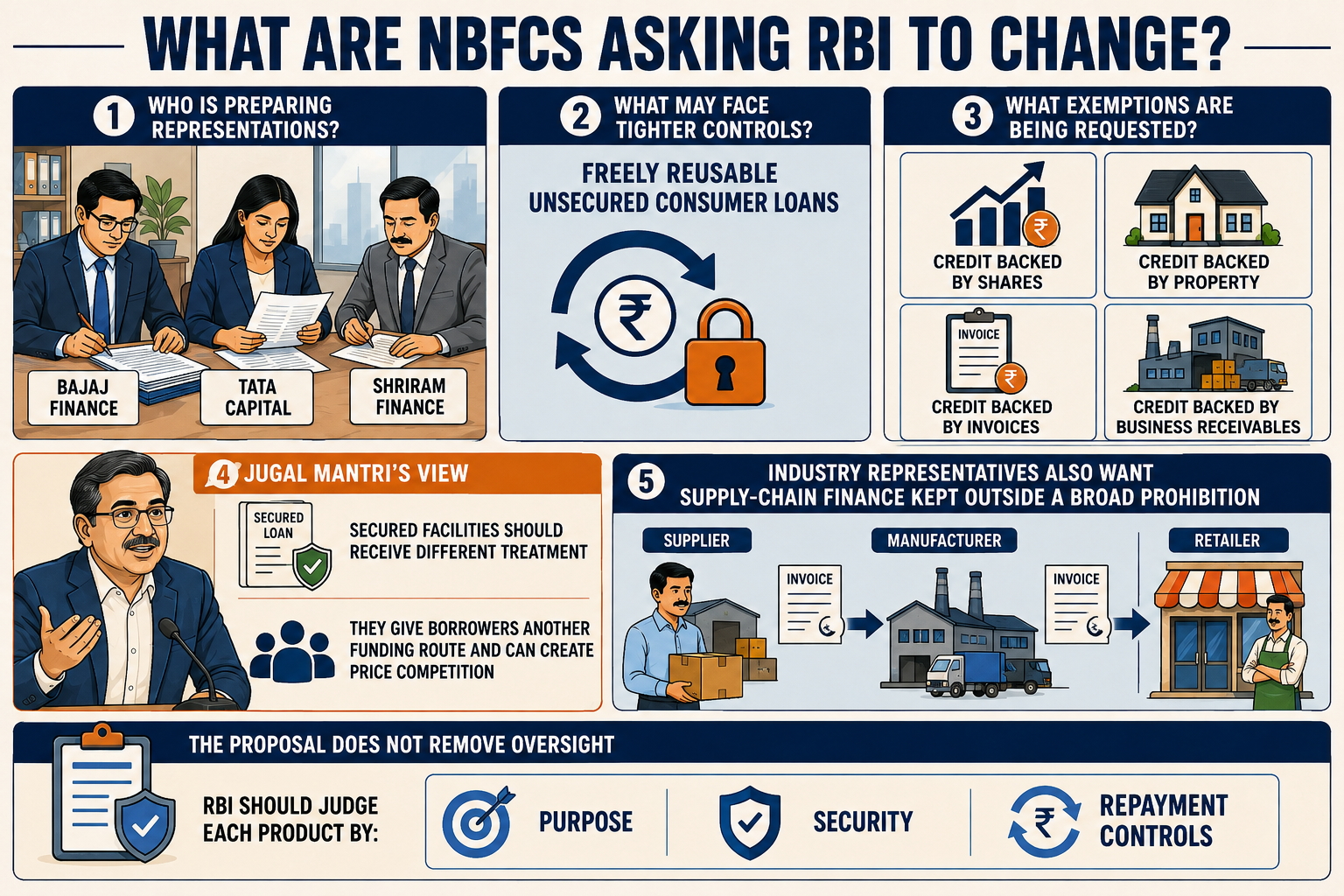
Large lenders, including Bajaj Finance, Tata Capital and Shriram Finance, were reported to be preparing representations against a blanket restriction. The industry is expected to support tighter controls on freely reusable unsecured consumer loans while requesting exemptions for credit backed by shares, property, invoices or business receivables.
Jugal Mantri said secured facilities should receive different treatment because they give borrowers another funding route and can create price competition. Industry representatives also want supply-chain finance kept outside a broad prohibition. Their proposal does not remove oversight. It asks the RBI to judge the purpose, security and repayment controls attached to each product.
The proposal may not reduce the amount a business borrows. It may simply divide 1 reusable facility into several short-term loans. That creates more documents, separate account entries and possible charges without lowering the borrower’s combined debt. A better final rule would measure total exposure, repayment source and use of funds rather than count the number of loan contracts.
RBI’s proposal addresses a real weakness in revolving credit. A borrower can use fresh withdrawals to keep earlier dues current, delaying signs of financial trouble. Fixed-term loans create stated repayment dates and prevent principal from returning automatically.
The proposed wording may still catch products built for genuine working-capital needs. Self-employed workers, traders and small suppliers often receive money after their own bills fall due. They use short-term limits to bridge that timing gap, not to keep debt running forever.
The final rule needs a narrower cut. Unsecured open-ended credit can face strict limits, while secured and invoice-backed facilities continue with declining limits, full bureau reporting and redraw blocks after missed payments. That approach would reduce hidden rollovers without sending reliable small-business borrowers through a fresh loan application every few weeks.
The draft does not explain the treatment of existing contracts. The final directions must state whether current limits can continue until maturity, require conversion or receive a transition period.
Yes, but only an NBFC already authorised by RBI to issue credit cards would receive the proposed exemption. Other NBFCs could not use the exemption for ordinary flexi loans.
Some borrowers may face extra processing charges if repeated withdrawals require separate term loans. The final cost will depend on lender pricing, loan frequency and transition rules.
The draft gives no direct answer for existing unused limits. Borrowers should wait for final directions and written communication from their lender before assuming that funds remain available.
Supply-chain funding is usually tied to invoices or identified purchases. NBFCs argue that it supports business activity and carries controls absent from freely usable consumer credit lines.








.png&w=3840&q=75)


