By continuing, you agree to LoansJagat's Credit Report Terms of Use, Terms and Conditions, Privacy Policy, and authorize contact via Call, SMS, Email, or WhatsApp
Disclaimer: The information published on LoansJagat is intended for general informational and educational purposes only and should not be considered financial, legal, or investment advice. Interest rates, loan terms, statistics, and other data may change over time and may vary by lender or source. Please verify the latest information and consult a qualified financial advisor or the respective Bank/NBFC before making any financial decisions.
Subscribe Now
About the author

Arshathul Afia is a journalism graduate and fintech content writer with 4+ years of experience in digital publishing and research-led writing. She has written 200+ articles covering personal finance, lending, banking, digital payments, credit, insurance, and major financial developments in India. At LoansJagat, she focuses on simplifying complex fintech news, RBI updates, loan-related changes, policy developments, and industry trends for everyday readers. Her journalism background helps her approach stories with research, context, and clarity, while her SEO experience ensures content remains discoverable and relevant. She aims to make financial news easier to understand, practical, and useful for readers across India.
Related News
Simplify All Your Loans Into One Affordable EMI

Customers Served

Debt Consolidated

1200+ Reviews

Locations in India
Club all Loans & Credit Card Bills into Single EMI

Quick Apply Loan
Consolidate your debts into one easy EMI.

Takes less than 2 minutes. No paperwork.

10 Lakhs+
Trusted Customers

2000 Cr+
Loans Disbursed

4.7/5
Google Reviews

50+
Banks & NBFCs Offers
Other services mentioned in this article
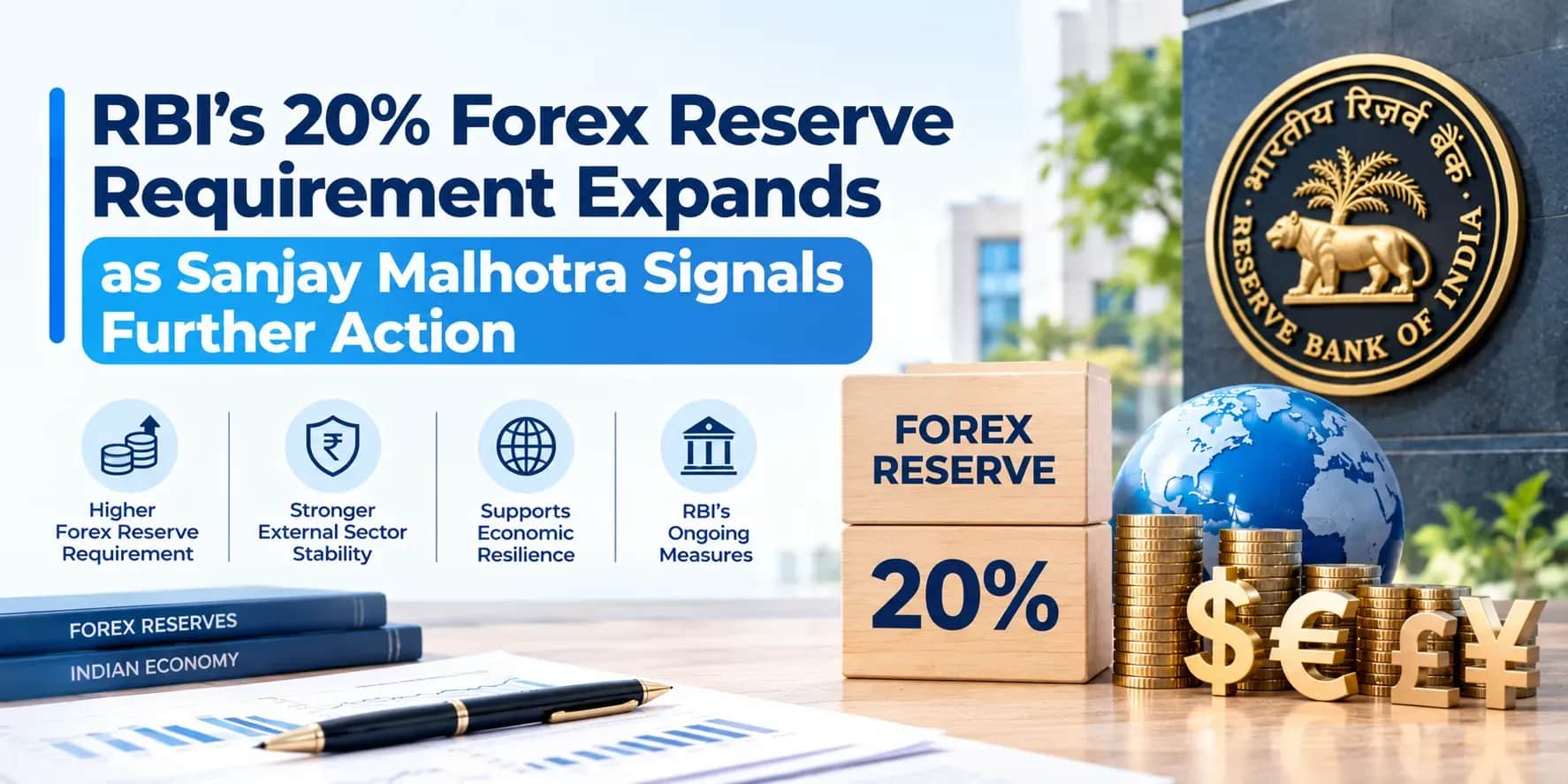
India has widened its 20% forex reserve rule while Governor Sanjay Malhotra says more action may follow if speculative rupee trades continue to build again.
Key Takeaways
The new forex regulations have introduced a 20% Foreign Exchange Risk Reserve to some derivative transactions conducted by authorised dealers on their own currency exposures. The reserve would come into effect under October 12, 2026 directions, for the situation where an authorised dealer hedges currency risk on its assets, liabilities with INR-linked foreign exchange derivatives, and purchases foreign currency against the rupee. On October 13, Governor Sanjay Malhotra stated that the broader measures are being implemented to curb speculation and additional steps might be taken if necessary.
The short-term benefit is less room for one-way dollar bets. The cost can appear in hedging. Reuters reported on October 14 that importers were paying 11 to 14 paise more per month to lock in future dollar purchases as banks passed on the compliance cost with a 20% cash reserve requirement. Hedging activity has become concentrated in shorter-term forward contracts of up to 3 months, bankers told Reuters on October 14.
Most households will never buy a currency forward, but imported fuel, machinery and industrial inputs feed into business costs. On October 11, Akashvani News said that if current account hedges (CAH) exceed $2 million, they will receive a cash reserve of 20%. It additionally indicated that the limit for the number of derivative transactions without taking on underlying exposure has dropped from $100 million to $5 million.
A stable rupee will make it easier for companies to make foreign payments without fluctuations in currency. However, the reserve doesn't cause oil to be cheaper or ensure a fixed exchange rate. The public effect depends on whether lower volatility offsets extra hedging expense passed to companies.
The package combines a reserve cost, tighter exposure rules and a separate channel for oil companies’ dollar demand.
The oil-company step took effect from October 12 and remains available until further notice, according to Akashvani News. We noted that routing these dollar needs separately may reduce pressure in the regular market, although the oil-import bill remains unchanged.
Banks have questioned the design. Reuters reported on October 12 that lenders, through a forex industry body, sought removal of the 20% cash deposit and asked for the $2 million threshold to go. Cash tied against qualifying contracts can affect liquidity and raise prices quoted to corporate clients.
Importers are adapting rather than stopping hedges. Samir Lodha, managing director at QuantArt Market Solutions, told Reuters that importers should keep hedges short and consider low-cost option structures. A practical response is matching hedge periods more closely with actual payment dates, with options used where suitable.
Malhotra’s explanation focused on trading behaviour. In his Moneycontrol interview, he said nearly one-third of some forex transactions were closed or cancelled on the same day they were entered into. He said forex markets should primarily serve genuine foreign-exchange requirements and hedging, not repeated directional bets. He also said the measures were not capital controls.
A Press Information Bureau release dated July 13 said banks and financial institutions had reported strong interest in FCNR(B), external commercial borrowing and overseas foreign-currency borrowing swap initiatives. Those steps worked on foreign-currency supply. October’s package focuses more directly on trading behaviour and demand.
There is no direct change to home-loan or personal-loan EMIs from the 20% forex reserve rule. If rupee weakness raises imported input costs, inflation pressure can rise and later affect interest-rate expectations.
For businesses, the immediate question is how much protection is needed and for how long. Shorter hedges, better exposure records and suitable options can reduce cost without leaving genuine dollar payments fully open.
The wider 20% forex reserve requirement shows a firmer attempt to reduce speculative dollar demand while keeping legitimate hedging available. Malhotra has left room for more action, but no fixed rupee target has been announced.
Lower speculation may help currency stability, yet hedging must remain workable for importers and banks. If costs rise too far, businesses will push harder for changes.
It requires banks to keep cash against specified rupee-linked forex derivative positions,
raising the funding cost of covered hedges rather than taxing every importer directly.
It may reduce speculative dollar demand, but oil prices, capital flows, trade payments,
interest-rate expectations and global currency moves still shape the rupee’s direction.
No. Imported goods may cost more, but final consumer prices still depend on hedging,
taxes, company margins, contracts, competition and domestic supply conditions overall too.
No. Intervention can reduce sharp moves, but longer-term currency direction also reflects trade
flows, foreign investment, inflation, interest rates and the global dollar cycle conditions.
Yes. Genuine hedging continues, though banks face tighter reserve and documentation requirements. Importers may use shorter forwards or suitable options for actual foreign-currency payment needs.