By continuing, you agree to LoansJagat's Credit Report Terms of Use, Terms and Conditions, Privacy Policy, and authorize contact via Call, SMS, Email, or WhatsApp
Disclaimer: The information published on LoansJagat is intended for general informational and educational purposes only and should not be considered financial, legal, or investment advice. Interest rates, loan terms, statistics, and other data may change over time and may vary by lender or source. Please verify the latest information and consult a qualified financial advisor or the respective Bank/NBFC before making any financial decisions.
Subscribe Now
About the author

LoansJagat Team
‘Simplify Finance for Everyone.’ This is the common goal of our team, as we try to explain any topic with relatable examples. From personal to business finance, managing EMIs to becoming debt-free, we do extensive research on each and every parameter, so you don’t have to. Scroll up and have a look at what 15+ years of experience in the BFSI sector looks like.
Related News
Simplify All Your Loans Into One Affordable EMI

Customers Served

Debt Consolidated

1200+ Reviews

Locations in India
Club all Loans & Credit Card Bills into Single EMI

Quick Apply Loan
Consolidate your debts into one easy EMI.

Takes less than 2 minutes. No paperwork.

10 Lakhs+
Trusted Customers

2000 Cr+
Loans Disbursed

4.7/5
Google Reviews

50+
Banks & NBFCs Offers
Other services mentioned in this article
Key Takeaways
RBI Holds Rates, Rolls Out Capital Measures: Is it Enough to Protect the Rupee?
The West Asia conflict pushed Brent crude into triple-digit territory. The rupee has fallen nearly 5% since the conflict began. Foreign portfolio outflows have not stopped. Rate changes cannot fix any of this directly.
The short-term pain is legitimate. A weaker rupee makes imports more expensive. Oil, electronics, and medicines all get pricier. Raising rates to defend the rupee slows growth. Cutting rates risks pushing the currency lower. That is the corner the RBI is sitting in right now.
Read More - Rupee at ₹95 Risk? Oil Prices
Here is what the RBI announced on June 5:
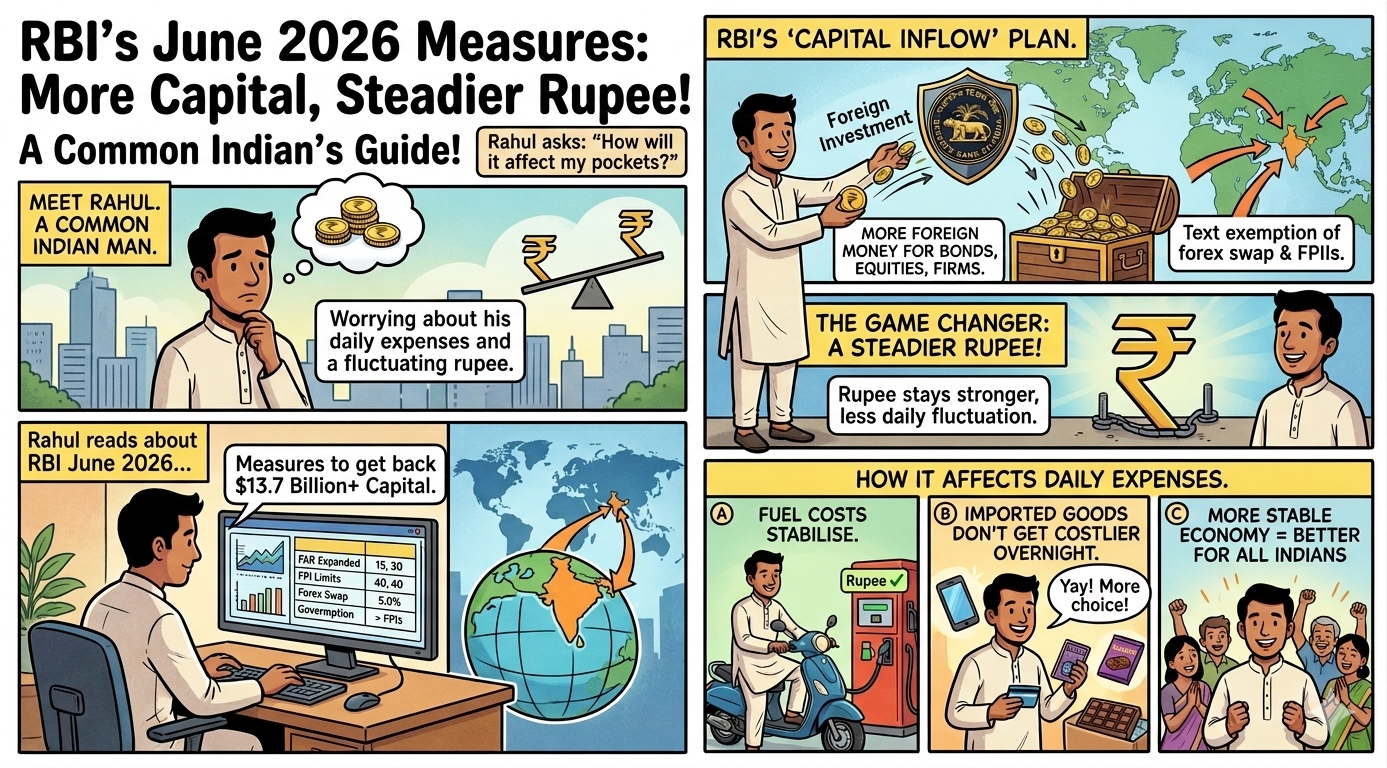
A steadier rupee means fuel and imported goods do not get more expensive overnight for most Indians. Foreign capital outflows from Indian equities have already crossed $13.7 billion in 2026. These steps are aimed at recovering that money.
Gaura Sen Gupta, Chief Economist at IDFC First Bank, said, “By announcing these capital inflow measures, it has reduced the risk that domestic interest-rate decisions would have to move in tandem with global policy. This gives the central bank greater flexibility to set rates based on domestic conditions.”
G. Chokkalingam, Founder and Head of Research at Equinomics Research, said, “The single largest problem for the Indian economy is the Iran war because it has led to a spike in oil prices, higher inflation, pressure on the rupee, and FII outflows.” He does not expect the RBI to move on rates until at least August.
With retail inflation still inside the 2-6% band, there is room to cut rates if global pressure eases. But the MPC’s own numbers show growth slowing to 6.3% in Q2 and inflation jumping to 5.9% by Q3. A rate cut may come, but only when oil and the rupee settle down.
The RBI has used every tool it has without touching the repo rate. The capital package buys some breathing room. But oil prices and global investor mood will decide where the rupee actually goes next. Watch the August MPC meeting for the next signal.
*T&C Apply
What did the RBI decide in the June 2026 monetary policy meeting?
RBI keeps repo rate unchanged at 5.25%, June 5, 2026. It was the third consecutive pause. The MPC cited West Asia tensions, high oil prices, and rupee pressure as key reasons. Core inflation sits at 5.1%, within the 2-6% tolerance band.
Will your home loan or car loan EMI change after the RBI’s June 2026 rate decision?
No change for now. The repo rate stays at 5.25%, so banks have no reason to revise lending rates. This EMI won't change. However, if oil prices continue to rise and the Indian rupee continues to fall further, an increase in the rate during late 2026 might lead to an increase in EMI.









.png&w=3840&q=75)



