

By continuing, you agree to LoansJagat's Credit Report Terms of Use, Terms and Conditions, Privacy Policy, and authorize contact via Call, SMS, Email, or WhatsApp
Disclaimer: The information published on LoansJagat is intended for general informational and educational purposes only and should not be considered financial, legal, or investment advice. Interest rates, loan terms, statistics, and other data may change over time and may vary by lender or source. Please verify the latest information and consult a qualified financial advisor or the respective Bank/NBFC before making any financial decisions.
Subscribe Now
About the author

Arshathul Afia
Arshathul Afia is a journalism graduate and fintech content writer with 4+ years of experience in digital publishing and research-led writing. She has written 200+ articles covering personal finance, lending, banking, digital payments, credit, insurance, and major financial developments in India. At LoansJagat, she focuses on simplifying complex fintech news, RBI updates, loan-related changes, policy developments, and industry trends for everyday readers. Her journalism background helps her approach stories with research, context, and clarity, while her SEO experience ensures content remains discoverable and relevant. She aims to make financial news easier to understand, practical, and useful for readers across India.
Related Blog Post
Simplify All Your Loans Into One Affordable EMI

Customers Served

Debt Consolidated

1200+ Reviews

Locations in India
Club all Loans & Credit Card Bills into Single EMI

Quick Apply Loan
Consolidate your debts into one easy EMI.

Takes less than 2 minutes. No paperwork.

10 Lakhs+
Trusted Customers

2000 Cr+
Loans Disbursed

4.7/5
Google Reviews

50+
Banks & NBFCs Offers
RBI’s draft loan-pricing rules may change how floating EMIs reset from April 2027, giving borrowers better visibility while passing rate increases faster across India.
For borrowers, the short-term effect is limited because the document remains a proposal. Later, loan agreements would identify the benchmark, spread, reset frequency and reset date. A rate becomes easier to check. The negative side is direct: a benchmark increase may reach a floating EMI within 3 months.
Home, vehicle and other individual loans generally fall within the personal-loan category. When a commercial bank issues such credit at a floating rate, it would have to use an external benchmark. Permitted references include the policy repo rate, Government of India Treasury Bill yields, the Secured Overnight Rupee Rate and other rates published by Financial Benchmarks India Private Limited. The customer could compare that published number with the contracted rate and identify the lender’s mark-up.
The change reaches a large pool of borrowers. Personal credit grew by 16.2% in FY 2025-26 and accounted for 33% of total bank credit, according to a Press Information Bureau release dated May 5, 2026. A faster reset may lower an eligible EMI or shorten the tenure when the benchmark falls. If it rises, the household may face a higher instalment or a longer repayment schedule. Either outcome depends on the agreement and the lender’s reset option.
India already has internal and external benchmarks, but they do not operate alike across every regulated lender. Commercial banks follow detailed MCLR and external benchmark requirements. Rules for NBFCs, cooperative banks and financial institutions focus more on lending conduct. Fixed-rate loans have fewer common pricing instructions.
RBI has identified differences in how commercial banks calculate marginal funding costs and build MCLR. Reset dates and day-count practices vary too. The proposal uses a daily reducing balance, the actual number of days and monthly resets. Borrowers may still pay different risk-based spreads.
Specified banks would calculate their internal benchmark from the moving average cost of fresh domestic deposits and borrowings over the preceding 3 months. The method must be system-generated, verifiable and publicly available.
The strongest feature is separating the benchmark from the spread. A loan rate may include credit risk, operating cost, term premium and business strategy. The credit-risk premium must stay positive and may change only after the borrower’s profile changes and the lender completes a review. Other components generally cannot change before 3 years, preventing an unrelated increase from cancelling a benchmark fall.
A LoansJagat analysis shows the effect. With a 6.50% benchmark and 1.75% spread, the payable rate is 8.25%. If the benchmark falls to 6.25% while the spread stays unchanged, the rate becomes 8%. Each sanction letter should show the benchmark, spread components, next reset date and full annual percentage rate together. Borrowers should compare all 4 before migrating or refinancing.
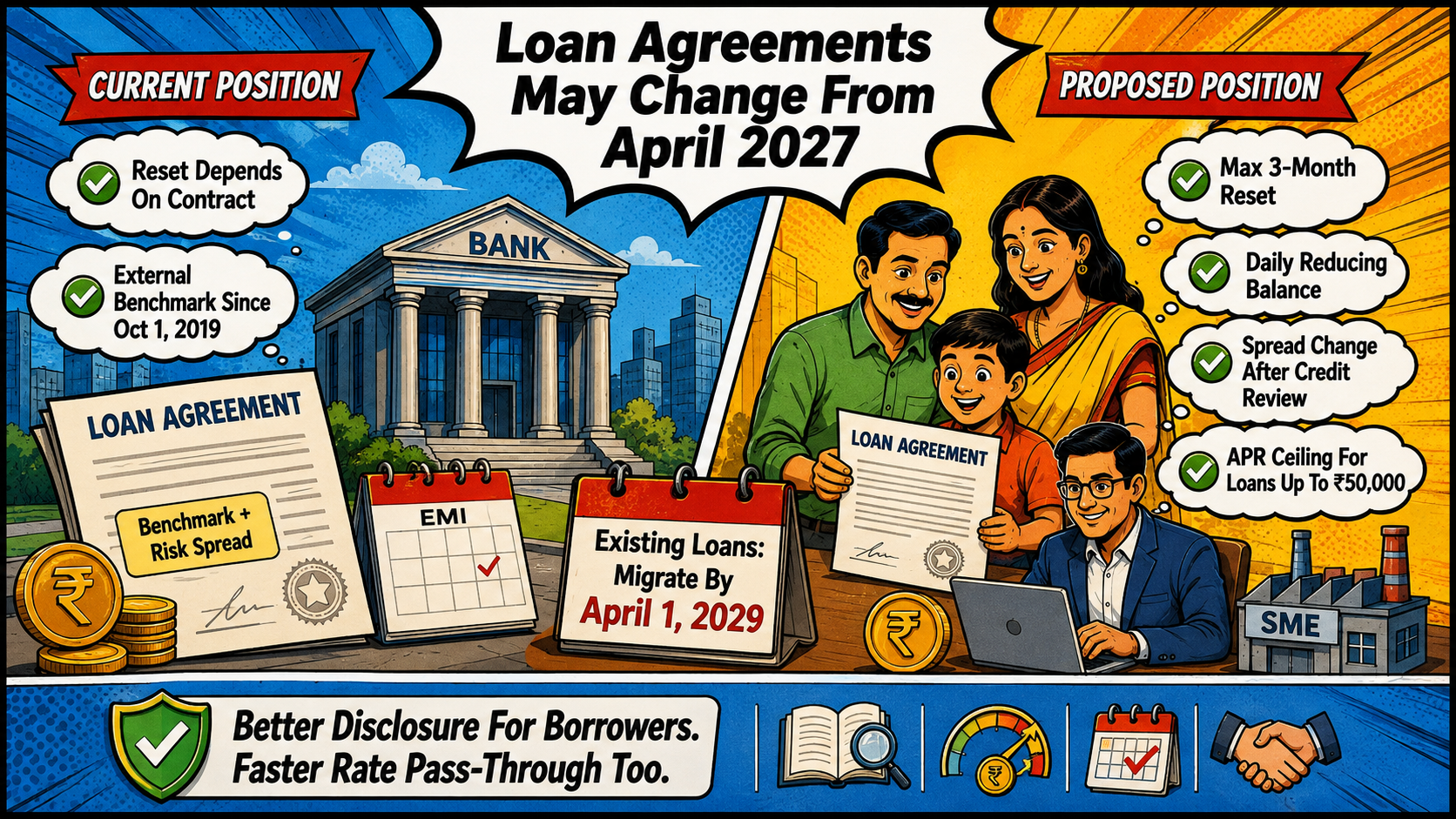
Both fixed and floating loans would follow a benchmark-plus-risk-spread formula. A regulated lender could not price a loan below its applicable benchmark. A genuine fixed-rate loan would keep the same rate for its entire tenor. A hybrid product, fixed for an initial period and floating later, would follow the relevant rules during each stage.
The table below keeps the operative position separate from the proposal. It does not promise an EMI saving because future benchmark movements cannot be known in advance.
The Department of Financial Services records the October 1, 2019, shift to external benchmarks for new floating retail and specified enterprise loans. The proposal builds on that route while giving smaller institutions selected exemptions.
Base layer NBFCs, Tier 1 and Tier 2 urban cooperative banks, and rural cooperative banks with deposits up to ₹1,000 crore would not have to follow the general 3-month reset limit or the 3-year restriction on selected spread components. External benchmarking would remain optional for NBFCs, housing finance companies, regional rural banks, cooperative banks and all-India financial institutions.
External benchmark lending began in October 2019 after older systems did not always pass policy-rate changes quickly. Banks linked new floating retail and specified enterprise loans to the repo rate, Treasury Bill yields or another approved market rate. MCLR continued for other eligible credit.
Floating EMI conduct changed again in 2023. Lenders had to explain how a rate increase affected the EMI and tenure. Options included a higher EMI, longer term, prepayment or a fixed-rate switch where offered. Some borrowers had seen tenures extended without adequate communication.
In September 2025, banks could reduce non-credit-risk spread components before 3 years when borrowers. A floating-to-fixed switch at reset became discretionary. The draft now brings benchmark calculation, spread revision and interest computation into one framework.
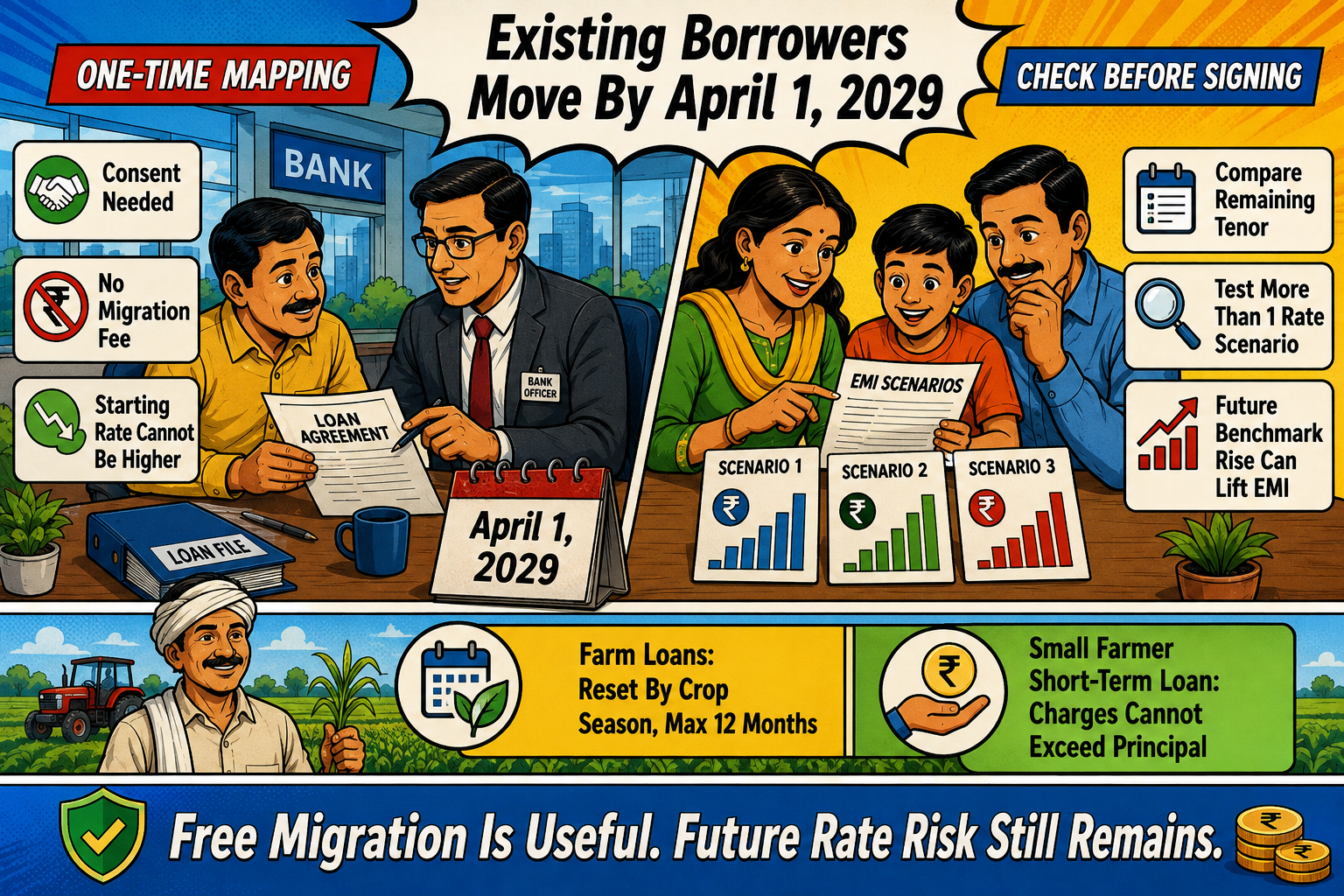
Existing loans linked to an internal or external benchmark would migrate through a one-time mapping exercise by April 1, 2029. The lender must obtain consent. At migration, the revised rate cannot exceed the rate charged immediately before the change, and the lender cannot collect a fee for moving the account.
That protection applies only at the point of transition. A later rise in the selected benchmark can still increase the rate according to the new reset schedule. Borrowers should therefore compare the starting migrated rate, remaining term and estimated future interest under more than one rate scenario. Signing solely because migration is free would be a weak decision.
Agricultural credit keeps separate treatment because repayment follows crop income. Floating resets may follow the crop season but cannot exceed 12 months. For a short-term loan of up to 1 year given to a small or marginal farmer, total interest, fees and other charges cannot exceed the principal. Government-backed schemes with prescribed rates and specified loans against term deposits remain exempt.
RBI’s new loan rate draft could change how quickly floating EMIs respond from April 2027. Its main gain is visibility. A borrower would know the benchmark, spread and reset date instead of seeing only the final lending rate. Restrictions on spread revision may also prevent some customers from missing a benchmark-linked reduction.
The proposal carries no promise of cheaper credit. Faster transmission works during rate increases too, and several smaller lenders have exemptions. Existing borrowers should wait for the final rules, inspect the full benchmark-plus-spread calculation and compare the remaining interest cost before approving migration by April 1, 2029.
No. It remains a draft, with April 1, 2027 proposed as the commencement date.
No. Commercial banks must use an external benchmark, but the chosen benchmark may differ.
No. The EMI changes only when the contracted benchmark and reset terms produce a lower rate.
Credit risk may change after review; other spread components generally remain fixed for 3 years.
No. Borrowers should wait for final directions and compare all revised terms before consenting.








.png&w=3840&q=75)


