

By continuing, you agree to LoansJagat's Credit Report Terms of Use, Terms and Conditions, Privacy Policy, and authorize contact via Call, SMS, Email, or WhatsApp
Disclaimer: The information published on LoansJagat is intended for general informational and educational purposes only and should not be considered financial, legal, or investment advice. Interest rates, loan terms, statistics, and other data may change over time and may vary by lender or source. Please verify the latest information and consult a qualified financial advisor or the respective Bank/NBFC before making any financial decisions.
Subscribe Now
About the author

Arshathul Afia
Arshathul Afia is a journalism graduate and fintech content writer with 4+ years of experience in digital publishing and research-led writing. She has written 200+ articles covering personal finance, lending, banking, digital payments, credit, insurance, and major financial developments in India. At LoansJagat, she focuses on simplifying complex fintech news, RBI updates, loan-related changes, policy developments, and industry trends for everyday readers. Her journalism background helps her approach stories with research, context, and clarity, while her SEO experience ensures content remains discoverable and relevant. She aims to make financial news easier to understand, practical, and useful for readers across India.
Related News
Simplify All Your Loans Into One Affordable EMI

Customers Served

Debt Consolidated

1200+ Reviews

Locations in India
Club all Loans & Credit Card Bills into Single EMI

Quick Apply Loan
Consolidate your debts into one easy EMI.

Takes less than 2 minutes. No paperwork.

10 Lakhs+
Trusted Customers

2000 Cr+
Loans Disbursed

4.7/5
Google Reviews

50+
Banks & NBFCs Offers
RBI’s proposed loan-pricing rules could reshape how lenders set fixed and floating rates, giving home, personal and MSME borrowers stronger safeguards across India over time.
The Reserve Bank of India published the draft DIRS 2026 in Mumbai on August 12, 2026. The draft notice applies to commercial banks, NBFCs, housing finance companies, regional rural banks, cooperative banks, and other lenders that it regulates. As per a DD News report dated August 5, 2026, the regulator aims to standardize the pricing of loans and the manner in which interest is assessed and resets are communicated across all the banks and non-banks that it regulates.
For borrowers, the immediate position does not change because consultation remains open until September 11, 2026. Over time, the rules could expose how lenders build a final rate and restrict unexplained changes to the spread added over a benchmark. Faster floating-rate resets also carry a risk. They can transmit an increase just as quickly as a reduction.
The draft uses a benchmark-plus-spread formula for fixed and floating-rate loans. A benchmark is the lender’s reference rate. The spread may contain a credit-risk premium, operating cost, term premium and business-strategy premium. A board-approved policy would define these components and their permitted range.
For commercial banks, floating personal loans and floating MSME loans would use an external benchmark. Loan agreements would state the benchmark, reset frequency and reset date. For most covered lenders, the reset interval could not exceed 3 months or change during the loan tenure. Fixed-rate loans would also refer to a benchmark plus spread, although their contracted rate would remain unchanged during the fixed period.
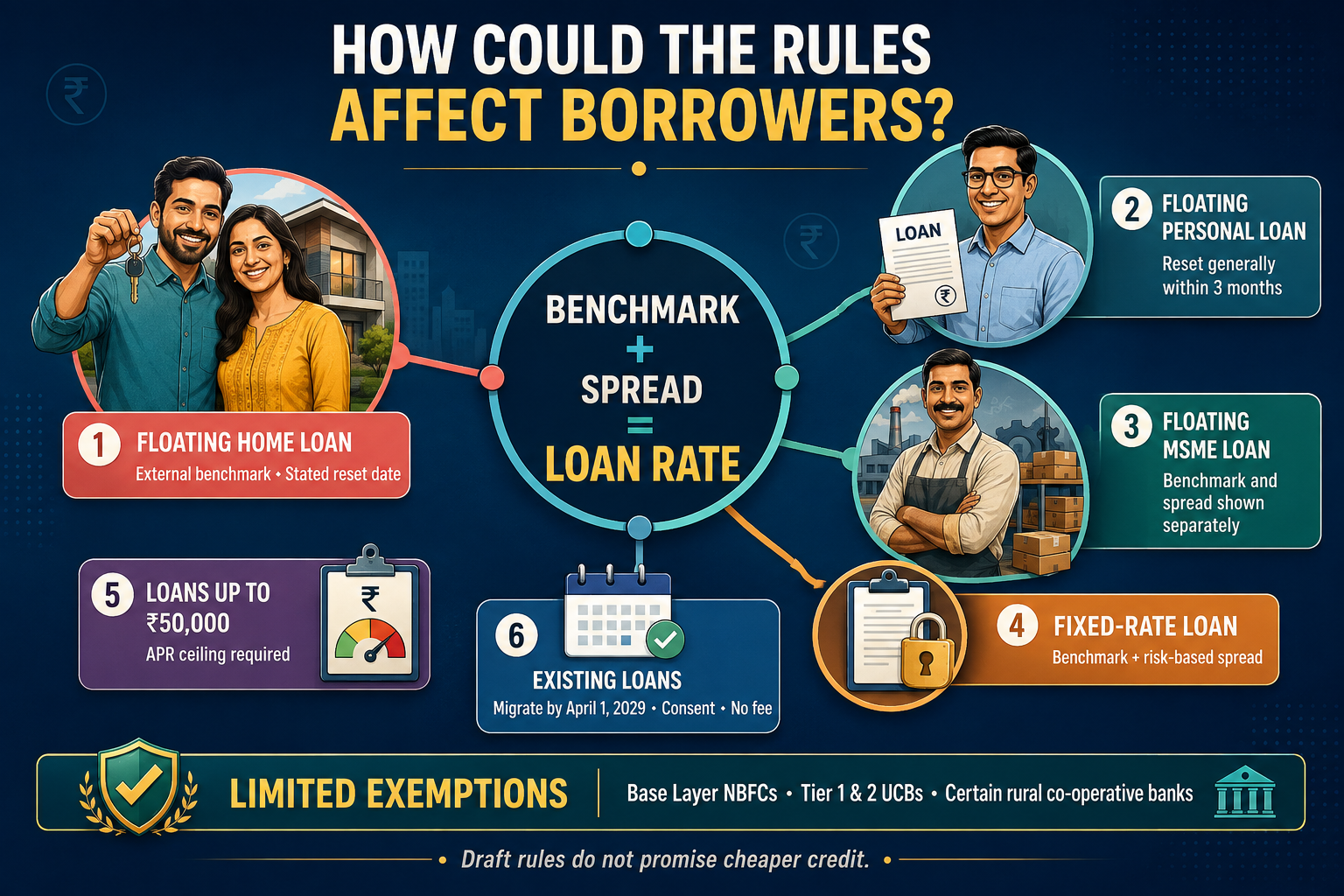
A home-loan customer may find the formula easier to check because an individual housing loan generally falls within the personal-loan category. If a commercial bank uses an external benchmark, the customer can compare it with the contracted rate and identify the spread. The reset schedule then decides when the EMI or remaining tenure responds.
For an MSME, the disclosure could help during renewal or refinancing. A small manufacturer may compare 2 working-capital offers by examining the benchmark and spread instead of relying on the advertised rate. Each fixed-tenure drawdown under a working-capital demand loan may be treated separately, so the business must examine every drawdown.
The table separates the main proposals from their likely effect. These are draft provisions, not current promises of cheaper credit.
The draft does not impose every requirement on every lender. Base layer NBFCs, Tier 1 and Tier 2 urban cooperative banks, and rural cooperative banks with deposits up to ₹1,000 crore would receive exemptions from the 3-month reset limit and the 3-year restriction on some spread changes. Customers must identify the lender category before assuming a protection applies.
The spread may decide whether an old customer pays more than a new customer using the same benchmark. Under the proposal, the credit-risk premium must remain positive. A lender could revise it only after the borrower’s credit profile changed and a full review took place. Other spread components generally could not be revised before 3 years. A lender could reduce them earlier for customer retention on justifiable, non-discriminatory grounds.
A hypothetical example shows the effect. If the benchmark is 6.50% and the spread is 1.75%, the loan rate becomes 8.25%. If the benchmark falls to 6.25% while the spread remains unchanged, the rate becomes 8%. A lender should not offset that 0.25% fall by increasing an unrelated spread component during the protected period.
The benchmark could still rise, while genuine deterioration in the customer’s credit profile could support a higher credit-risk premium. Arrears, weaker business cash flow or reduced collateral coverage may influence that review. The lender would need a recorded risk assessment, not a general pricing decision.
Lenders would also compute interest on a daily reducing balance through the Actual/Actual day-count convention and generally charge it at monthly rests. Agricultural credit would follow crop-linked provisions.
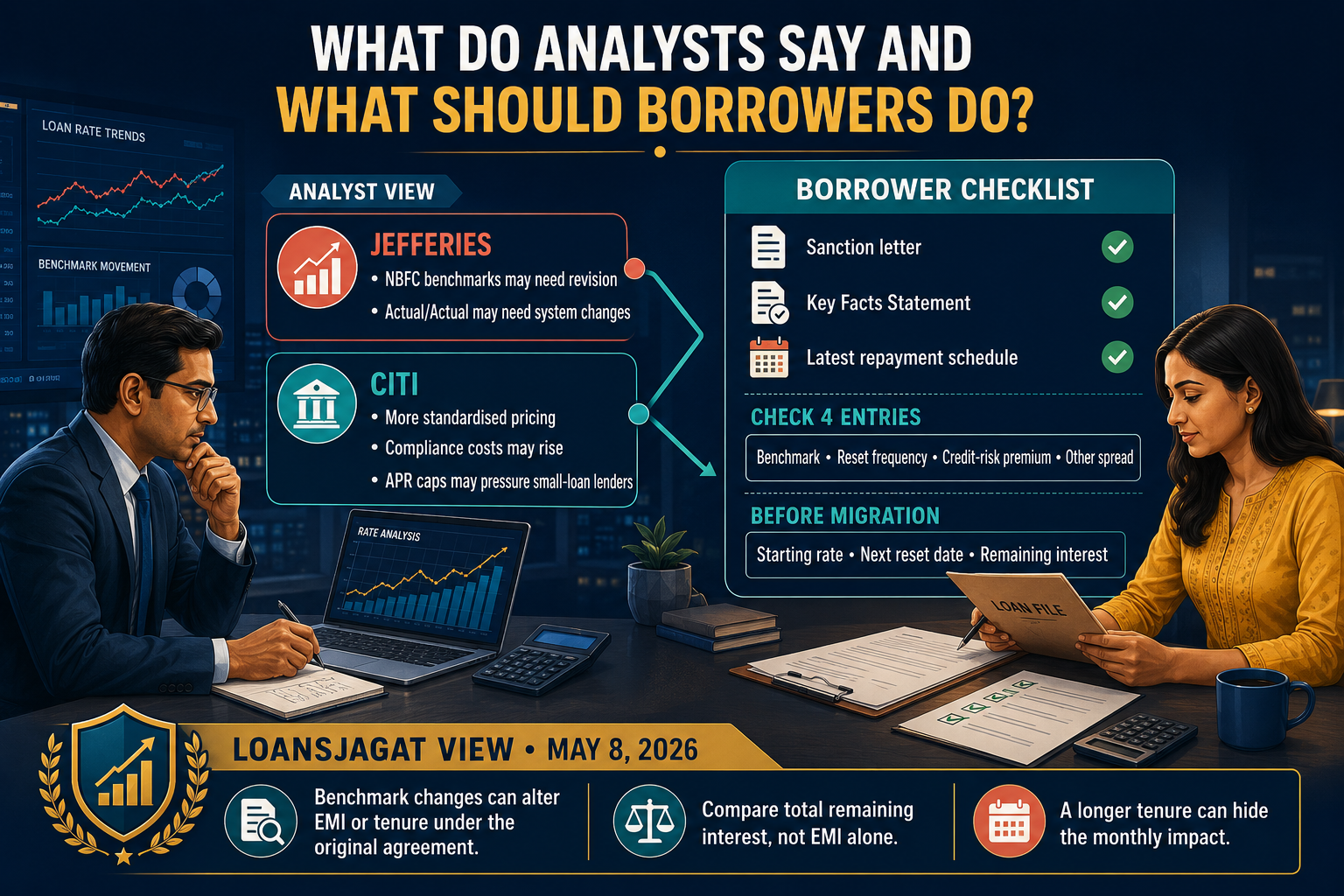
Brokerage firm Jefferies, cited by NDTV Profit on August 13, 2026, said NBFCs using discounts to their prime lending rate may need to revise their benchmark structure. Jefferies also expects operational work around Actual/Actual calculations. Citi described the proposal as a step towards standardised pricing and borrower protection but warned that compliance costs and annual percentage rate caps could affect lenders focused on high-yield small loans.
Borrowers should retain the sanction letter, key facts statement and latest repayment schedule. They should check 4 entries: benchmark, reset frequency, credit-risk premium and other spread. Before giving migration consent, an existing customer should compare the new benchmark, starting rate and next reset date. A LoansJagat analysis published on May 8, 2026, explains that benchmark changes can alter EMI or tenure under the original agreement. Its borrower-focused view supports another check: compare total remaining interest, since a longer tenure can hide the monthly impact.
The latest review followed the August 2026 monetary policy process. The regulator wanted common principles across lender categories, standard day-count treatment and defined benchmark reset dates. Existing detailed benchmark rules applied mainly to commercial banks, while other lenders relied more on conduct-based requirements. Fixed-rate pricing had fewer detailed instructions.
Borrower protection had developed through earlier changes. News On AIR reported on August 19, 2023 that lenders were asked to inform individual customers about options after floating-rate EMI resets, including a possible switch to a fixed rate under the lender’s board-approved policy. Those directions responded to cases where higher rates stretched tenures without customers fully tracking the change.
The 2026 proposal brings fixed-rate pricing, floating benchmarks, spread components, interest calculation and existing-loan migration into one draft framework. After consultation, separate final directions are expected for different lender categories. The final provisions may therefore differ for a commercial bank, NBFC or cooperative bank.
The proposal could make loan pricing more transparent for customers who currently see only a final rate. The benchmark-plus-spread formula would give them a better basis for comparing offers, questioning an expensive spread and checking whether a loan transfer saves money after fees.
No borrower needs to request migration yet. The September 11, 2026 consultation may change thresholds, exemptions or dates before the proposed April 1, 2027 start. Existing customers should wait for the final directions and avoid treating the draft as an announced EMI reduction.
No. It remains a draft, with April 1, 2027 proposed as the starting date after consultation.
Commercial banks must use one for floating personal loans and floating loans provided to MSME borrowers.
No. Migration protects the starting rate, but later benchmark changes can still alter EMI or tenure.
The credit-risk premium may change after a documented review. Other spread components generally cannot increase earlier.
The borrower should compare the benchmark, full spread, starting rate, reset date and remaining interest cost.









.png&w=3840&q=75)


