

By continuing, you agree to LoansJagat's Credit Report Terms of Use, Terms and Conditions, Privacy Policy, and authorize contact via Call, SMS, Email, or WhatsApp
Disclaimer: The information published on LoansJagat is intended for general informational and educational purposes only and should not be considered financial, legal, or investment advice. Interest rates, loan terms, statistics, and other data may change over time and may vary by lender or source. Please verify the latest information and consult a qualified financial advisor or the respective Bank/NBFC before making any financial decisions.
Subscribe Now
About the author

Arshathul Afia
Arshathul Afia is a journalism graduate and fintech content writer with 4+ years of experience in digital publishing and research-led writing. She has written 200+ articles covering personal finance, lending, banking, digital payments, credit, insurance, and major financial developments in India. At LoansJagat, she focuses on simplifying complex fintech news, RBI updates, loan-related changes, policy developments, and industry trends for everyday readers. Her journalism background helps her approach stories with research, context, and clarity, while her SEO experience ensures content remains discoverable and relevant. She aims to make financial news easier to understand, practical, and useful for readers across India.
Related Blog Post
Simplify All Your Loans Into One Affordable EMI

Customers Served

Debt Consolidated

1200+ Reviews

Locations in India
Club all Loans & Credit Card Bills into Single EMI

Quick Apply Loan
Consolidate your debts into one easy EMI.

Takes less than 2 minutes. No paperwork.

10 Lakhs+
Trusted Customers

2000 Cr+
Loans Disbursed

4.7/5
Google Reviews

50+
Banks & NBFCs Offers
RBI’s 2026 draft may give existing borrowers more control during benchmark migration, while 3-month resets could make floating loan EMIs change far faster across India.
The Reserve Bank of India issued draft loan-pricing directions from Mumbai on 12 August 2026, proposing a common framework for banks, NBFCs, housing finance companies and other regulated lenders. According to the official draft, existing loans linked to an internal or external benchmark would move to the revised framework by 1 April 2029. The borrower must agree. The move followed the interest-rate framework review announced on 5 August 2026 and reported by DD News.
For borrowers, the immediate position does not change because consultation is still open. Rate cuts may reach floating loans sooner under a 3-month reset ceiling, but increases may arrive just as quickly.
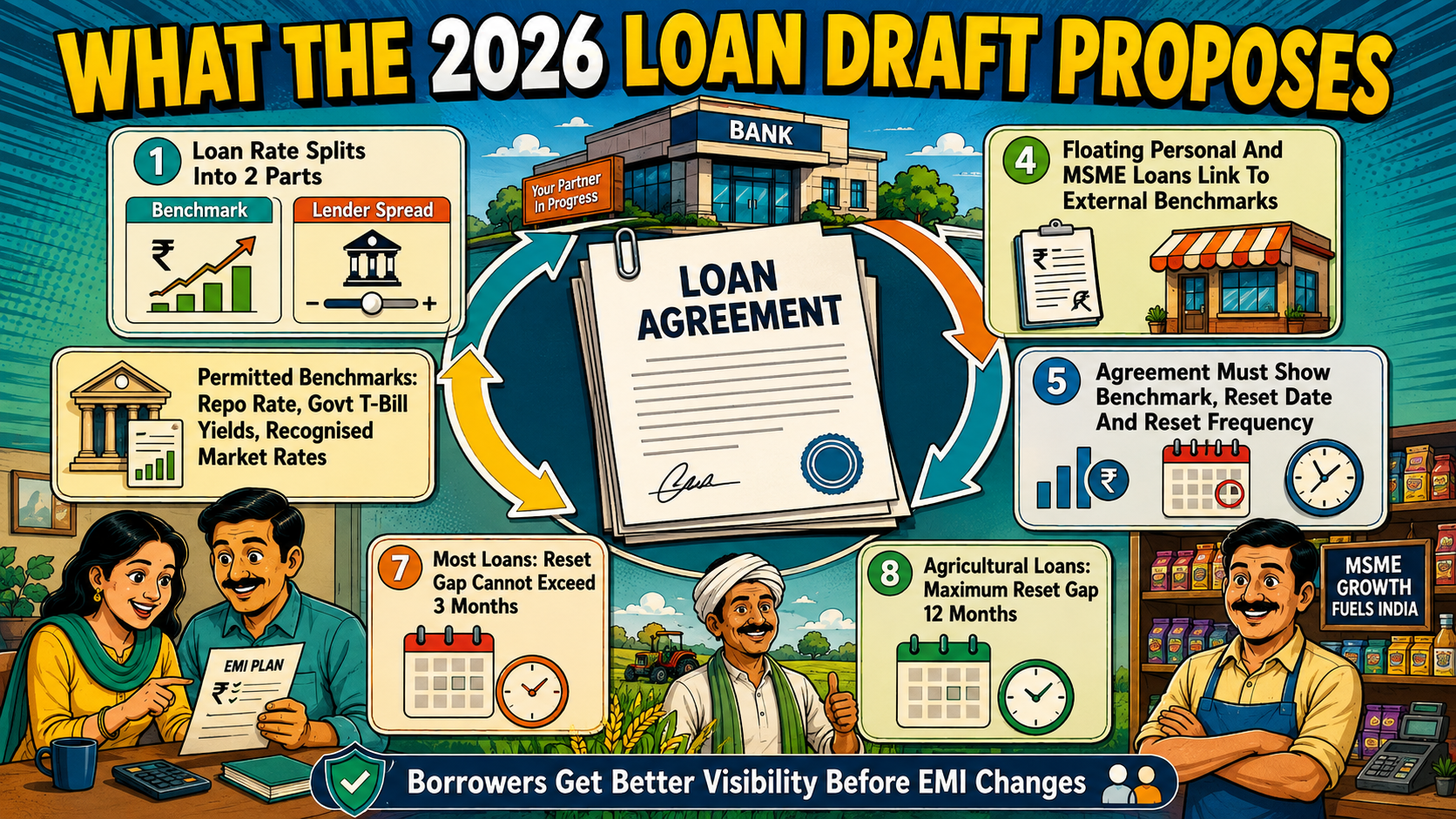
The proposal separates a loan rate into the benchmark and the lender’s spread. Commercial banks would have to connect floating personal and MSME loans to an external benchmark. Permitted references include the policy repo rate, Government of India Treasury Bill yields and other recognised market rates.
The loan agreement would have to identify the benchmark, reset date and reset frequency. For most lenders, the interval could not exceed 3 months or change during the loan tenure. Agricultural loans would follow the crop season, with a maximum reset interval of 12 months.
A home-loan borrower in Pune, Chennai or Jaipur could compare the published benchmark with the final rate and identify the lender’s spread. If only the final rate rises, the borrower can ask which component changed.
The proposal also limits repeated spread changes. A lender could revise the credit-risk premium only after the borrower’s credit profile changes and is reviewed. Other components generally could not be revised before 3 years, although justified customer-retention reductions would remain possible.
A benchmark reset does not automatically mean a lower EMI. If the reference rate falls, the borrower may receive a smaller installment or a shorter tenure. If it rises, the lender may increase the EMI, extend repayment or use both methods under the applicable borrower-protection rules.
Consider a ₹50 lakh home loan with 20 years left. At 8.5%, the EMI is about ₹43,390. A fall to 8.25% would bring it close to ₹42,600 if the remaining tenure stayed unchanged, a monthly difference of roughly ₹790. The illustration uses a standard amortisation formula and is not an official forecast.
The table places the existing position beside the main draft proposals. It does not treat the draft as a final rule.
The 3-month ceiling works both ways. An annual-reset borrower may receive a cut earlier but also face an increase sooner. The revised EMI and total repayment both need checking.
Consent applies to the one-time migration of an existing benchmark-linked loan into the proposed framework. It does not give a borrower the right to reject each scheduled movement in a benchmark already named in the loan agreement. Repo-linked and other floating rates would continue moving on their contracted reset dates.
If a benchmark is discontinued, the lender may replace it without putting the borrower at a disadvantage through the applicable rate at transition. The agreement may name a fallback benchmark. Before consenting to migration, a borrower should request the old and proposed benchmark, spread, effective rate, reset date, EMI and remaining tenure in writing.
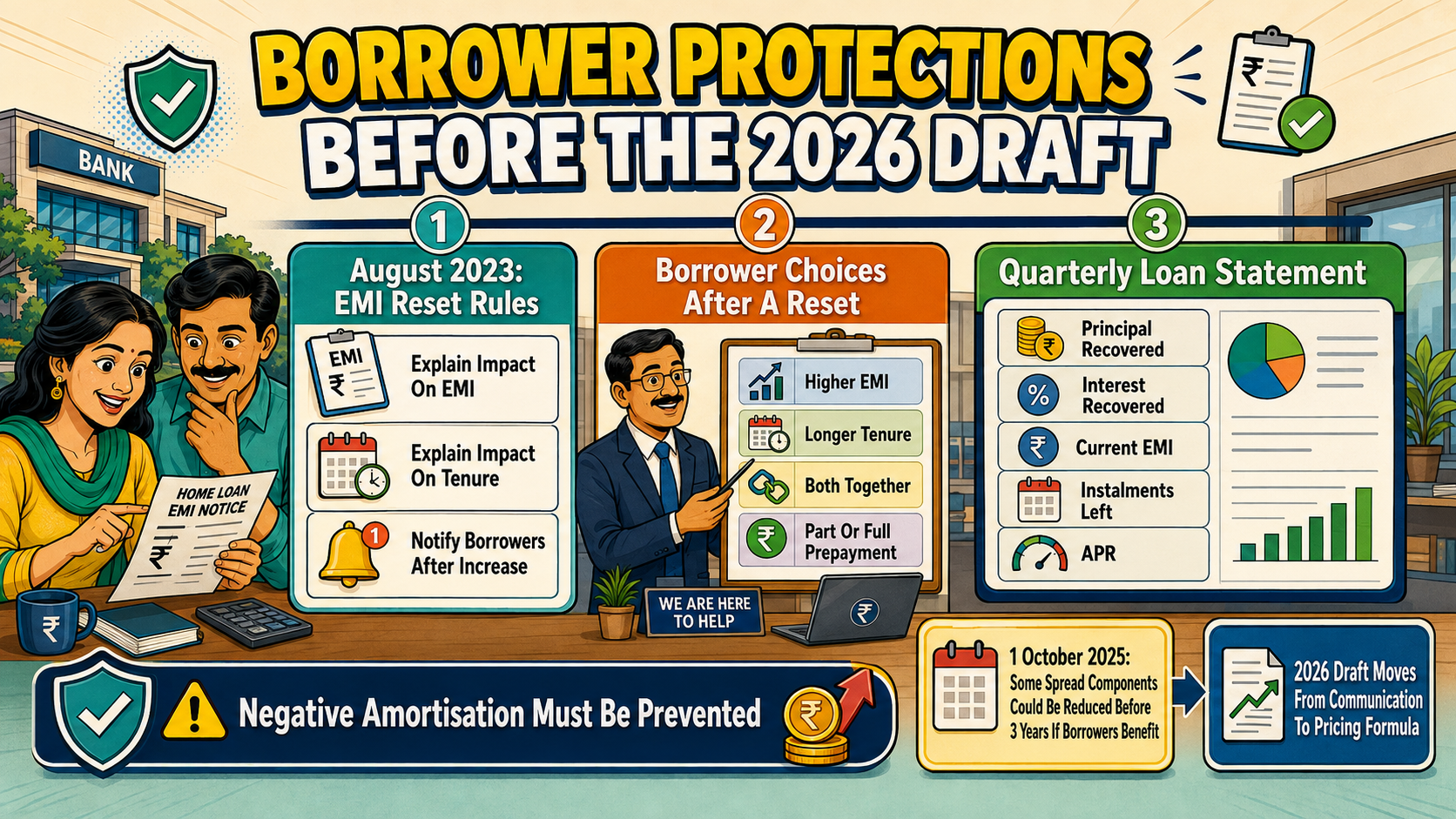
The 2026 proposal follows earlier action on floating EMI loans. Rules issued in August 2023 required lenders to explain how a benchmark change could affect the EMI, tenure or both. Lenders also had to notify borrowers after an increase and offer a choice between a higher EMI, longer tenure, a combination of the 2, or part or full prepayment.
Quarterly statements must show principal and interest recovered, the current EMI, instalments left and the annualised rate or APR. Lenders must also prevent negative amortisation, where the repayment fails to cover the interest being added. A further amendment effective from 1 October 2025 allowed selected spread components to be reduced before 3 years when the change benefits borrowers.
Those earlier steps dealt mainly with borrower communication and choices after a reset. The 2026 draft goes further into the pricing formula itself, including benchmark selection, spread components, reset dates and daily interest calculation.
Kapil Makhija, Chief Operations Officer at MinEMI, said on 14 August 2026 that annual-reset borrowers can keep paying an older EMI for months after a rate cut. He also warned that the proposed 3-month cycle would pass faster. Vijendra Singh Shekhawat, CEO of Choice Finserv, expects a stronger effect on borrowers still linked to internal benchmarks such as MCLR.
Sarika Grover, Co-founder of LoansJagat, said the draft should improve transparency but should not be read as an automatic reduction in borrowing costs. A LoansJagat analysis reaches the same practical view: quicker transmission helps when rates fall and pinches sooner when they rise. The useful borrower response is simple. Check the formula, ask for the revised repayment schedule and compare total interest before giving migration consent.
Easier verification is the strongest borrower gain. The draft promises no lower rate. If someone offered a reduced EMI, they should check whether the lender has extended the tenure. Another borrower whose credit score has improved can ask for a spread review, although the draft does not force an automatic reduction merely because the score moved upward.
The RBI Loan Rules 2026 draft gives existing borrowers a defined role during benchmark migration. Consent, zero migration charges and protection against an immediate rate increase are useful safeguards. The 3-month reset proposal could also shorten the wait for rate cuts.
There is a harder side. Increases may reach an EMI earlier, and no provision promises cheaper credit. Borrowers should identify their benchmark, inspect the spread and obtain a full repayment comparison before approving any migration after the final rules arrive.
Benchmark migration is the one-time movement of an existing loan from its current pricing structure to the proposed 2026 framework. Under the draft, this must happen by 1 April 2029 with consent, without a migration fee and without an immediate increase in the applicable rate.
No. The draft changes how rates are determined and reset. An EMI may fall only if the applicable benchmark or spread decreases. When rates rise, the EMI may increase or the repayment tenure may become longer.
Normal movements in a benchmark already written into the agreement do not require fresh permission. Consent is required for migration to the new framework. If the original benchmark ends, its replacement cannot disadvantage the borrower through the applicable rate at transition.
A lower EMI helps a borrower facing monthly cash pressure. Keeping the old EMI after a rate cut can shorten the tenure and usually reduces total interest more. The borrower should compare both repayment schedules before selecting either option.
The proposed starting date is 1 April 2027. Existing benchmark-linked loans would have until 1 April 2029 for migration. The provisions may still change after public feedback, so borrowers should wait for the final directions before acting.








.png&w=3840&q=75)


