
By continuing, you agree to LoansJagat's Credit Report Terms of Use, Terms and Conditions, Privacy Policy, and authorize contact via Call, SMS, Email, or WhatsApp
Disclaimer: The information published on LoansJagat is intended for general informational and educational purposes only and should not be considered financial, legal, or investment advice. Interest rates, loan terms, statistics, and other data may change over time and may vary by lender or source. Please verify the latest information and consult a qualified financial advisor or the respective Bank/NBFC before making any financial decisions.
Subscribe Now
About the author

Arshathul Afia
Arshathul Afia is a journalism graduate and fintech content writer with 4+ years of experience in digital publishing and research-led writing. She has written 200+ articles covering personal finance, lending, banking, digital payments, credit, insurance, and major financial developments in India. At LoansJagat, she focuses on simplifying complex fintech news, RBI updates, loan-related changes, policy developments, and industry trends for everyday readers. Her journalism background helps her approach stories with research, context, and clarity, while her SEO experience ensures content remains discoverable and relevant. She aims to make financial news easier to understand, practical, and useful for readers across India.
Related News
Simplify All Your Loans Into One Affordable EMI

Customers Served

Debt Consolidated

1200+ Reviews

Locations in India
Club all Loans & Credit Card Bills into Single EMI

Quick Apply Loan
Consolidate your debts into one easy EMI.

Takes less than 2 minutes. No paperwork.

10 Lakhs+
Trusted Customers

2000 Cr+
Loans Disbursed

4.7/5
Google Reviews

50+
Banks & NBFCs Offers
India’s floating-rate borrowers may see home loan EMIs react faster from April 1, 2027, as a proposed 3-month reset cap shortens rate transmission across banks.
The Reserve Bank of India proposed a new loan-pricing framework on August 12, 2026, covering how fixed and floating loans are benchmarked, reset and disclosed. Nothing changes to a borrower’s EMI today. The draft remains open for comments until September 11, 2026 and, if finalised broadly in its present form, would start on April 1, 2027.
The short-term benefit could be quicker transmission after a benchmark falls. A borrower may not have to wait through a long reset cycle before the contracted rate changes. The risk works the other way too. A benchmark increase could arrive faster, raising the EMI or extending tenure depending on the repayment setup.
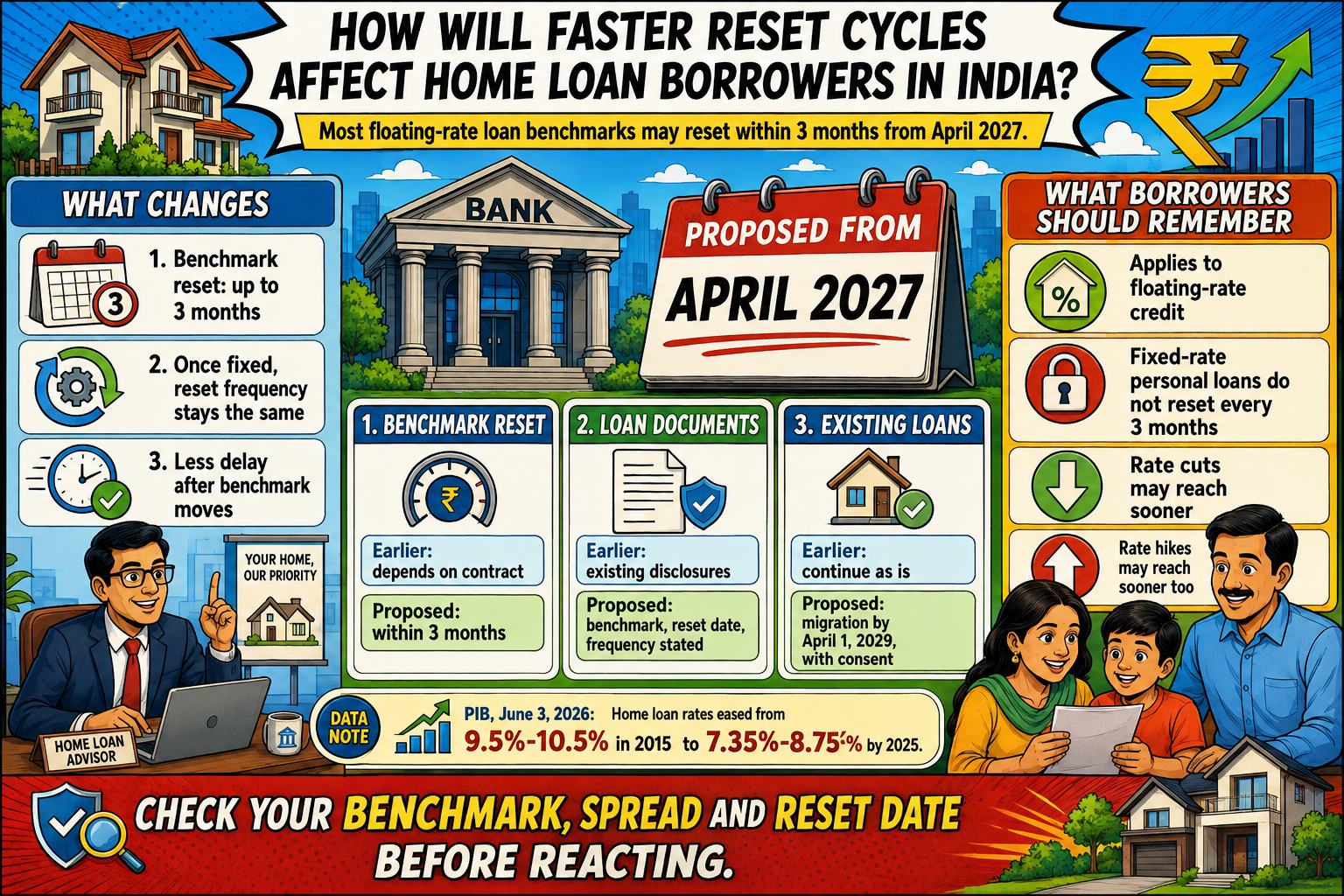
The proposal says the benchmark for most floating-rate loans should reset within a maximum of 3 months. Once the lender fixes that frequency for a loan, it would generally stay unchanged through the tenure. That can reduce the delay between a benchmark movement and the rate finally applied to the customer.
The Press Information Bureau reported on June 3, 2026, that home loan rates, which were around 9.5% to 10.5% in 2015, had eased to roughly 7.35% to 8.75% by 2025. Personal loan rates moved from 14.25% in 2014 to 12.5% in 2026. Those figures show why transmission time gets noticed. A lower benchmark only helps a floating borrower after the account reaches its reset point.
The table also explains why fixed-rate personal loan customers should not assume their EMI will start changing every 3 months. The faster reset proposal concerns floating credit. A genuinely fixed-rate loan continues according to its contract. Borrowers need to check the rate clause before reacting to the April 2027 date.
Vijendra Singh Shekhawat, CEO of Choice Finserv Private Limited, told NDTV on August 19, 2026, that the gain for home loan customers is mainly timing and transparency rather than a lower rate from day 1. He also pointed borrowers towards the spread over the benchmark because that component can remain attached to a long-tenure loan while the benchmark moves.
That leaves borrowers with a simple check before signing or refinancing. Compare the benchmark, lender spread, reset frequency and next reset date. If a borrower’s credit profile has improved since the loan began, asking for a spread review may also help.
A borrower-side calculation shows the impact. On a ₹50 lakh loan for 20 years, the EMI is about ₹41,822 at 8%. At 7.5%, it is roughly ₹40,280. At 8.5%, it rises to about ₹43,391. This is not a 2027 forecast. It shows why a 0.5 percentage-point movement can be noticeable once a floating loan resets.
The LoansJagat view published on August 14, 2026, reaches a similar borrower-focused conclusion. A 3-month reset should not be treated as guaranteed savings. Faster transmission works in both directions, so the benchmark and spread have to be read together.
India has already moved retail lending towards external benchmarks. The Department of Financial Services, Ministry of Finance, records that new floating personal or retail bank loans, including housing and auto loans, have used specified external benchmarks from October 1, 2019. These can include the policy repo rate and specified Government of India Treasury bill yields published by Financial Benchmarks India Private Limited.
The 2027 proposal goes further by trying to standardise parts of reset timing, spread revision, day-count practices and interest calculation. A customer can know the benchmark today and still wait for the contracted reset date. A shorter reset window reduces that lag without deciding whether future rates will rise or fall.
The October 1, 2019 external-benchmark shift was an earlier attempt to improve the passage of policy-rate changes into new floating retail loans. The Department of Financial Services still lists that framework on its banking information page. Before external benchmarking, retail borrowers had encountered systems such as Base Rate and MCLR, depending on when their loan was sanctioned.
Floating EMI protections changed again in 2023, when lenders were required to communicate the effect of rate resets on EMI and tenure and provide applicable repayment choices. The current draft builds on those earlier changes rather than replacing the basic idea of benchmark-linked lending.
The policy backdrop has also been steady in August 2026. DD News reported on August 5 that the repo rate remained at 5.25%. That decision came 7 days before the loan-pricing draft.
Housing representatives welcomed the August 5 rate stability because borrowing costs influence purchase decisions. DD News reported that Anshuman Magazine, Chairman and CEO for India, Southeast Asia, the Middle East and Africa at CBRE, viewed stable rates positively ahead of the festive season. NAREDCO President Parveen Jain also linked rate stability with support for under-construction property sales and construction activity.
Homebuyers prefer predictable monthly costs. Faster benchmark transmission can help during a falling-rate period, but households need more repayment room when rates move upward. Shekhawat’s comments to NDTV add another borrower concern: the headline rate alone does not show how the loan will behave over a long tenure.
From a borrower-analysis angle, the strongest feature is traceability. A loan showing its benchmark, spread and reset date gives the customer 3 items to check before accepting a revised rate. That is more useful than relying only on a promotional starting rate.
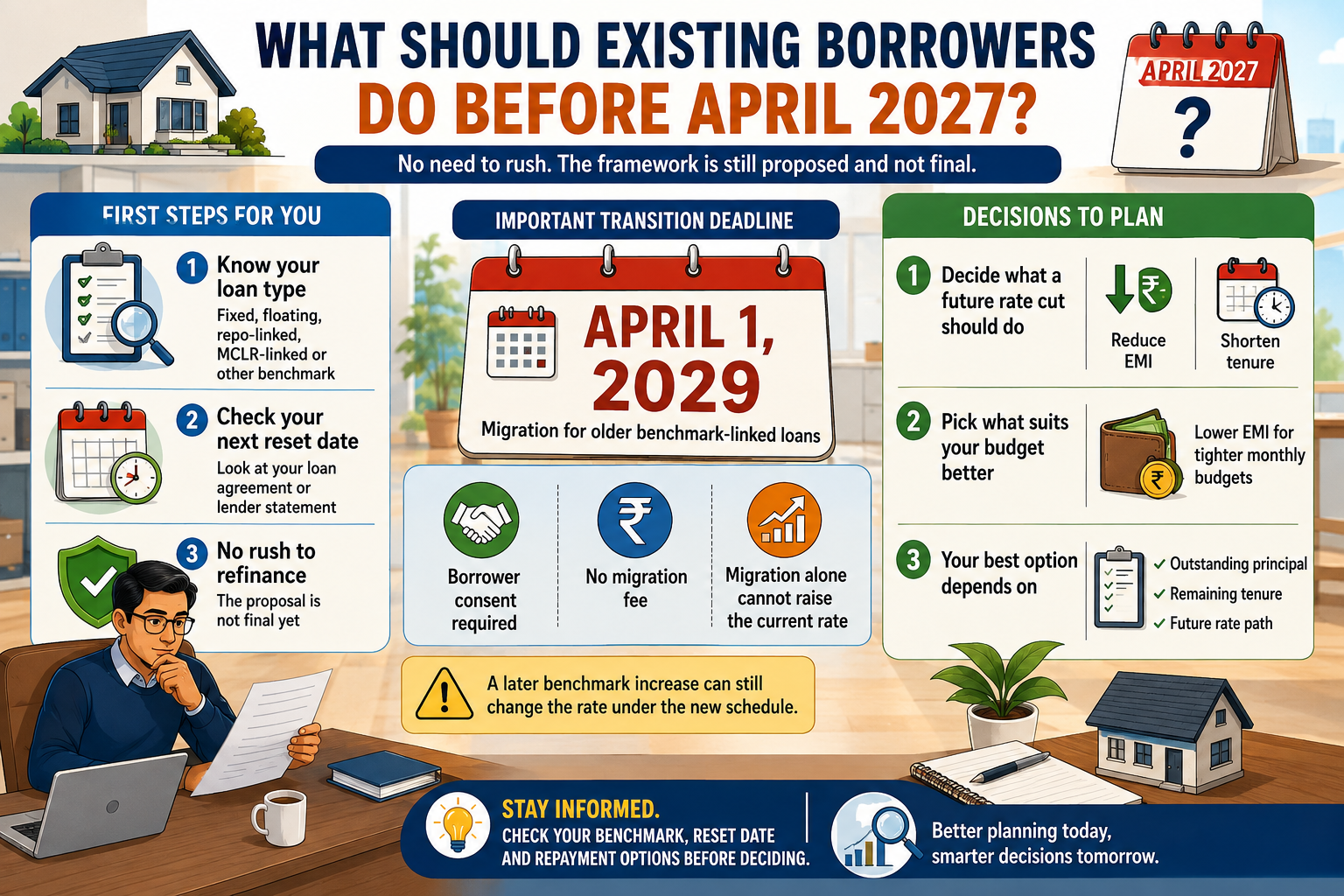
Existing borrowers do not need to rush into refinancing because the proposed start date is still ahead and the framework is not final. The first job is to identify whether the loan is fixed, floating, repo-linked, MCLR-linked or tied to another benchmark. The next reset date should then be checked in the loan agreement or lender statement.
Older benchmark-linked loans have a separate proposed transition deadline of April 1, 2029. Migration would require borrower consent, no separate migration fee could be charged, and the lender could not raise the prevailing rate merely because the account moved. A later benchmark increase could still change the rate under the new schedule.
Borrowers should also decide whether a future rate cut should reduce the EMI or shorten tenure, where that choice is available. Someone with a tight monthly budget may prefer a lower instalment. Another borrower may keep the EMI unchanged and reduce the repayment period instead. The cheaper route depends on the outstanding principal, remaining tenure and future rate path.
RBI’s 2027 loan proposal could make floating home loan rates react faster from April 1, but it does not guarantee cheaper EMIs. The proposed 3-month ceiling mainly changes timing. A lower benchmark could reach an eligible borrower sooner. A higher one could too.
For households, preparation is fairly basic. Check the loan type, benchmark, spread and reset date. Existing customers should wait for the final framework before acting on the proposed 2029 migration. The change could shorten the wait between a benchmark movement and the loan rate, which makes the terms inside the loan agreement more important than the headline rate alone.
No. EMIs change only when the floating benchmark, spread and scheduled reset produce a different loan rate.
Not necessarily. Fixed-rate personal loans continue under their contracts, while the reset proposal mainly applies to floating credit.
There is no guaranteed 2027 rate cut. Borrowers should compare affordability, benchmark, spread, tenure and reset terms before deciding.
It depends on the lender’s repayment setup. The benefit may reduce EMI, tenure, or use a combination of both.
No. Existing benchmark-linked loans have a proposed April 1, 2029 deadline, and migration would require borrower consent.









.png&w=3840&q=75)


